
[Paper Review] FICE: Text-Conditioned Fashion Image Editing With Guided GAN Inversion
FICE editing uses text descriptions to guide GAN inversion for fashion images, preserving pose/identity while integrating new clothing via CLIP-based semantics and image stitching.
Fashion-image editing represents a challenging computer vision task, where the goal is to incorporate selected apparel into a given input image. Most existing techniques, known as Virtual Try-On methods, deal with this task by first selecting an example image of the desired apparel and then transferring the clothing onto the target person. Conversely, in this paper, we consider editing fashion images with text descriptions. Such an approach has several advantages over example-based virtual try-on techniques, e.g.: (i) it does not require an image of the target fashion item, and (ii) it allows the expression of a wide variety of visual concepts through the use of natural language. Existing image-editing methods that work with language inputs are heavily constrained by their requirement for training sets with rich attribute annotations or they are only able to handle simple text descriptions. We address these constraints by proposing a novel text-conditioned editing model, called FICE (Fashion Image CLIP Editing), capable of handling a wide variety of diverse text descriptions to guide the editing procedure. Specifically with FICE, we augment the common GAN inversion process by including semantic, pose-related, and image-level constraints when generating images. We leverage the capabilities of the CLIP model to enforce the semantics, due to its impressive image-text association capabilities. We furthermore propose a latent-code regularization technique that provides the means to better control the fidelity of the synthesized images. We validate FICE through rigorous experiments on a combination of VITON images and Fashion-Gen text descriptions and in comparison with several state-of-the-art text-conditioned image editing approaches. Experimental results demonstrate FICE generates highly realistic fashion images and leads to stronger editing performance than existing competing approaches.
Motivation & Objective
- Motivate and enable editing fashion images with natural language descriptions without needing target garment images.
- Preserve subject pose, identity, and background while editing only the clothing region.
- Leverage CLIP and auxiliary differentiable models to enforce semantic, pose, and image-consistency constraints during inversion.
- Introduce latent-code regularization to improve realism and constrain edits to a well-defined latent space.
Proposed method
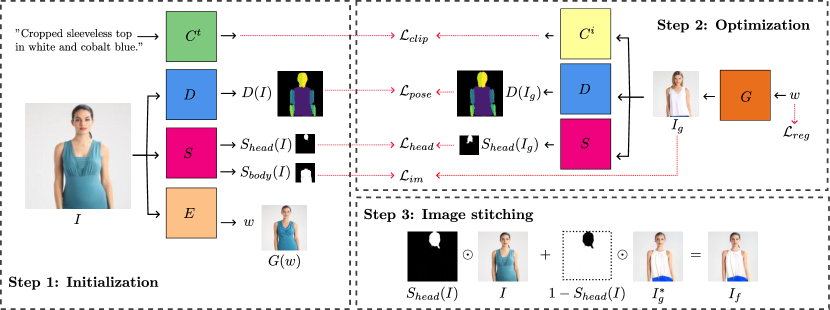
- Use a three-stage pipeline: initialization, constrained GAN inversion, and image stitching.
- Employ a pretrained StyleGAN2 generator as the editing backbone.
- Use CLIP-based semantic loss to align edited image with text descriptions.
- Incorporate DensePose for pose-preservation and a segmentation model for region-aware editing.
- Regularize extended latent codes in W+ space to reduce distribution drift between spaces.
- Stitch edited regions with the original image to preserve identity and minimize artifacts.
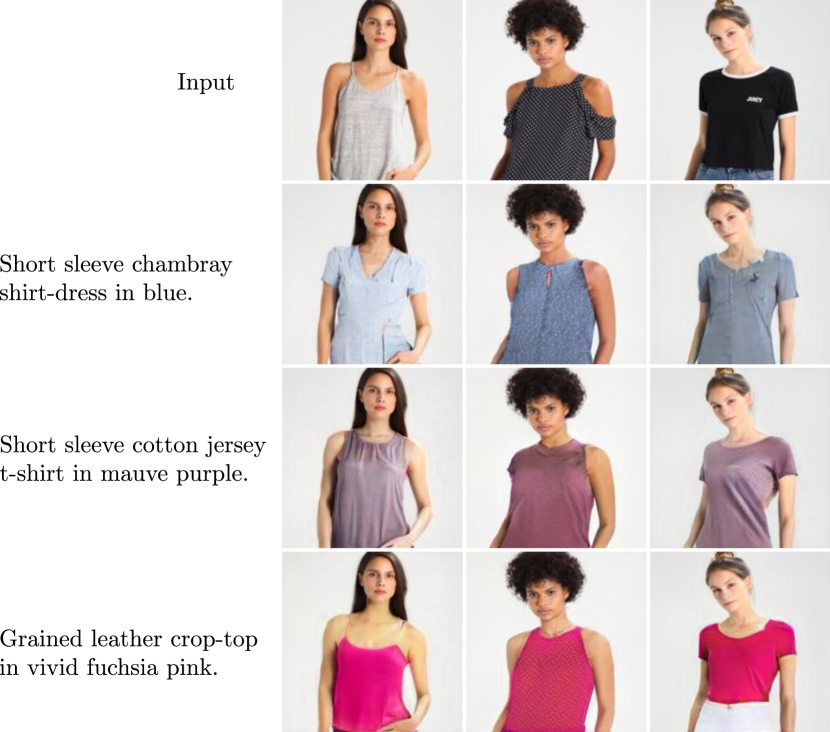
Experimental results
Research questions
- RQ1Can text descriptions alone guide realistic fashion image edits while preserving pose and identity?
- RQ2Do CLIP-based semantics, pose constraints, and region-aware losses yield superior text-driven edits compared to generic GAN editing?
- RQ3Does latent-code regularization improve realism and consistency of edits in StyleGAN-based fashion editing?
- RQ4How does FICE perform when combining text descriptions with real-world fashion images from VITON and Fashion-Gen datasets?
Key findings
- FICE produces highly realistic fashion edits that preserve pose and identity.
- FICE outperforms competing text-based editing approaches on qualitative and quantitative assessments.
- The combination of CLIP semantics, pose preservation, and image-region losses yields convincing garment integration.
- Latent-code regularization helps maintain image realism by aligning extended W+ codes with the original latent space.
- Image stitching further improves fidelity and reduces artifacts at region boundaries.
Read this paper
Open the full text in the Nubint reader and ask about any passage as you read.
Read this paper on NubintThis review was generated by AI from the original paper. Please check the paper before citing it.