
[Paper Review] File Fragment Classification using Light-Weight Convolutional Neural Networks
This paper proposes lightweight depthwise separable convolutional neural network models—DSC, DSC-SE, and M-DSC—for file fragment classification in digital forensics. By reducing model parameters and FLOPs, the approach achieves 79.27% accuracy on the FFT-75 dataset with only 100K parameters and 164M FLOPs, outperforming state-of-the-art models in inference speed (up to 105x faster) while maintaining competitive accuracy.
In digital forensics, file fragment classification is an important step toward completing file carving process. There exist several techniques to identify the type of file fragments without relying on meta-data, such as using features like header/footer and N-gram to identify the fragment type. Recently, convolutional neural network (CNN) models have been used to build classification models to achieve this task. However, the number of parameters in CNNs tends to grow exponentially as the number of layers increases. This results in a dramatic increase in training and inference time. In this paper, we propose light-weight file fragment classification models based on depthwise separable CNNs. The evaluation results show that our proposed models provide faster inference time with comparable accuracy as compared to the state-of-art CNN based models. In particular, our models were able to achieve an accuracy of 79\% on the FFT-75 dataset with nearly 100K parameters and 164M FLOPs, which is 4x smaller and 6x faster than the state-of-the-art classifier in the literature.
Motivation & Objective
- Address the high computational cost and slow inference times of existing deep learning models for file fragment classification in digital forensics.
- Reduce model complexity and parameter count in convolutional neural networks without sacrificing classification accuracy.
- Enable efficient file fragment classification on resource-constrained devices by minimizing FLOPs and model size.
- Improve inference speed over state-of-the-art models like FiFTy and RNN-based classifiers while maintaining comparable or better accuracy.
- Optimize neural network architecture using depthwise separable convolutions and attention mechanisms (SE blocks) for better efficiency and performance.
Proposed method
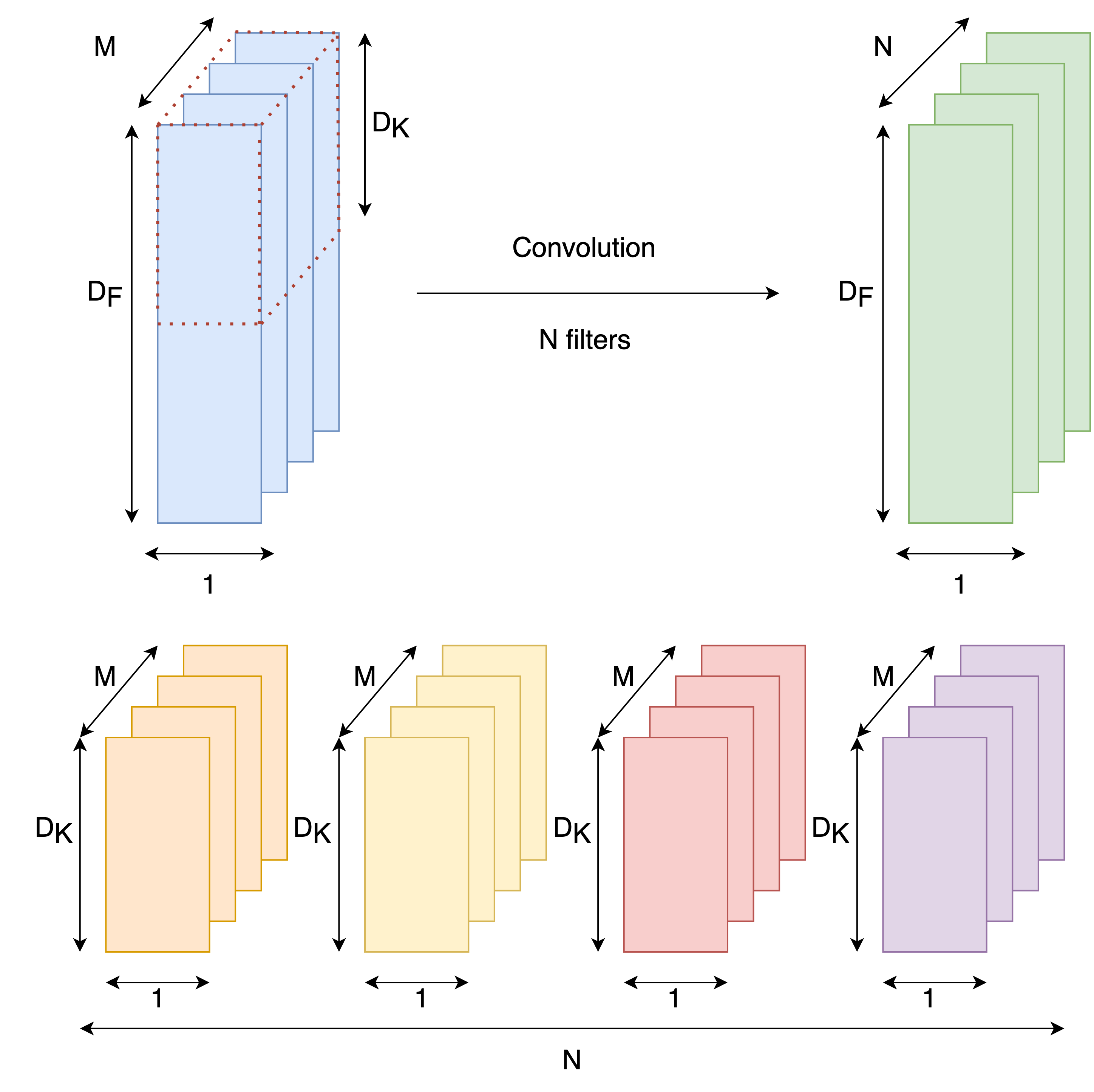
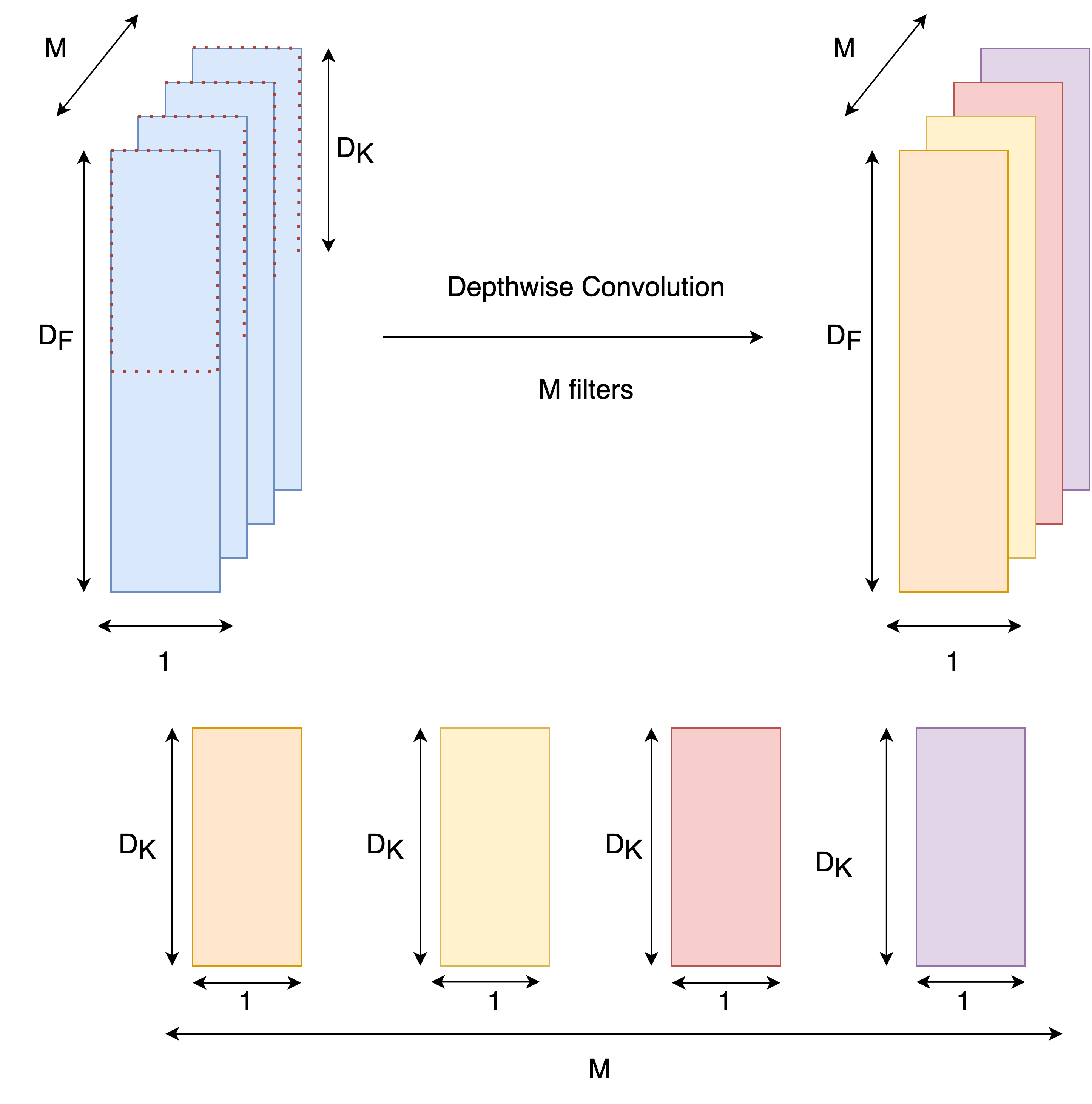
- Employ depthwise separable convolutions to drastically reduce the number of parameters and FLOPs compared to standard CNNs.
- Introduce a Squeeze-and-Excitation (SE) module in the DSC-SE variant to adaptively recalibrate channel features for improved representation learning.
- Design a modified depthwise separable architecture (M-DSC) to further optimize parameter efficiency and inference speed.
- Train models on the FFT-75 dataset, which includes six scenarios with varying fragment sizes and file types.
- Use raw byte sequences as input, converting them into 2D grayscale-like representations for input to the CNNs, preserving spatial texture patterns.
- Evaluate models using standard metrics: accuracy, inference time (ms per block), parameter count, and FLOPs.
Experimental results
Research questions
- RQ1Can depthwise separable CNNs achieve comparable or better classification accuracy than existing SOTA models while significantly reducing model size and inference time?
- RQ2How does the integration of Squeeze-and-Excitation modules affect the performance and efficiency of lightweight file fragment classifiers?
- RQ3To what extent can model compression via depthwise separable convolutions reduce FLOPs and parameters without degrading accuracy on file fragment classification tasks?
- RQ4How does the proposed model compare in inference speed to FiFTy and RNN-based baselines across different fragment sizes (e.g., 512 bytes and 4096 bytes)?
- RQ5Can lightweight models maintain high accuracy on diverse file types even when trained on fragmented data with limited metadata?
Key findings
- The proposed models achieved 79.27% accuracy on the FFT-75 dataset, outperforming FiFTy’s 77.04% accuracy with significantly fewer parameters.
- The best model used only 100K parameters and 164M FLOPs—4× smaller and 6× faster than FiFTy, which used over 400K parameters and 1 GFLOP.
- Inference speed was 15× faster than FiFTy on GPU and 105× faster than the baseline RNN model.
- On 4096-byte fragments, the model required 6.3× fewer FLOPs than FiFTy; on 512-byte fragments, it required 87× fewer FLOPs.
- The models were 660× faster than a recurrent neural network baseline and reduced processing time from 9 minutes per GB to 0.05 minutes per GB.
- The models demonstrated strong generalization across all six scenarios in the FFT-75 dataset, indicating robustness to varying fragment sizes and file types.
Read this paper
Open the full text in the Nubint reader and ask about any passage as you read.
Read this paper on NubintThis review was generated by AI from the original paper. Please check the paper before citing it.