
[Paper Review] Fillers in Spoken Language Understanding: Computational and Psycholinguistic Perspectives
The article synthesizes psycholinguistic and computational perspectives on fillers in SLU, covering production, comprehension, annotation, ASR integration, generation, and evaluation challenges.
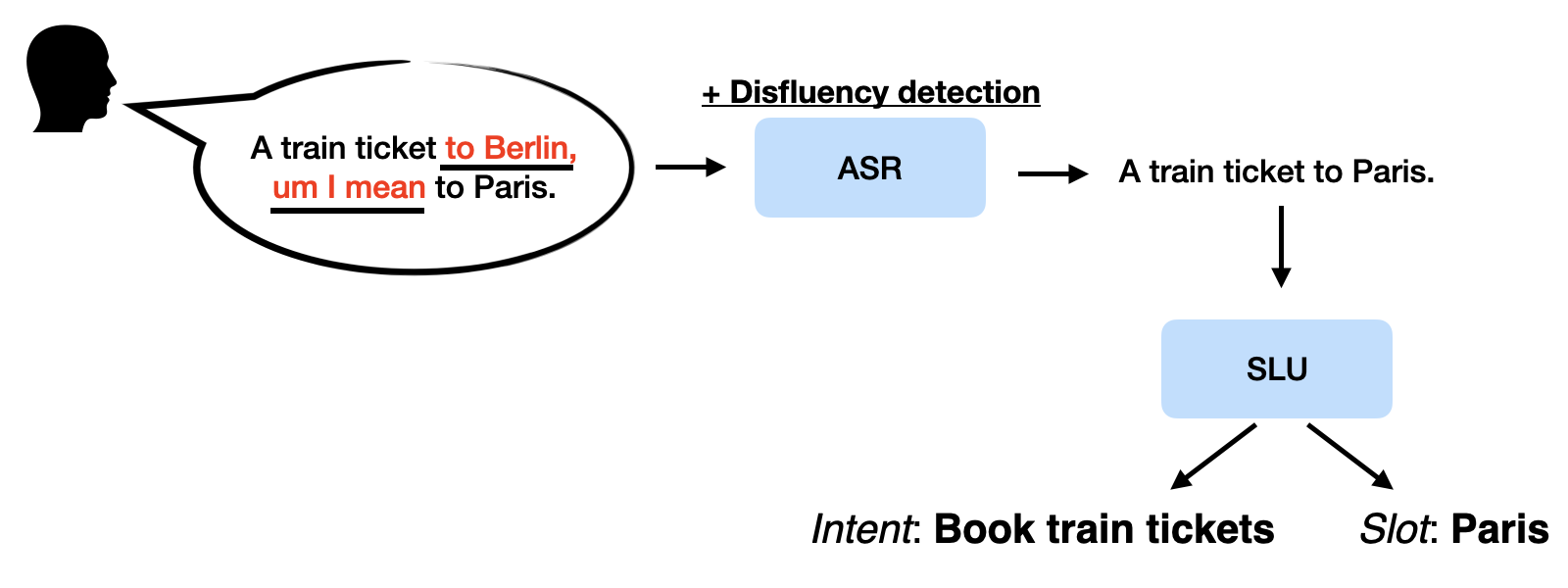
Disfluencies (i.e. interruptions in the regular flow of speech), are ubiquitous to spoken discourse. Fillers ("uh", "um") are disfluencies that occur the most frequently compared to other kinds of disfluencies. Yet, to the best of our knowledge, there isn't a resource that brings together the research perspectives influencing Spoken Language Understanding (SLU) on these speech events. This aim of this article is to survey a breadth of perspectives in a holistic way; i.e. from considering underlying (psycho)linguistic theory, to their annotation and consideration in Automatic Speech Recognition (ASR) and SLU systems, to lastly, their study from a generation standpoint. This article aims to present the perspectives in an approachable way to the SLU and Conversational AI community, and discuss moving forward, what we believe are the trends and challenges in each area.
Motivation & Objective
- Synthesize diverse perspectives on fillers from psycholinguistics and SLU to inform ASR and conversational AI.
- Analyze how fillers inform speech production and listener comprehension within SLU pipelines.
- Discuss annotation schemes, detection, and generation considerations for fillers across SLU tasks.
- Examine the trade-offs between removing versus integrating fillers in SDS and broader SLU.
- Identify trends, limitations, and open challenges for real-world, in-the-wild SLU systems.
Proposed method
- Survey psycholinguistic theories of fillers in production and comprehension.
- Review computational approaches to disfluency handling in SLU, including detection, removal, and integration.
- Compare SDS-focused pipelines (ASR -> disfluency removal -> semantic frame) with broader SLU tasks.
- Discuss annotation schemes for disfluency detection (Switchboard-based) and their limitations.
- Summarize generation and TTS considerations for fillers as social/ discourse cues.
Experimental results
Research questions
- RQ1What informative roles do fillers play in production and comprehension according to psycholinguistic research?
- RQ2How should SLU systems handle fillers (removal vs integration) across SDS and broader SLU tasks?
- RQ3What annotation schemes exist for disfluency detection, and how robust are they in real-world, online settings?
- RQ4What are the challenges and trade-offs in detection, online processing, and evaluation of fillers in SLU?
- RQ5How do fillers influence generation and TTS in conversational AI?
Key findings
- Fillers are frequent in spontaneous speech and exhibit distinct acoustic/paralinguistic properties.
- Treating fillers as noise is task-dependent; some SLU tasks benefit from removing fillers, others from retaining them as social/cognitive cues.
- Disfluency detection is evolving from pre-segmented, Switchboard-based corpora to online, ASR-derived transcripts, highlighting generalization challenges.
- Annotation schemes for disfluencies are largely form-based and focus on repair structures, potentially limiting cross-task applicability.
- There is growing interest in end-to-end systems that jointly recognize and remove disfluencies or preserve them for broader social signaling, with trade-offs in robustness.
- Generation and TTS research are increasingly considering fillers as informative signals rather than mere noise, influencing social perception and discourse structure.
Read this paper
Open the full text in the Nubint reader and ask about any passage as you read.
Read this paper on NubintThis review was generated by AI from the original paper. Please check the paper before citing it.