
[Paper Review] Findings of the Second BabyLM Challenge: Sample-Efficient Pretraining on Developmentally Plausible Corpora
This paper presents the findings of the second BabyLM Challenge, which explored sample-efficient pretraining on developmentally plausible corpora using a 100M-word (or 10M-word) data budget. A hybrid causal-masked language model architecture outperformed others, while performance strongly correlated with training FLOPs; multimodal models failed to surpass baselines, highlighting challenges in visual grounding for low-data language learning.
The BabyLM Challenge is a community effort to close the data-efficiency gap between human and computational language learners. Participants compete to optimize language model training on a fixed language data budget of 100 million words or less. This year, we released improved text corpora, as well as a vision-and-language corpus to facilitate research into cognitively plausible vision language models. Submissions were compared on evaluation tasks targeting grammatical ability, (visual) question answering, pragmatic abilities, and grounding, among other abilities. Participants could submit to a 10M-word text-only track, a 100M-word text-only track, and/or a 100M-word and image multimodal track. From 31 submissions employing diverse methods, a hybrid causal-masked language model architecture outperformed other approaches. No submissions outperformed the baselines in the multimodal track. In follow-up analyses, we found a strong relationship between training FLOPs and average performance across tasks, and that the best-performing submissions proposed changes to the training data, training objective, and model architecture. This year's BabyLM Challenge shows that there is still significant room for innovation in this setting, in particular for image-text modeling, but community-driven research can yield actionable insights about effective strategies for small-scale language modeling.
Motivation & Objective
- Address the data-efficiency gap between human and artificial language learners by simulating child-like language acquisition with limited training data.
- Investigate how cognitive plausibility in training data, model architecture, and objectives can improve sample efficiency in language modeling.
- Enable broader research participation beyond large industry labs by providing accessible, low-data training benchmarks and evaluation tools.
- Extend the challenge to include vision-language modeling to explore grounded language acquisition, inspired by child development research.
- Identify actionable strategies for improving performance under strict data and compute constraints through community-driven experimentation.
Proposed method
- Organized a multi-track competition with 10M-word and 100M-word text-only tracks, and a 100M-word vision-language track using curated, developmentally plausible corpora.
- Allowed participants to curate their own training datasets within the word limits, emphasizing data quality over quantity.
- Introduced a novel multimodal evaluation pipeline to assess visual grounding, pragmatic reasoning, and grammatical competence.
- Evaluated models on diverse tasks including grammatical ability, visual question answering, and pragmatic reasoning to measure cognitive plausibility.
- Used a hybrid causal-masked language model architecture as the strongest baseline, combining autoregressive and masked language modeling objectives.
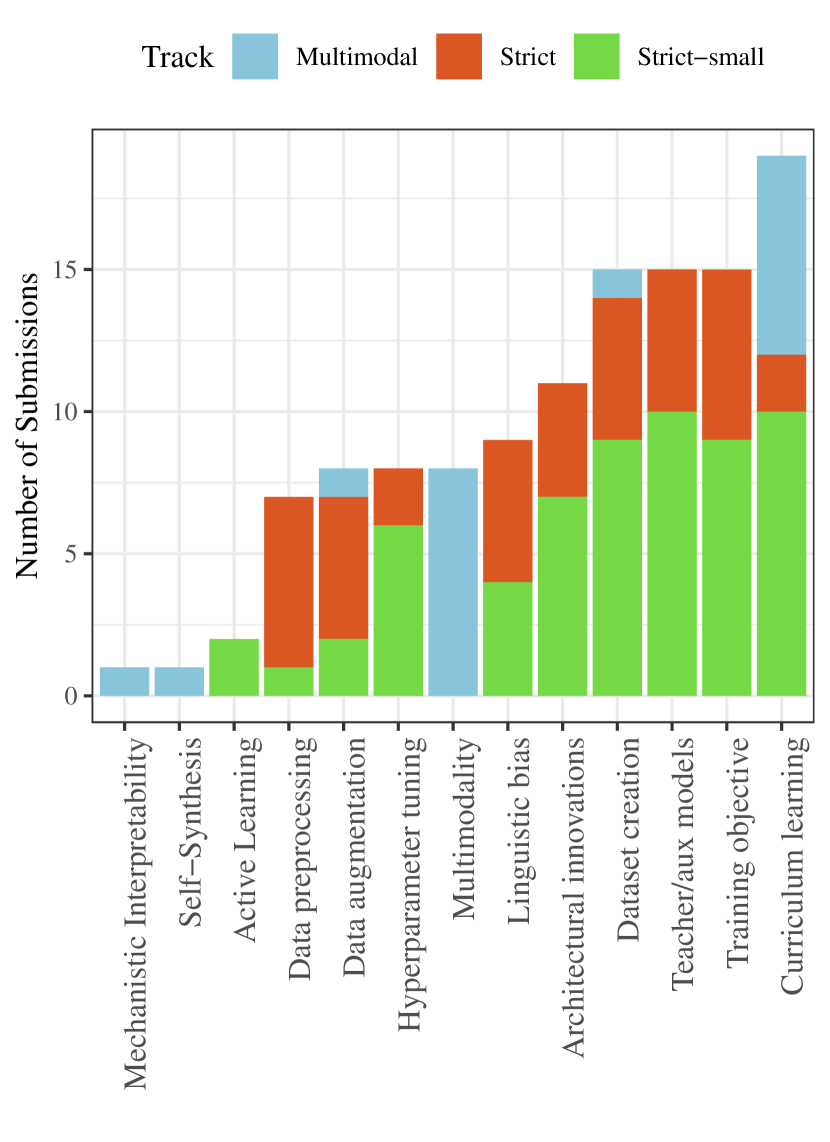
- Conducted meta-analysis of submissions to identify performance drivers, including FLOPs, architectural choices, and training objectives.
Experimental results
Research questions
- RQ1What architectural and training objective designs lead to improved performance in low-data language modeling settings?
- RQ2How does the quality and curation of training data impact model performance when data is strictly limited?
- RQ3Can vision-language pretraining improve language model capabilities in a data-efficient setting, particularly for grounded language understanding?
- RQ4To what extent do cognitive-inspired techniques—such as curriculum learning or linguistically motivated tokenization—enhance sample efficiency?
- RQ5What is the relationship between computational resources (FLOPs) and model performance in low-data language learning scenarios?
Key findings
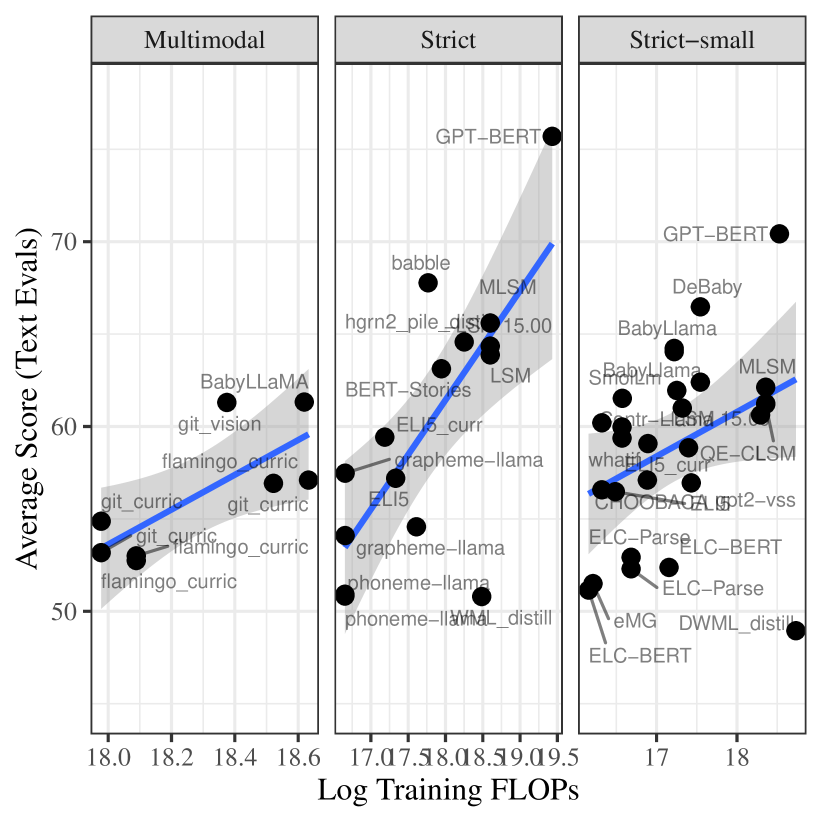
- The hybrid causal-masked language model architecture (e.g., GPT-BERT) achieved the highest performance across the 10M and 100M-word text-only tracks.
- Performance across evaluation tasks showed a strong positive correlation with training FLOPs, indicating that compute remains a key performance driver even in low-data regimes.
- No submissions outperformed the baseline in the multimodal track, suggesting that effective integration of visual input into low-data language models remains a significant challenge.
- Top-performing submissions often improved performance through custom dataset construction, novel training objectives, or architectural innovations, rather than relying on standard pretraining.
- Linguistically motivated tokenization (e.g., graphemes, phonemes) was explored but did not yield measurable gains on the core BabyLM evaluation tasks.
- Multi-objective training, particularly combining causal and masked language modeling, proved highly effective, with GPT-BERT and AntLM achieving strong results.
Read this paper
Open the full text in the Nubint reader and ask about any passage as you read.
Read this paper on NubintThis review was generated by AI from the original paper. Please check the paper before citing it.