
[Paper Review] Fine-grained Hallucination Detection and Editing for Language Models
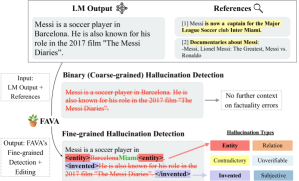
The paper introduces a fine-grained taxonomy of LM hallucinations, presents Fava for detection and editing, and introduces FavaBench, a benchmark with ~1,000 human judgments across LMs, showing Fava outperforms baselines in detection and editing of factual errors.
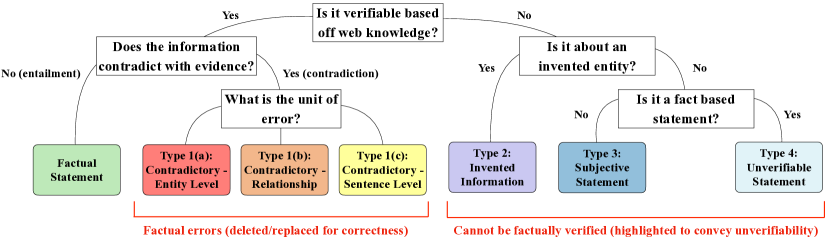
Large language models (LMs) are prone to generate factual errors, which are often called hallucinations. In this paper, we introduce a comprehensive taxonomy of hallucinations and argue that hallucinations manifest in diverse forms, each requiring varying degrees of careful assessments to verify factuality. We propose a novel task of automatic fine-grained hallucination detection and construct a new evaluation benchmark, FavaBench, that includes about one thousand fine-grained human judgments on three LM outputs across various domains. Our analysis reveals that ChatGPT and Llama2-Chat (70B, 7B) exhibit diverse types of hallucinations in the majority of their outputs in information-seeking scenarios. We train FAVA, a retrieval-augmented LM by carefully creating synthetic data to detect and correct fine-grained hallucinations. On our benchmark, our automatic and human evaluations show that FAVA significantly outperforms ChatGPT and GPT-4 on fine-grained hallucination detection, and edits suggested by FAVA improve the factuality of LM-generated text.
Motivation & Objective
- Develop a fine-grained taxonomy of hallucinations in language model outputs for information-seeking tasks.
- Create a benchmark (FavaBench) with span-level annotations of LM hallucinations across multiple models and domains.
- Build a retrieval-augmented editing model (Fava) to detect and correct factual errors in LM outputs.
- Demonstrate that fine-grained detection and editing improve factuality over strong baselines.
Proposed method
- Propose a six-type fine-grained hallucination taxonomy and a two-task evaluation: detection (span-level error type identification) and editing (span-level corrections).
- Construct FavaBench with ~1,000 model outputs annotated at the span level for diverse prompts and domains.
- Train Fava as a retrieval-augmented editing model that uses retrieved documents to identify and tag factual errors in LM outputs.
- Generate high-quality synthetic training data by a three-step pipeline: seed passage generation, targeted error insertion using taxonomy, and post-processing.
- Initialize and train an editing LM (Fava) on synthesized data using a retrieval module to select relevant documents (top-5) for context.
- Evaluate Fava against ChatGPT, GPT-4, and retrieval-augmented baselines on fine-grained detection (F1 across error types) and editing (FActScore-based gains).
Experimental results
Research questions
- RQ1What are the distinct fine-grained categories of hallucinations in LM outputs for information-seeking tasks?
- RQ2Can a retrieval-augmented editing model detect and correct span-level factual errors more effectively than strong baselines?
- RQ3Does a synthetic data generation pipeline suffice to train a capable fine-grained hallucination detector/editor?
- RQ4How does retrieval quality and context affect editing performance for factual correctness?
- RQ5What is the prevalence and distribution of hallucination types across different models and domains?
Key findings
- All evaluated models show hallucinations in the majority of outputs across information-seeking prompts.
- Entity errors are the most frequent, but invented and unverifiable errors are also common, highlighting the need for fine-grained detection.
- Fava outperforms ChatGPT, GPT-4, and retrieval-augmented baselines in fine-grained hallucination detection and in editing effectiveness, with substantial gains in FActScore.
- Retrieval-augmented editing with top-5 documents improves factuality over using a single document or no retrieval.
- Larger synthetic training data improves detection performance; better retrieval ordering and entity-based prompting further boost editing efficacy.
- Human evaluation confirms Fava’s detection and editing capabilities provide meaningful factual improvements over strong baselines.
Read this paper
Open the full text in the Nubint reader and ask about any passage as you read.
Read this paper on NubintThis review was generated by AI from the original paper. Please check the paper before citing it.