
[Paper Review] Fine-grained style control in Transformer-based Text-to-speech Synthesis
This paper proposes a novel Transformer-based text-to-speech system with fine-grained style control by introducing local style tokens (LST) extracted from reference speech via wav2vec 2.0 features. It uses cross-attention blocks to fuse content and style representations, reducing content leakage and improving naturalness, intelligibility, and style transferability—achieving state-of-the-art performance on LJ Speech and VCTK datasets without additional regularization.
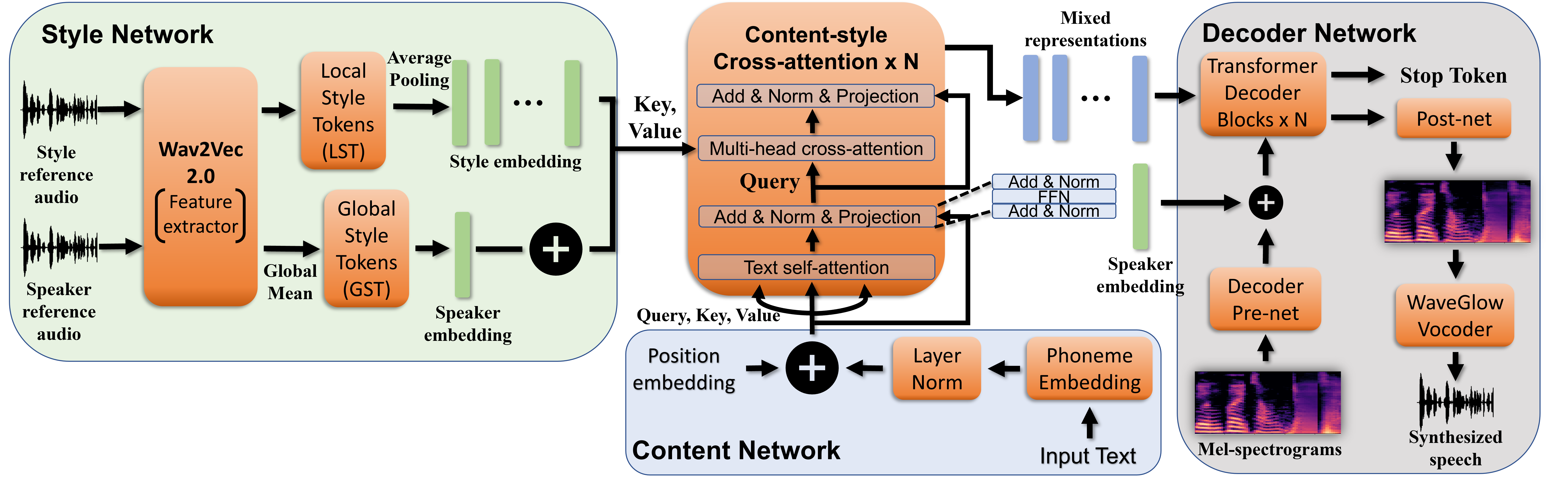
In this paper, we present a novel architecture to realize fine-grained style control on the transformer-based text-to-speech synthesis (TransformerTTS). Specifically, we model the speaking style by extracting a time sequence of local style tokens (LST) from the reference speech. The existing content encoder in TransformerTTS is then replaced by our designed cross-attention blocks for fusion and alignment between content and style. As the fusion is performed along with the skip connection, our cross-attention block provides a good inductive bias to gradually infuse the phoneme representation with a given style. Additionally, we prevent the style embedding from encoding linguistic content by randomly truncating LST during training and using wav2vec 2.0 features. Experiments show that with fine-grained style control, our system performs better in terms of naturalness, intelligibility, and style transferability. Our code and samples are publicly available.
Motivation & Objective
- To enable fine-grained control over speaking styles such as prosody, speaking rate, and loudness in Transformer-based text-to-speech synthesis.
- To address content-leakage in style modeling, where linguistic content inadvertently leaks into style embeddings during training.
- To design a style representation that captures time-varying, frame-level prosodic variations without relying on global style embeddings alone.
- To improve speech quality and style transferability in TTS by fusing content and style representations through a cross-attention mechanism with skip connections.
- To demonstrate that the system generalizes across multi-speaker settings and enables zero-shot style transfer without emotion or style labels.
Proposed method
- The style network uses wav2vec 2.0 as a feature extractor from reference speech, providing robust, disentangled representations that reduce content leakage.
- Local style tokens (LST) are learned via a learnable codebook and multi-head attention, producing a sequence of frame-level style embeddings.
- A cross-attention block fuses phoneme representations with LST embeddings, enabling gradual infusion of style through skip connections and inductive bias.
- Content leakage is mitigated by randomly truncating LST during training and using wav2vec 2.0 features instead of raw waveforms or spectrograms.
- The system employs a content network with only phoneme embedding and layer normalization, and a decoder network similar to MultiSpeech.
- Style control is achieved by conditioning the decoder on both content and style representations, allowing independent manipulation of speaking style.
Experimental results
Research questions
- RQ1Can fine-grained, frame-level speaking style control be effectively integrated into a Transformer-based TTS system without introducing content leakage?
- RQ2How does the proposed cross-attention fusion mechanism between content and style representations affect speech naturalness and intelligibility?
- RQ3To what extent can the system transfer subtle prosodic variations such as speaking rate and loudness from reference speech to synthesized speech?
- RQ4Does the use of wav2vec 2.0 features as a representation backbone reduce content leakage compared to traditional spectral or embedding-based inputs?
- RQ5Can the system generalize to multi-speaker settings and maintain high-quality style transfer without explicit emotion or style annotations?
Key findings
- The LST-A variant achieved a MOS of 3.62 ± 0.09 for naturalness and 3.28 ± 0.10 for style similarity on LJ Speech, outperforming prior methods including Tan et al. [10] on both metrics.
- On VCTK, the system maintained high performance with a MOS of 3.75 ± 0.10 for naturalness and 3.25 ± 0.12 for style similarity under the LST-A setup.
- The system achieved 68.4% accuracy in transferring emotion labels using a pretrained SER classifier, demonstrating effective emotion pattern transfer without any emotion supervision.
- Random truncation of LST during training (LST-R) did not degrade speech intelligibility, confirming that style control is robust and independent of sequential dependencies.
- The SPK variant showed higher WER due to content representation being adjusted to include prosodic information, suggesting improved robustness in alignment learning.
- The system generalizes well to multi-speaker settings, with both LST-A and LST-S achieving low WER on VCTK and maintaining high style similarity even when speaker identities differ between content and style inputs.
Better researchstarts right now
From reading papers to final review, dramatically reduce your research time.
No credit card · Free plan available
This review was created by AI and reviewed by human editors.