
[Paper Review] Fine-Pruning: Joint Fine-Tuning and Compression of a Convolutional Network with Bayesian Optimization
This paper proposes Fine-Pruning, a joint fine-tuning and compression method for convolutional networks using Bayesian optimization to adaptively adjust pruning parameters across iterations. It achieves up to 48.8-fold parameter reduction on UCMerced Land Use and 23.7-fold on Describable Textures while maintaining test accuracy within 1% of the dense fine-tuned model.
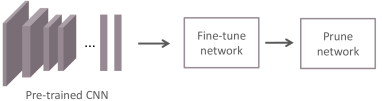
When approaching a novel visual recognition problem in a specialized image domain, a common strategy is to start with a pre-trained deep neural network and fine-tune it to the specialized domain. If the target domain covers a smaller visual space than the source domain used for pre-training (e.g. ImageNet), the fine-tuned network is likely to be over-parameterized. However, applying network pruning as a post-processing step to reduce the memory requirements has drawbacks: fine-tuning and pruning are performed independently; pruning parameters are set once and cannot adapt over time; and the highly parameterized nature of state-of-the-art pruning methods make it prohibitive to manually search the pruning parameter space for deep networks, leading to coarse approximations. We propose a principled method for jointly fine-tuning and compressing a pre-trained convolutional network that overcomes these limitations. Experiments on two specialized image domains (remote sensing images and describable textures) demonstrate the validity of the proposed approach.
Motivation & Objective
- Address the inefficiency of over-parameterized fine-tuned networks in specialized visual domains such as remote sensing and textures.
- Overcome limitations of independent fine-tuning and post-pruning, including static pruning parameters and prohibitive hyperparameter search.
- Develop a principled, adaptive method that jointly optimizes network compression and fine-tuning to improve memory efficiency without sacrificing accuracy.
- Enable automated, dynamic adjustment of layer-wise pruning rates during training via Bayesian optimization to suit evolving network characteristics.
Proposed method
- Introduce an iterative process that alternates between fine-tuning the network and updating pruning parameters using Bayesian optimization.
- Use Bayesian optimization to learn optimal pruning parameters (e.g., sparsity levels per layer) that adapt over time based on network performance.
- Model the pruning process as a differentiable objective function where the goal is to minimize parameters while preserving accuracy.
- Apply a parameterized pruning module that allows layer-wise control of sparsity, enabling the controller to prioritize high-parameter layers like fc6 and fc7.
- Use a fixed learning rate of 0.001 and train for 10 epochs per iteration to ensure stable convergence during each fine-tuning phase.
- Leverage the compatibility between knowledge transfer and compression by allowing feedback between pruning and fine-tuning to guide the optimization process.

Experimental results
Research questions
- RQ1Can joint fine-tuning and pruning via adaptive optimization reduce model size more effectively than independent post-pruning?
- RQ2How does Bayesian optimization improve the selection of pruning parameters across layers during iterative compression?
- RQ3To what extent can the proposed method maintain high accuracy while achieving significant compression on specialized image domains?
- RQ4Does the method automatically prioritize compression of high-parameter layers such as fc6 and fc7, and if so, why?
- RQ5Can the adaptive pruning strategy learned by Bayesian optimization outperform fixed or coarse pruning heuristics in terms of memory-accuracy trade-offs?
Key findings
- Fine-Pruning achieved a 48.8-fold reduction in parameters (1.17M vs. 57.0M) on the UCMerced Land Use dataset while maintaining test accuracy within 1% of the dense fine-tuned network.
- On the more challenging Describable Textures dataset, Fine-Pruning achieved a 23.7-fold compression rate (2.41M parameters), outperforming the independent baseline by 5.9-fold in compression efficiency.
- The Bayesian optimization controller learned to apply strong initial pruning and gradually increase aggressiveness, with pruning rates tapering off as the network converged.
- The method automatically prioritized compression of fc6 and fc7 layers—responsible for 99.2% and 99.6% of parameter reduction—due to their high influence on the objective function.
- Layer-wise compression results showed that 98.0% of parameters were pruned overall on UCMerced, with the highest reductions in fully connected layers.
- The approach demonstrated consistent performance across ten random runs, indicating robustness and generalization to specialized visual domains.
Read this paper
Open the full text in the Nubint reader and ask about any passage as you read.
Read this paper on NubintThis review was generated by AI from the original paper. Please check the paper before citing it.