
[Paper Review] Fine-tuning multilingual language models in Twitter/X sentiment analysis: a study on Eastern-European V4 languages
This study fine-tunes multilingual LLMs—BERT, BERTweet, Llama2, Llama3, and Mistral—for aspect-based sentiment analysis on Twitter/X data in Eastern European V4 languages (Czech, Slovak, Polish, Hungarian) during the Russia-Ukraine war. Despite limited training data (as few as 6K tweets), fine-tuned Llama2 and Mistral models with DeepL-translation outperformed in-context GPT-4 and other models, achieving SOTA-level performance, highlighting strong model- and language-specific fine-tuning effects.
The aspect-based sentiment analysis (ABSA) is a standard NLP task with numerous approaches and benchmarks, where large language models (LLM) represent the current state-of-the-art. We focus on ABSA subtasks based on Twitter/X data in underrepresented languages. On such narrow tasks, small tuned language models can often outperform universal large ones, providing available and cheap solutions. We fine-tune several LLMs (BERT, BERTweet, Llama2, Llama3, Mistral) for classification of sentiment towards Russia and Ukraine in the context of the ongoing military conflict. The training/testing dataset was obtained from the academic API from Twitter/X during 2023, narrowed to the languages of the V4 countries (Czech Republic, Slovakia, Poland, Hungary). Then we measure their performance under a variety of settings including translations, sentiment targets, in-context learning and more, using GPT4 as a reference model. We document several interesting phenomena demonstrating, among others, that some models are much better fine-tunable on multilingual Twitter tasks than others, and that they can reach the SOTA level with a very small training set. Finally we identify combinations of settings providing the best results.
Motivation & Objective
- Address the lack of multilingual, low-resource sentiment analysis models for Eastern European V4 languages (Czech, Slovak, Polish, Hungarian) in the context of the Russia-Ukraine war.
- Investigate whether small, fine-tuned LLMs can outperform large universal models like GPT-4 in low-resource, multilingual Twitter sentiment analysis.
- Evaluate the impact of translation (Helsinki, DeepL) and in-context learning on model performance across diverse languages and sentiment targets.
- Identify optimal model and hyperparameter combinations for aspect-based sentiment classification in underrepresented, conflict-sensitive languages.
Proposed method
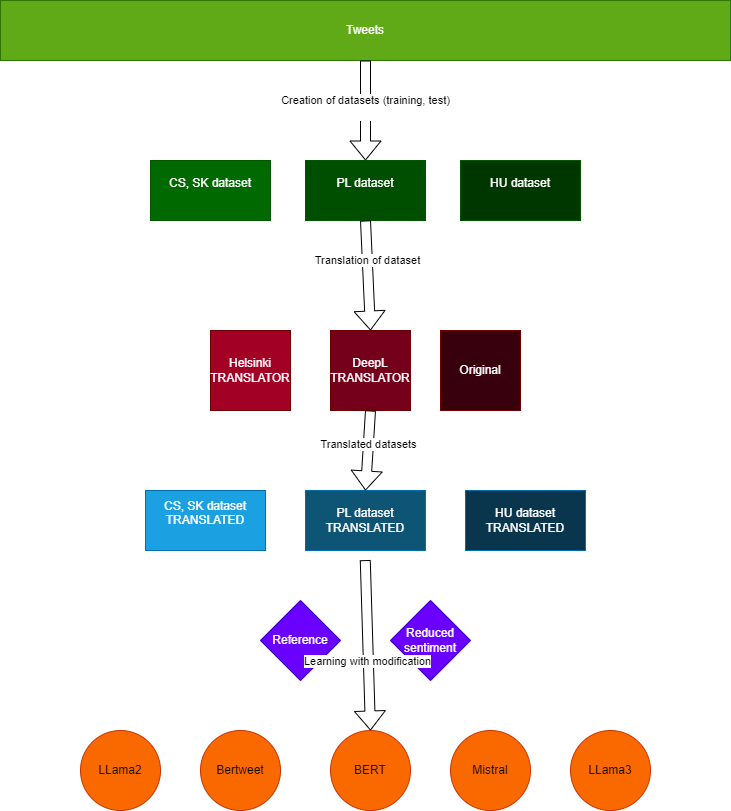
- Collected Twitter/X data via the academic API during 2023, filtered for V4 languages and keywords related to the Russia-Ukraine conflict.
- Manually annotated language-specific datasets for sentiment polarity (negative/neutral/positive) toward Russia and Ukraine.
- Created nine experimental datasets by translating original tweets into English using Helsinki and DeepL translators.
- Fine-tuned five LLMs—BERT, BERTweet, Llama2, Llama3, and Mistral—on each language and translation variant using binary and ternary classification.
- Evaluated models using macro-averaged precision, recall, and F1 scores, with GPT-4 used as a zero-shot reference model.
- Tested variants including in-context learning and reference tweet usage to assess context sensitivity and fine-tuning efficiency.
Experimental results
Research questions
- RQ1Can fine-tuned small multilingual models achieve SOTA performance in aspect-based sentiment analysis on low-resource, multilingual Twitter data for V4 languages?
- RQ2How does translating tweets into English affect the performance of multilingual LLMs compared to using the original language?
- RQ3To what extent does in-context learning with GPT-4 outperform fine-tuned models on this specific task and language set?
- RQ4Are there significant model- or language-specific performance differences in sentiment classification, particularly in culturally and politically sensitive contexts?
- RQ5What is the minimum effective training size required for fine-tuned models to achieve competitive performance on this task?
Key findings
- Fine-tuning with as few as 6,000 multilingual tweets achieved SOTA-level performance, significantly outperforming in-context learning with GPT-4.
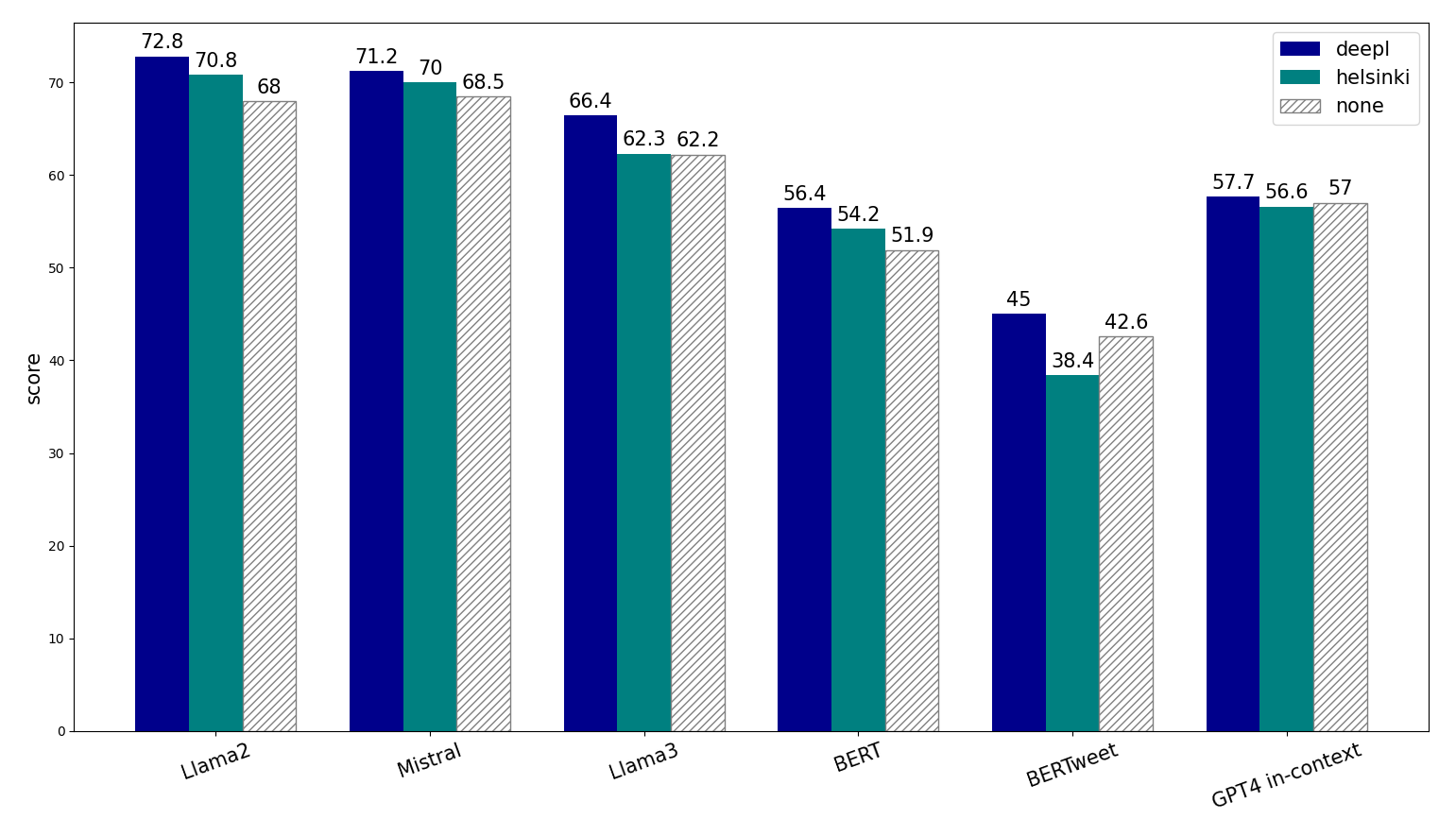
- Llama2 and Mistral, when combined with DeepL translation, achieved the best results, outperforming even GPT-4 in several language-specific evaluations.
- Llama3, BERTweet, and GPT-4 performed significantly worse than Llama2 and Mistral, indicating that performance is highly model-dependent, even across similar architectures.
- Translation to English provided a consistent performance advantage over using the original language, even for multilingual pre-trained models, suggesting that English-aligned representations improve zero-shot generalization.
- Models exhibited language-specific biases—particularly in Hungarian, where recall for the positive class was ~10% lower than for the negative class, indicating a tendency to overclassify as negative.
- Fine-tuning effectively aligned model behavior with target aspects (e.g., sentiment toward Ukraine vs. war), reducing misclassification despite short, context-poor tweets.
Read this paper
Open the full text in the Nubint reader and ask about any passage as you read.
Read this paper on NubintThis review was generated by AI from the original paper. Please check the paper before citing it.