
[Paper Review] Finetuning Foundation Models for Joint Analysis Optimization
This paper proposes a foundation model finetuning framework for end-to-end optimization in High Energy Physics (HEP), replacing sequential reconstruction and analysis pipelines with joint, gradient-based training. It demonstrates up to a 100-fold improvement in data efficiency and a two-fold performance gain in signal rejection over frozen backbone models, using ParT-based jet representations finetuned on heavy resonance searches with di-Higgs decays to four b-jets.
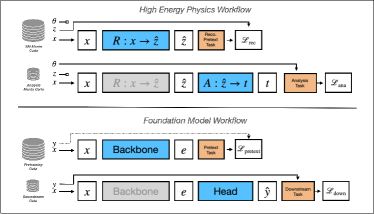
In this work we demonstrate that significant gains in performance and data efficiency can be achieved in High Energy Physics (HEP) by moving beyond the standard paradigm of sequential optimization or reconstruction and analysis components. We conceptually connect HEP reconstruction and analysis to modern machine learning workflows such as pretraining, finetuning, domain adaptation and high-dimensional embedding spaces and quantify the gains in the example usecase of searches of heavy resonances decaying via an intermediate di-Higgs system to four $b$-jets.
Motivation & Objective
- To overcome the limitations of sequential, greedy optimization in HEP data analysis pipelines.
- To establish a conceptual and practical bridge between foundation model training in machine learning and hierarchical particle physics analysis workflows.
- To quantify performance and data efficiency improvements from end-to-end, gradient-based optimization using finetuning and pretraining.
- To explore domain adaptation in HEP by initializing models on unrelated but physics-similar datasets (e.g., JetClass).
- To evaluate whether finetuning reconstruction-level representations leads to better downstream analysis performance.
Proposed method
- Adopt a foundation model paradigm: pretrain a jet representation model (ParT) on a pretext task (Xbb-tagging) using a large, publicly available dataset (JetClass).
- Fine-tune the pretrained backbone on the target HEP analysis task (heavy resonance decaying to di-Higgs → four b-jets) using a smaller, task-specific dataset from CMS Open Data.
- Compare three training strategies: (1) from-scratch training, (2) frozen backbone finetuned on downstream task, and (3) full end-to-end finetuning.
- Use high-dimensional embeddings from the ParT model as joint representations for both reconstruction and analysis, enabling gradient flow across the entire pipeline.
- Apply domain adaptation by initializing models with weights pre-trained on JetClass, even though it uses a different simulator and distribution than the target dataset.
- Train and evaluate models across varying dataset sizes to measure data efficiency and performance gains.
Experimental results
Research questions
- RQ1Can end-to-end finetuning of a foundation model backbone improve performance and data efficiency in HEP analysis compared to frozen or from-scratch training?
- RQ2To what extent does pretraining on a large, unrelated dataset (JetClass) improve downstream performance in a different simulation domain?
- RQ3Does finetuning the reconstruction-level representation (jet embeddings) lead to better event-level analysis performance than optimizing only the analysis head?
- RQ4How does the performance gap between frozen and finetuned models evolve with increasing training data size?
- RQ5Can successful domain adaptation be achieved in a hierarchical HEP pipeline, where the backbone is pretrained on a different distribution?
Key findings
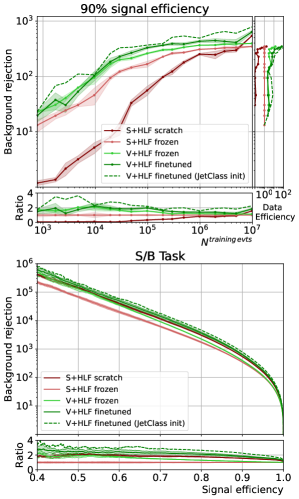
- Finetuning the full model leads to a performance gain of up to a factor of two in signal rejection compared to using a frozen backbone.
- The data efficiency of finetuned models is up to 100 times higher than the frozen backbone baseline, meaning fewer training samples are needed to reach a given performance level.
- Models initialized with JetClass-pretrained weights outperform all other configurations, including those finetuned from random initialization, demonstrating successful domain adaptation across different simulation domains.
- The performance gap between frozen and finetuned models diminishes with increasing training data size, and from-scratch models eventually surpass frozen models when sufficient data is available.
- The best-performing configuration is the JetClass-initialized finetuning setup, which consistently outperforms all others across all dataset sizes and is shown as the top dashed curve in Figure 4.
- The results demonstrate, for the first time, a viable finetuning workflow in a hierarchical HEP setting involving per-object representations and event-level inference.
Read this paper
Open the full text in the Nubint reader and ask about any passage as you read.
Read this paper on NubintThis review was generated by AI from the original paper. Please check the paper before citing it.