
[Paper Review] First stars signatures in high-z absorbers
This paper identifies three very metal-poor, C-enhanced absorbers at z ≈ 3–4 as gaseous fossils of the first stars, showing chemical signatures analogous to CEMP-no stars in the Milky Way halo. Using abundance modeling, it demonstrates these systems were enriched by low-energy supernovae from Population III stars, with ≥50% of their metals originating from these primordial explosions.
The first stars were likely more massive than those forming today and thus rapidly evolved, exploding as supernovae and enriching the surrounding gas with their chemical products. In the Local Group, the chemical signature of the first stars has been identified in the so-called Carbon-Enhanced Metal-Poor stars (CEMP-no). On the contrary, a similar C-excess was not found in dense neutral gas traced by high-redshift absorption systems. Here we discuss the recent discovery of three C-enhanced very metal-poor ([Fe/H]< -2) optically thick absorbers at redshift z ~ 3-4, reported by (Saccardi et al. 2023). We show that these absorbers are extra-galactic tracers of the chemical signatures of the first stars, analogous to the CEMP-no stars observed in the Galactic halo and ultra-faint dwarf galaxies. Furthermore, by comparing observations with model predictions we demonstrate that these systems have most likely been imprinted by first stars exploding as low-energy supernovae, which provided > 50% of the metals in these absorbers
Motivation & Objective
- To identify and characterize high-redshift gaseous absorbers with chemical abundances indicative of primordial star enrichment.
- To determine whether the chemical signatures of the first stars—specifically C-enhancement without neutron-capture element enrichment—can be detected in dense, neutral gas at high redshift.
- To compare the abundance patterns of these absorbers with those of CEMP-no stars in the Local Group to establish a direct link between gaseous and stellar fossils of Population III stars.
- To constrain the contribution of Population III supernovae to the metal enrichment of early interstellar media using observed abundance ratios.
- To assess the viability of diffuse, metal-poor absorbers as pristine tracers of early cosmic chemical evolution, free from later contamination by normal stars.
Proposed method
- Analyzed high-resolution quasar absorption spectra from the XQ-100 legacy survey to measure iron, carbon, and other elemental abundances in sub-DLAs and Lyman Limit Systems at z ≈ 3–4.
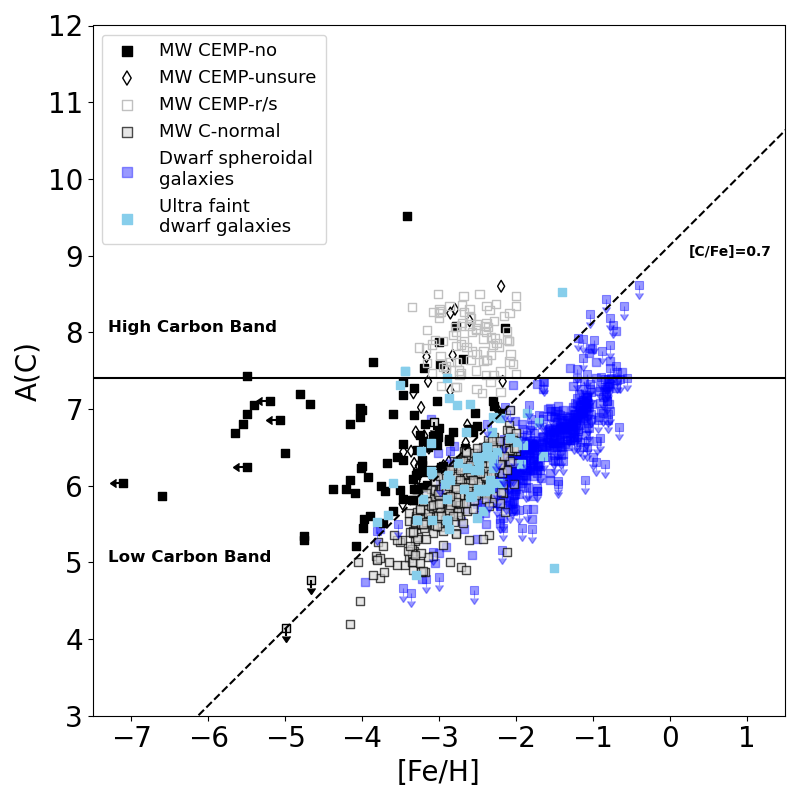
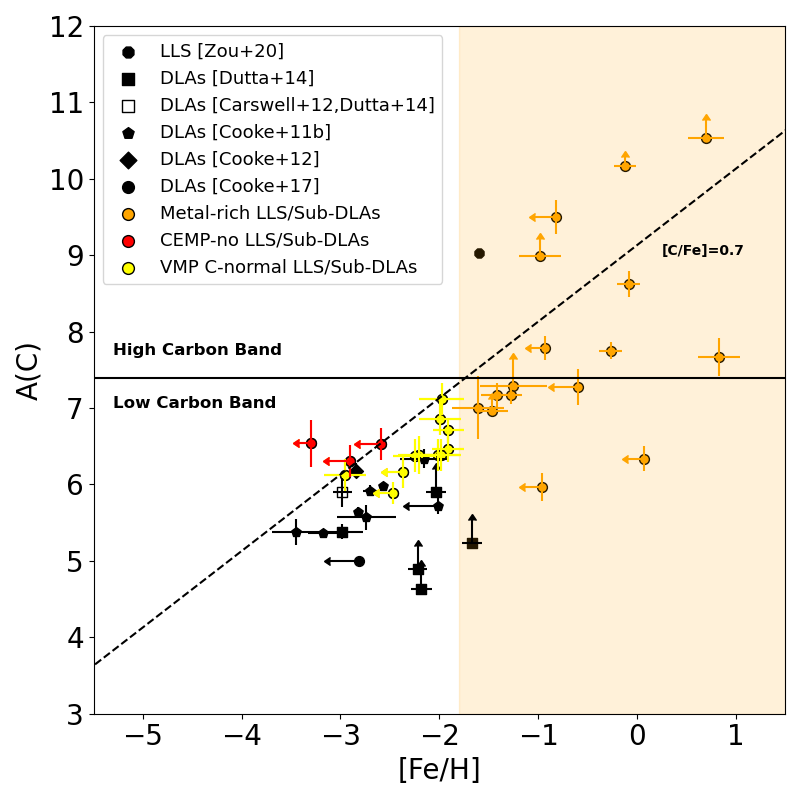
- Used absolute carbon abundance (A(C) = log(N_C/N_H) + 12) and [C/Fe] ratios to classify absorbers as CEMP-no-like, based on the distinction between low-C (A(C) < 7.4) and high-C (A(C) ≥ 7.4) bands.
- Compared observed abundance patterns in the three C-enhanced absorbers with theoretical models of Population III star enrichment, particularly focusing on low-energy supernovae (E ≤ 10^51 erg).
- Employed a parametric model of early interstellar medium enrichment that varies the fraction of metals from Population III stars (f_PopIII), star formation efficiency, and dilution factor to simulate observed abundance trends.
- Evaluated the consistency of observed [Fe/H] and [C/Fe] values with predictions from models where f_PopIII ≥ 50%, indicating dominant enrichment by primordial supernovae.
- Assessed the impact of dust depletion and signal-to-noise limitations on abundance measurements, particularly at higher metallicities.
Experimental results
Research questions
- RQ1Can the chemical signature of Population III stars—specifically C-enhancement without neutron-capture element enrichment—be detected in high-redshift gaseous absorbers?
- RQ2Do the observed abundance patterns in metal-poor, C-enhanced absorbers at z ≈ 3–4 match those of CEMP-no stars in the Local Group?
- RQ3What fraction of metals in these absorbers can be attributed to Population III supernovae, and what does this imply about the explosion energetics of the first stars?
- RQ4Are these absorbers sufficiently diffuse and chemically isolated to preserve pristine signatures of first-star enrichment without contamination from later generations?
- RQ5How do the observed abundance ratios compare to theoretical models of low-energy supernovae from massive Population III stars?
Key findings
- Three C-enhanced, very metal-poor absorbers at z ≈ 3–4 were identified with [Fe/H] < -2 and [C/Fe] > +0.7, placing them in the CEMP-no-like region of the A(C) vs. [Fe/H] diagram.
- These absorbers exhibit A(C) < 7.4, confirming their classification as low-C band systems, consistent with the chemical signature of CEMP-no stars and distinct from CEMP-s stars.
- The observed abundance patterns are best explained by models where at least 50% of the metals in these systems originated from low-energy supernovae of Population III stars (E ≤ 10^51 erg).
- The systems are consistent with being chemically isolated, with no evidence of later contamination, supporting their role as gaseous fossils of early star formation.
- The results suggest that optically thick, relatively diffuse absorbers at high redshift can preserve the chemical imprints of the first stars, even in the absence of star formation.
- Future high-resolution spectroscopy with instruments like ANDES on the ELT will enable detection of key elements such as zinc, further testing the primordial origin of these abundances.
Read this paper
Open the full text in the Nubint reader and ask about any passage as you read.
Read this paper on NubintThis review was generated by AI from the original paper. Please check the paper before citing it.