
[Paper Review] FITS: Modeling Time Series with $10k$ Parameters
FITS proposes a lightweight complex-frequency domain interpolation model for time series that achieves competitive state-of-the-art results with around 5k–10k parameters by performing interpolation in the frequency domain and mapping back to time domain.
In this paper, we introduce FITS, a lightweight yet powerful model for time series analysis. Unlike existing models that directly process raw time-domain data, FITS operates on the principle that time series can be manipulated through interpolation in the complex frequency domain. By discarding high-frequency components with negligible impact on time series data, FITS achieves performance comparable to state-of-the-art models for time series forecasting and anomaly detection tasks, while having a remarkably compact size of only approximately $10k$ parameters. Such a lightweight model can be easily trained and deployed in edge devices, creating opportunities for various applications. The code is available in: \url{https://github.com/VEWOXIC/FITS}
Motivation & Objective
- Motivate time series analysis on resource-constrained edge devices where traditional models are too large.
- Introduce a frequency-domain interpolation approach that uses complex-valued parameters to capture amplitude and phase.
- Demonstrate that a small, 5k–10k parameter model can achieve state-of-the-art or near-state-of-the-art performance.
- Showcase the applicability of FITS to forecasting and anomaly detection tasks via a simple, trainable pipeline.
Proposed method
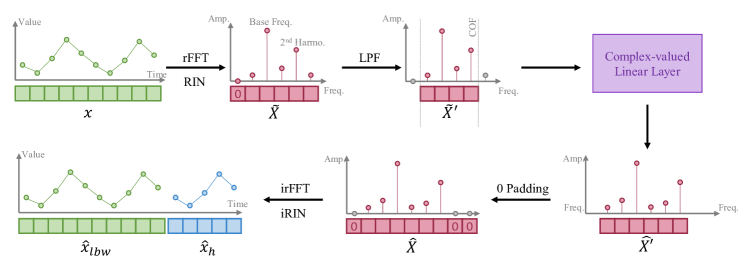
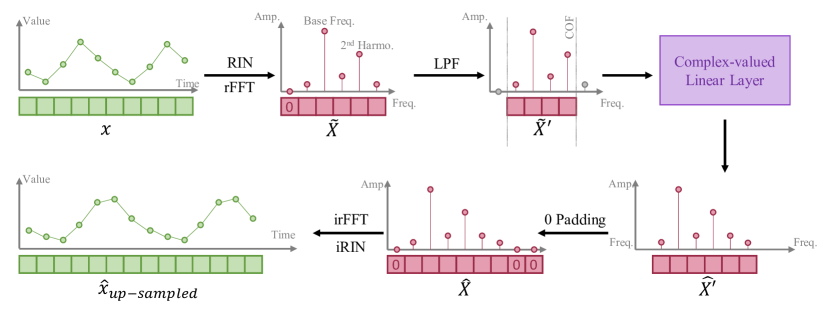
- Transform time series segments to the complex frequency domain via rFFT.
- Learn an amplitude scaling and phase shift through a single complex-valued linear layer to interpolate in the frequency domain.
- Apply a low-pass filter to compress the frequency representation while preserving essential information.
- Inverse transform back to the time domain for supervision with standard losses (e.g., MSE).
- Use reversible instance-wise normalization to handle DC components and stabilize training.
- Train with supervision that combines look-back windows, horizons (forecast), and backcasting for forecasting tasks; reconstructive supervision for reconstruction tasks.
Experimental results
Research questions
- RQ1Can frequency-domain interpolation with a compact complex-valued layer achieve competitive forecasting accuracy versus larger TSF models?
- RQ2Does applying a low-pass filter and reversible normalization preserve essential information while enabling edge-device deployment?
- RQ3How does FITS perform on forecasting and anomaly detection across standard benchmarks with significantly fewer parameters?
- RQ4What is the impact of look-back window length and cutoff frequency on performance and efficiency?
- RQ5Can joint forecasting and backcasting supervision improve performance in practical forecasting tasks?
Key findings
- FITS achieves competitive or state-of-the-art results across long-term forecasting datasets with only about 5k–10k parameters.
- The model outperforms several larger baselines in MSE on ETTh1/ETTh2 and Electricity datasets while using far fewer parameters and MACs.
- Across Table 3, FITS uses 4.5K–16K parameters with 1.6M–8.9M MACs and 0.6ms inference time (CPU) for look-back=96, horizon=720 on Electricity.
- FITS demonstrates orders-of-magnitude smaller parameter counts (compared to TimesNet, Pyraformer, etc.) while maintaining strong performance.
- Longer look-back windows generally improve performance; increasing cutoff frequency yields marginal gains with higher computational cost.
- In anomaly detection, FITS achieves top F1-scores on several datasets with low parameter counts and sub-millisecond inference times, highlighting its suitability as a fast first-responder tool.
Read this paper
Open the full text in the Nubint reader and ask about any passage as you read.
Read this paper on NubintThis review was generated by AI from the original paper. Please check the paper before citing it.