
[Paper Review] Flatten: Video Action Recognition is an Image Classification task
This paper proposes Flatten, a plug-and-play module that converts 3D video clips into 2D spatial representations via row-major flattening, enabling standard image classification models to effectively recognize video actions. By transforming temporal sequences into spatial layouts, Flatten achieves state-of-the-art performance on Kinetics-400, Something-Want-2, and HMDB-51 with ResNet, SwinV2, and Uniformer backbones, significantly outperforming their original 3D counterparts.
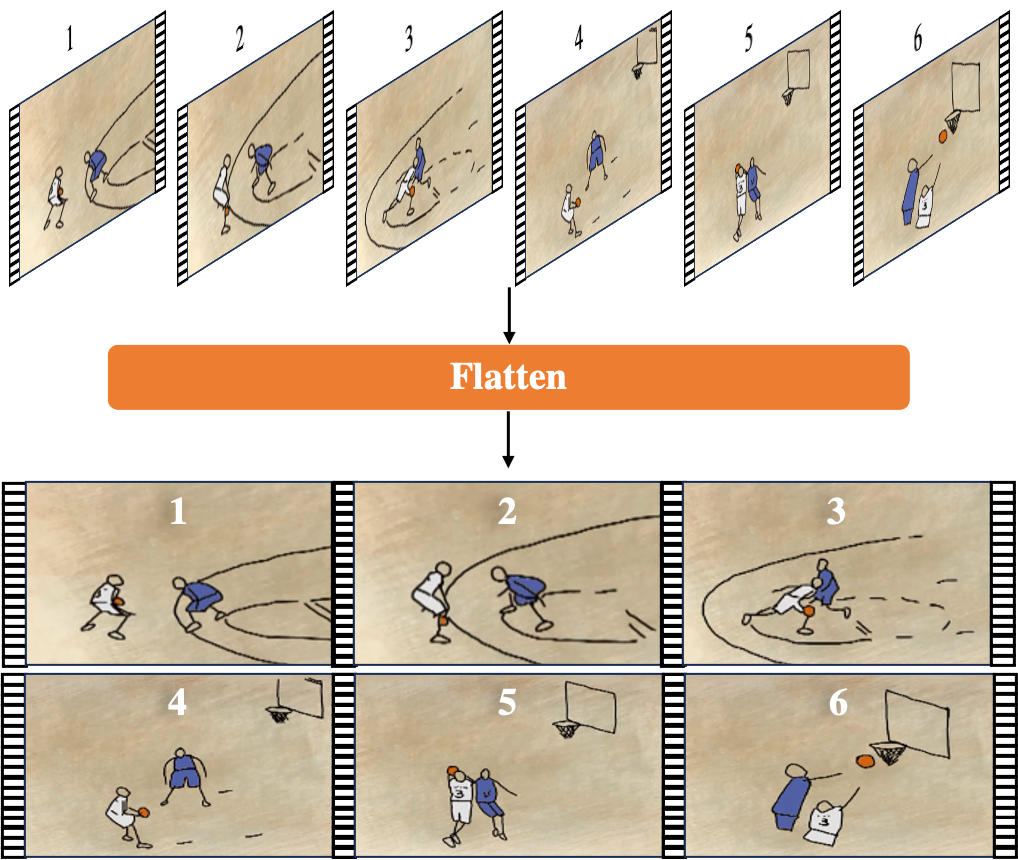
In recent years, video action recognition, as a fundamental task in the field of video understanding, has been deeply explored by numerous researchers.Most traditional video action recognition methods typically involve converting videos into three-dimensional data that encapsulates both spatial and temporal information, subsequently leveraging prevalent image understanding models to model and analyze these data. However,these methods have significant drawbacks. Firstly, when delving into video action recognition tasks, image understanding models often need to be adapted accordingly in terms of model architecture and preprocessing for these spatiotemporal tasks; Secondly, dealing with high-dimensional data often poses greater challenges and incurs higher time costs compared to its lower-dimensional counterparts.To bridge the gap between image-understanding and video-understanding tasks while simplifying the complexity of video comprehension, we introduce a novel video representation architecture, Flatten, which serves as a plug-and-play module that can be seamlessly integrated into any image-understanding network for efficient and effective 3D temporal data modeling.Specifically, by applying specific flattening operations (e.g., row-major transform), 3D spatiotemporal data is transformed into 2D spatial information, and then ordinary image understanding models are used to capture temporal dynamic and spatial semantic information, which in turn accomplishes effective and efficient video action recognition. Extensive experiments on commonly used datasets (Kinetics-400, Something-Something v2, and HMDB-51) and three classical image classification models (Uniformer, SwinV2, and ResNet), have demonstrated that embedding Flatten provides a significant performance improvements over original model.
Motivation & Objective
- To simplify video action recognition by eliminating the need for specialized 3D architectures.
- To bridge the gap between image and video understanding by enabling 2D image models to model temporal dynamics.
- To reduce computational complexity and training overhead associated with 3D spatiotemporal modeling.
- To demonstrate that video action recognition can be effectively solved using standard image classification frameworks with minimal modification.
- To validate the effectiveness of flattening 3D video data into 2D form for preserving and leveraging temporal relationships.
Proposed method
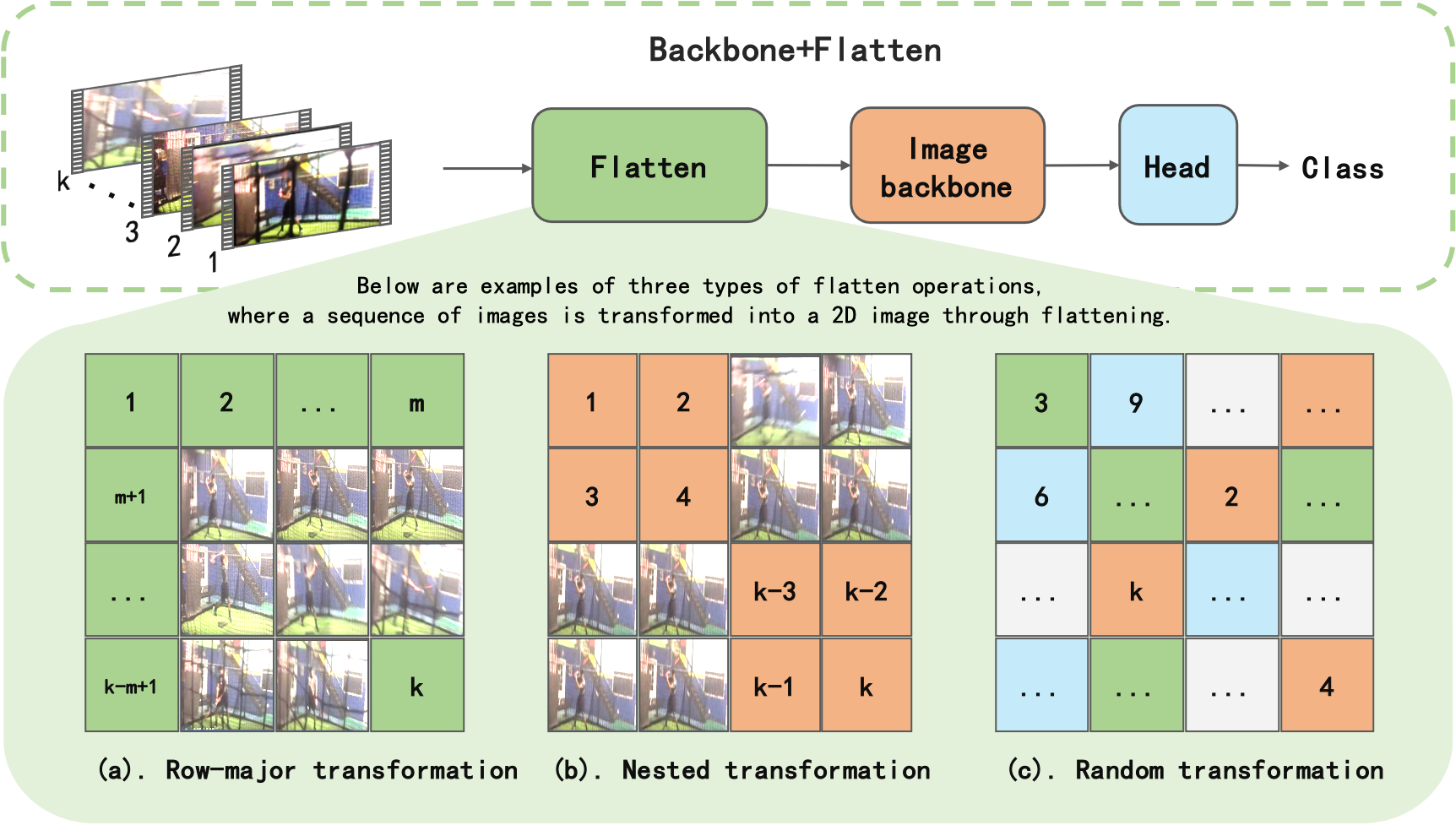
- The Flatten module applies a row-major flattening operation to convert a sequence of video frames into a single 2D image tensor.
- Input video clips of shape (T, C, H, W) are reshaped into (C, H*n, W*m) where T = n*m, preserving spatial and temporal structure.
- The method uses standard image classification models (e.g., ResNet, SwinV2, Uniformer) without architectural modifications.
- The flattening operation enables the model to learn temporal dependencies through spatial positional encoding in the 2D layout.
- The approach is plug-and-play: it requires no retraining of the backbone and only a single transformation step before inference.
- The method supports multiple flattening types (e.g., row-major, column-major) and dynamically selects optimal n and m based on sequence length.
Experimental results
Research questions
- RQ1Can video action recognition be effectively performed using standard 2D image classification models after transforming 3D video data into 2D spatial form?
- RQ2Does flattening temporal sequences into spatial layouts preserve sufficient temporal dynamics for accurate action recognition?
- RQ3How does the performance of flattened video representations compare to traditional 3D convolutional or transformer-based video models?
- RQ4Can a simple, lightweight module like Flatten be universally applied across different image classification backbones to improve video recognition accuracy?
- RQ5To what extent does the 2D spatial layout of flattened frames enable attention mechanisms to focus on motion patterns?
Key findings
- Flatten significantly improves action recognition accuracy across all evaluated datasets: Kinetics-400, Something-Something v2, and HMDB-51.
- On Kinetics-400, Uniformer-S+Flatten achieves 85.1% top-1 accuracy, outperforming the original 3D Uniformer-S model.
- SwinV2-T+Flatten achieves 84.3% top-1 accuracy on Kinetics-400, surpassing the original SwinV2-T model.
- ResNet101+Flatten achieves 83.7% top-1 accuracy on Kinetics-400, demonstrating consistent gains across deeper architectures.
- Visualization shows that Uniformer-S+Flatten learns more focused attention on motion patterns compared to the 3D variant.
- Feature map analysis confirms that deeper layers in Flatten-enhanced models capture increasingly global temporal representations, indicating effective long-range modeling.
Read this paper
Open the full text in the Nubint reader and ask about any passage as you read.
Read this paper on NubintThis review was generated by AI from the original paper. Please check the paper before citing it.