
[Paper Review] FLAVA: A Foundational Language And Vision Alignment Model
FLAVA is a single transformer-based model pretrained on unimodal and multimodal data to excel in vision, language, and multimodal reasoning tasks, evaluated across 35 tasks.
State-of-the-art vision and vision-and-language models rely on large-scale visio-linguistic pretraining for obtaining good performance on a variety of downstream tasks. Generally, such models are often either cross-modal (contrastive) or multi-modal (with earlier fusion) but not both; and they often only target specific modalities or tasks. A promising direction would be to use a single holistic universal model, as a "foundation", that targets all modalities at once -- a true vision and language foundation model should be good at vision tasks, language tasks, and cross- and multi-modal vision and language tasks. We introduce FLAVA as such a model and demonstrate impressive performance on a wide range of 35 tasks spanning these target modalities.
Motivation & Objective
- Motivate the need for a single foundation model that handles vision, language, and multimodal tasks simultaneously.
- Propose a unified FLAVA architecture that fuses unimodal and multimodal representations.
- Develop joint pretraining objectives that combine contrastive, masked multimodal modeling, and image-text matching.
- Demonstrate FLAVA’s effectiveness on a broad suite of downstream tasks using public data.
- Show that unimodal pretraining data improves multimodal and language capabilities.
Proposed method
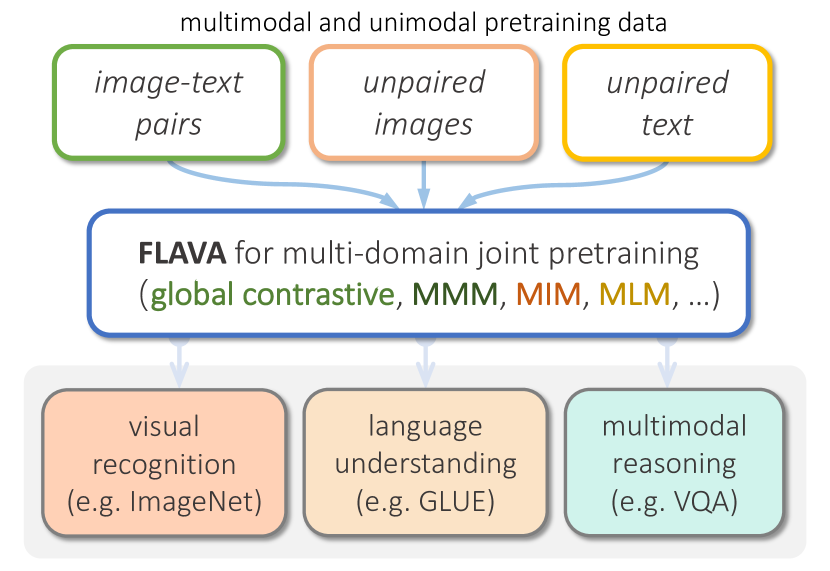
- Architecture combines three transformers: an image encoder (ViT) for unimodal vision, a text encoder (ViT-based) for unimodal language, and a multimodal encoder for fused representations.
- Multimodal pretraining uses global contrastive loss, masked multimodal modeling (MMM), and image-text matching (ITM).
- Unimodal pretraining includes masked image modeling (MIM) for images and masked language modeling (MLM) for text, with optional unimodal initialization.
- Joint unimodal and multimodal training alternates data types (PMD, ImageNet-1K, CCNews, BookCorpus) with round-robin sampling.
- Data sources comprise 70M publicly available image-text pairs (PMD) plus unimodal datasets (ImageNet-1K, CCNews, BookCorpus).
- The model uses a shared trunk and applies task-specific heads for vision, NLP, and multimodal tasks.
Experimental results
Research questions
- RQ1Can a single foundation model learn strong representations for vision, language, and multimodal reasoning from both unimodal and multimodal data?
- RQ2How do different pretraining objectives (contrastive, MMM, ITM, MLM, MIM) contribute to unimodal and multimodal performance?
- RQ3What gains come from unimodal pretraining and global back-propagation across GPUs for contrastive learning?
- RQ4How does FLAVA perform across a 35-task benchmark spanning vision, NLP, and multimodal domains?
- RQ5How does FLAVA compare to state-of-the-art multimodal models trained on larger private corpora?
Key findings
- FLAVA achieves strong average performance across vision, language, and multimodal tasks, outperforming several ablations.
- Incorporating MMM and ITM objectives improves multimodal results beyond contrastive-only pretraining.
- Joint unimodal and multimodal pretraining with unimodal initialization improves NLP performance, with notable gains when using pretrained vision and language encoders.
- FLAVA trained on publicly available data (70M PMD pairs plus unimodal data) remains competitive with models trained on much larger private datasets.
- Global back-propagation for the contrastive objective yields macro-average gains over multiple modalities.
- FLAVA demonstrates strong results on a wide task suite, including VQA, SNLI-VE, Hateful Memes, and GLUE-style language tasks.

Read this paper
Open the full text in the Nubint reader and ask about any passage as you read.
Read this paper on NubintThis review was generated by AI from the original paper. Please check the paper before citing it.