
[Paper Review] Flexible Clustered Federated Learning for Client-Level Data Distribution Shift
This paper proposes FlexCFL, a flexible clustered federated learning framework that groups clients based on optimization direction similarity using a novel Euclidean distance of Decomposed Cosine similarity (EDC) measure to reduce training divergence under client-level data distribution shift. It introduces a cold start mechanism for newcomers and a dynamic client migration strategy using Wasserstein distance, achieving up to +40.9% test accuracy improvement over FedSEM on FEMNIST while maintaining communication efficiency.
Federated Learning (FL) enables the multiple participating devices to collaboratively contribute to a global neural network model while keeping the training data locally. Unlike the centralized training setting, the non-IID, imbalanced (statistical heterogeneity) and distribution shifted training data of FL is distributed in the federated network, which will increase the divergences between the local models and the global model, further degrading performance. In this paper, we propose a flexible clustered federated learning (CFL) framework named FlexCFL, in which we 1) group the training of clients based on the similarities between the clients' optimization directions for lower training divergence; 2) implement an efficient newcomer device cold start mechanism for framework scalability and practicality; 3) flexibly migrate clients to meet the challenge of client-level data distribution shift. FlexCFL can achieve improvements by dividing joint optimization into groups of sub-optimization and can strike a balance between accuracy and communication efficiency in the distribution shift environment. The convergence and complexity are analyzed to demonstrate the efficiency of FlexCFL. We also evaluate FlexCFL on several open datasets and made comparisons with related CFL frameworks. The results show that FlexCFL can significantly improve absolute test accuracy by +10.6% on FEMNIST compared to FedAvg, +3.5% on FashionMNIST compared to FedProx, +8.4% on MNIST compared to FeSEM. The experiment results show that FlexCFL is also communication efficient in the distribution shift environment.
Motivation & Objective
- Address the challenge of client-level data distribution shift in federated learning, which degrades model accuracy and convergence.
- Reduce training divergence caused by statistical heterogeneity and non-IID data across clients.
- Improve communication efficiency and scalability in large-scale FL systems with dynamic client participation.
- Enable practical deployment through a robust cold start mechanism for newcomer devices.
- Maintain high model accuracy under shifting data distributions via adaptive client migration and inter-group aggregation.
Proposed method
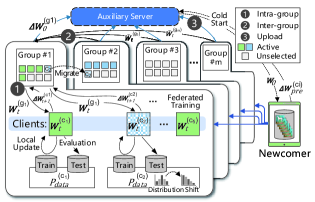
- Cluster clients using a novel data-driven measure, Euclidean distance of Decomposed Cosine similarity (EDC), to avoid high-dimensional concentration issues.
- Implement an auxiliary server to manage client cold starts, enabling efficient onboarding of new devices without retraining.
- Detect client-level data distribution shifts using the Wasserstein distance between local and group model distributions.
- Dynamically migrate clients between clusters based on distribution shift detection to maintain cluster coherence.
- Apply inter-group aggregation with a learnable inter-group learning rate (ηg) to enhance model generalization across clusters.
- Integrate a flexible clustering and migration pipeline that adapts to changing client data distributions during training.
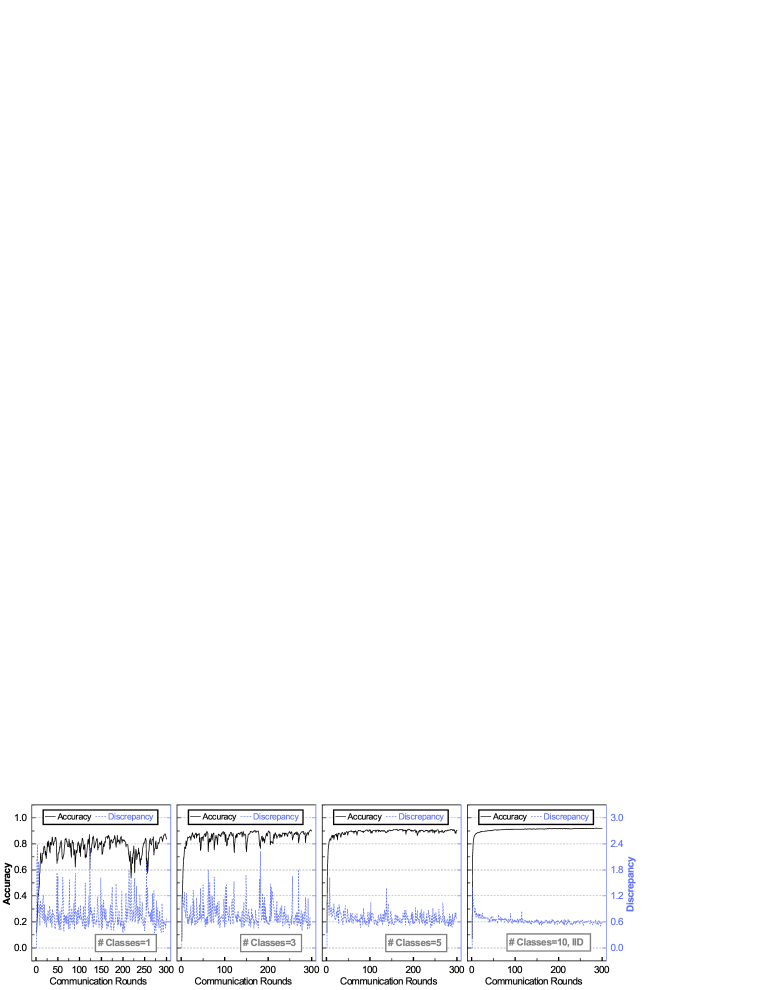
Experimental results
Research questions
- RQ1How can client clustering in federated learning be made robust to client-level data distribution shifts?
- RQ2What is an efficient and scalable method to handle newcomer devices in dynamic federated learning systems?
- RQ3Can dynamic client migration improve model accuracy under distribution shift while maintaining communication efficiency?
- RQ4How does inter-group aggregation with adaptive learning rates affect convergence and performance in clustered FL?
- RQ5To what extent does FlexCFL outperform existing FL frameworks like FedAvg, FedProx, and FeSEM under distribution shift?
Key findings
- FlexCFL achieves a +40.9% absolute improvement in top-1 test accuracy on FEMNIST compared to FedSEM, demonstrating superior performance under distribution shift.
- On FEMNIST, FlexCFL improves accuracy by +10.6% over FedAvg and +3.5% over FedProx, even under extreme data skew.
- The inter-group aggregation strategy with ηg = 5.0 boosts accuracy by +10.5% on FEMNIST in the swap part setting compared to FlexCFL without inter-group learning.
- FlexCFL achieves a 5.2% accuracy gain over FedAvg with only 1.26× the communication cost, outperforming IFCA-MIG, which requires 5.48× more communication for a 1.9% gain.
- In the swap all setting, FlexCFL improves accuracy by +2.2% on MNIST, +3.9% on FEMNIST, and +1.4% on FashionMNIST compared to FedAvg, showing resilience to distribution shifts.
- Ablation studies confirm that both the EDC clustering and client migration strategies are essential for performance gains, with the latter significantly improving robustness under distribution shift.
Read this paper
Open the full text in the Nubint reader and ask about any passage as you read.
Read this paper on NubintThis review was generated by AI from the original paper. Please check the paper before citing it.