
[Paper Review] Flocking to Mastodon: Tracking the Great Twitter Migration
This study tracks the migration of 136,009 Twitter users to Mastodon following Elon Musk’s acquisition, analyzing user distribution across instances, social network influence on migration choices, and cross-platform usage patterns. It reveals strong user-driven centralization on Mastodon (top 25% instances host 96% of users), yet smaller instances show higher user activity, and migrated users post largely different content on each platform, with only 1.53% identical posts.
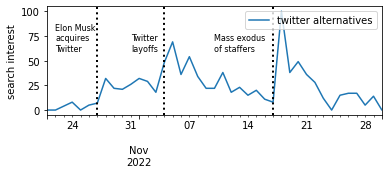
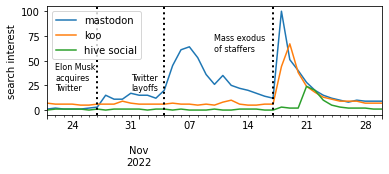
The acquisition of Twitter by Elon Musk has spurred controversy and uncertainty among Twitter users. The move raised as many praises as concerns, particularly regarding Musk's views on free speech. As a result, a large number of Twitter users have looked for alternatives to Twitter. Mastodon, a decentralized micro-blogging social network, has attracted the attention of many users and the general media. In this paper, we track and analyze the migration of 136,009 users from Twitter to Mastodon. Our analysis sheds light on the user-driven pressure towards centralization in a decentralized ecosystem and identifies the strong influence of the social network in platform migration. We also characterize the activity of migrated users on both Twitter and Mastodon.
Motivation & Objective
- To understand how users are distributed across Mastodon instances following the Twitter migration, assessing decentralization trends.
- To examine the role of users’ existing Twitter follower networks in influencing their choice of Mastodon instance.
- To characterize the content and behavioral patterns of migrated users on both Twitter and Mastodon.
- To evaluate differences in content toxicity and user engagement between the two platforms.
Proposed method
- Collected and analyzed migration data from 136,009 unique Twitter users who created accounts on Mastodon.
- Mapped users to 2,879 distinct Mastodon instances to study distribution and centrality.
- Tracked user activity on both platforms, including post frequency, content similarity, and toxicity levels.
- Used ActivityPub protocol metadata to identify cross-instance following behavior and federation patterns.
- Applied natural language processing to compare content similarity between Twitter and Mastodon posts (using Jaccard similarity).
- Measured toxicity using a pre-trained classifier on both platforms, comparing rates across migrated users.
Experimental results
Research questions
- RQ1How are new users distributed across Mastodon instances, and what are the implications for decentralization?
- RQ2To what extent does a user’s ego-centric Twitter follower network influence their choice of Mastodon instance?
- RQ3What are the usage patterns of migrated users on both Twitter and Mastodon, particularly in terms of content and engagement?
Key findings
- The top 25% of Mastodon instances by size hosted 96% of the migrated users, indicating strong user-driven centralization pressure.
- Despite centralization in user distribution, smaller instances (especially single-user instances) had 121% higher average post frequency than larger ones.
- On average, only 1.53% of a user’s Mastodon posts were identical to their Twitter posts, indicating distinct content strategies across platforms.
- Toxicity levels were low on both platforms: 5.49% of tweets and 2.80% of Mastodon statuses posted by migrated users were classified as toxic.
- 14.72% of a user’s Twitter followees migrated to the same Mastodon instance, showing a significant social network influence on instance choice.
- 14.26% of migrated users posted at least one toxic status on both platforms, suggesting some continuity in behavior despite platform differences.
Read this paper
Open the full text in the Nubint reader and ask about any passage as you read.
Read this paper on NubintThis review was generated by AI from the original paper. Please check the paper before citing it.