
[Paper Review] Flow-induced nonequilibrium self-assembly in suspensions of stiff, apolar, active filaments
This study reveals a nonequilibrium self-assembly mechanism in suspensions of stiff, apolar, active filaments driven by hydrodynamic flows. Extensile filaments form ballistically translating and rotating clusters via lateral attraction, while contractile filaments develop volume fraction-dependent microstructures—asters, clusters, and incipient gels—through diffusive, non-thermal motion, demonstrating a generic pathway for hierarchical active matter assembly beyond equilibrium thermodynamics.
Active bodies in viscous fluids interact hydrodynamically through self-generated flows. Here we study spontaneous aggregation induced by hydrodynamic flow in a suspension of stiff, apolar, active filaments. Lateral hydrodynamic attractions in extensile filaments lead, independent of volume fraction, to anisotropic aggregates which translate and rotate ballistically. Lateral hydrodynamic repulsion in contractile filaments lead, with increasing volume fractions, to microstructured states of asters, clusters, and incipient gels where, in each case, filament motion is diffusive. Our results demonstrate that the interplay of active hydrodynamic flows and anisotropic excluded volume interactions provides a generic nonequilibrium mechanism for hierarchical self-assembly of active soft matter.
Motivation & Objective
- To understand how hydrodynamic flows from active, apolar filaments induce nonequilibrium self-assembly without thermal fluctuations.
- To investigate the role of anisotropic excluded volume and flow symmetry (extensile vs. contractile) in determining collective filament dynamics.
- To identify distinct microstructural states in contractile filament suspensions as a function of volume fraction.
- To demonstrate that collective motion arises from broken time-reversal symmetry in internal, active flows, not external forces.
- To provide a particle-level model that captures short-wavelength hydrodynamic effects beyond continuum theories.
Proposed method
- Model individual stiff, apolar filaments as rigid chains of active beads generating force-free, torque-free stresslet flows.
- Use the irreducible stresslet approximation to represent the dominant, long-ranged hydrodynamic flow field of each filament.
- Simulate suspensions with explicit hydrodynamic and excluded volume interactions, resolving near-field dynamics.
- Track filament positions, orientations, and center-of-mass motion to quantify diffusion and clustering kinetics.
- Compute stationary k-mer distributions P*(k) to classify microstructural states across volume fractions.
- Analyze mean square displacement to distinguish diffusive motion from ballistic dynamics in different regimes.
Experimental results
Research questions
- RQ1How do extensile and contractile active filaments self-assemble under hydrodynamic flow, and what drives their distinct dynamics?
- RQ2What role does excluded volume anisotropy play in stabilizing or destabilizing filament aggregates?
- RQ3How does volume fraction govern the transition from asters to clusters to incipient gels in contractile suspensions?
- RQ4Can non-thermal, diffusive motion emerge in active systems without thermal noise, and how does its diffusion constant scale with concentration?
- RQ5Why do extensile filaments form stable, ballistically moving clusters while contractile filaments remain isotropic yet microstructured?
Key findings
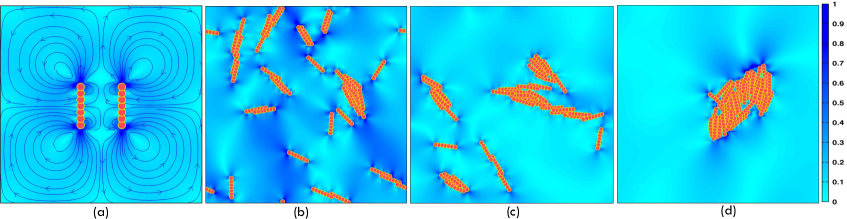
- Extensile filaments spontaneously form stable, rotating dimers due to lateral hydrodynamic attraction, leading to rapid dimerization and subsequent coagulation into large, ballistically translating clusters.
- Contractile filaments exhibit volume fraction-dependent microstructures: asters at φ = 0.05–0.15, clusters at φ = 0.21–0.24, and incipient gels at φ = 0.34, with a sharp transition near φ = 0.3.
- The mean square displacement of filament centers increases linearly with time in all microstructured states, confirming non-thermal, diffusive motion with a diffusion constant D that decreases with increasing volume fraction.
- The diffusion constant D does not follow the Stokes-Einstein relation, as it arises from active, nonequilibrium forces rather than thermal agitation.
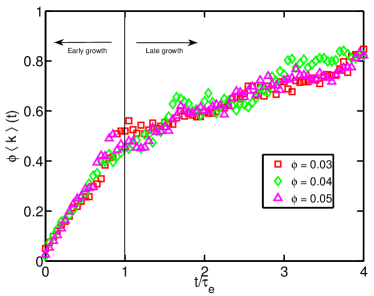
- The system exhibits a two-step aggregation kinetics in extensile suspensions: fast initial cluster growth followed by slow merging into large dynamic aggregates.
- The absence of Onsager symmetry in the mobility matrix enables relative motion between filaments, allowing collective, nonequilibrium dynamics unattainable in passive systems.
Read this paper
Open the full text in the Nubint reader and ask about any passage as you read.
Read this paper on NubintThis review was generated by AI from the original paper. Please check the paper before citing it.