
[Paper Review] FOCAL: Contrastive Learning for Multimodal Time-Series Sensing Signals in Factorized Orthogonal Latent Space
FOCAL introduces a self-supervised contrastive framework that learns both shared and private modality-specific features in a factorized orthogonal latent space for multimodal time-series data, with a temporal locality constraint to improve representations and downstream tasks.
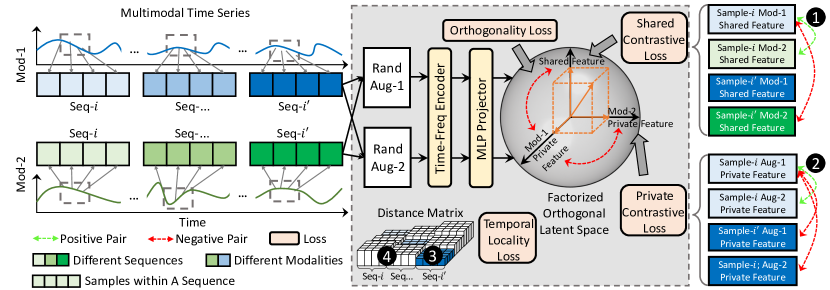
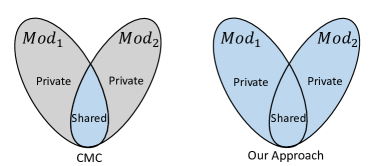
This paper proposes a novel contrastive learning framework, called FOCAL, for extracting comprehensive features from multimodal time-series sensing signals through self-supervised training. Existing multimodal contrastive frameworks mostly rely on the shared information between sensory modalities, but do not explicitly consider the exclusive modality information that could be critical to understanding the underlying sensing physics. Besides, contrastive frameworks for time series have not handled the temporal information locality appropriately. FOCAL solves these challenges by making the following contributions: First, given multimodal time series, it encodes each modality into a factorized latent space consisting of shared features and private features that are orthogonal to each other. The shared space emphasizes feature patterns consistent across sensory modalities through a modal-matching objective. In contrast, the private space extracts modality-exclusive information through a transformation-invariant objective. Second, we propose a temporal structural constraint for modality features, such that the average distance between temporally neighboring samples is no larger than that of temporally distant samples. Extensive evaluations are performed on four multimodal sensing datasets with two backbone encoders and two classifiers to demonstrate the superiority of FOCAL. It consistently outperforms the state-of-the-art baselines in downstream tasks with a clear margin, under different ratios of available labels. The code and self-collected dataset are available at https://github.com/tomoyoshki/focal.
Motivation & Objective
- Motivate multimodal time-series representation learning by leveraging both shared and modality-exclusive information.
- Develop a factorized orthogonal latent space to separate shared vs. private modality features.
- Introduce a temporal locality constraint to respect time-series structure during pretraining.
- Propose concrete loss terms for shared, private, orthogonality, and temporal constraints.
- Demonstrate improved downstream performance across multiple datasets and backbones.
Proposed method
- Encode each modality into a factorized latent space with shared and private components.
- Apply modality-wise and cross-modality contrastive losses in shared and private spaces (InfoNCE in shared space; NT-Xent in private space).
- Enforce orthogonality between shared and private components and across private spaces of different modalities.
- Impose a temporal locality constraint: average intra-sequence distance <= average inter-sequence distance during pretraining.
- Train with random augmentations per modality and within-batch contrastive comparisons without memory banks.
Experimental results
Research questions
- RQ1How can multimodal time-series representations be enriched by explicitly modeling modality-shared and modality-private information?
- RQ2Does enforcing orthogonality between shared/private spaces improve downstream discrimination for multimodal sensing?
- RQ3Can a temporal locality constraint better respect time-series structure during self-supervised pretraining?
- RQ4What is the impact of FOCAL’s components on downstream classification and clustering tasks across diverse datasets?
- RQ5Is FOCAL robust to label scarcity and transferable across backbone encoders?
Key findings
- FOCAL consistently outperforms 11 baselines across four multimodal datasets and two backbones for linear-probing and KNN finetuning.
- Private-space and orthogonality constraints yield notable gains over using only shared information.
- Temporal locality constraint accelerates convergence and improves semantic structure during pretraining.
- Temporal constraint acts as a plugin improving several baselines beyond FOCAL’s own framework.
- Ablation shows removing private space or orthogonality degrades performance; temporal constraint provides additional gains.
Read this paper
Open the full text in the Nubint reader and ask about any passage as you read.
Read this paper on NubintThis review was generated by AI from the original paper. Please check the paper before citing it.