
[Paper Review] Forecasting Workload in Cloud Computing: Towards Uncertainty-Aware Predictions and Transfer Learning
This paper proposes univariate and bivariate Bayesian deep learning models—HBNN and LSTMD—for uncertainty-aware workload forecasting in cloud computing. By modeling both aleatoric and epistemic uncertainty, the models improve service-level metrics through confidence-based resource allocation, with transfer learning showing success only when source domains are large and similar to the target.
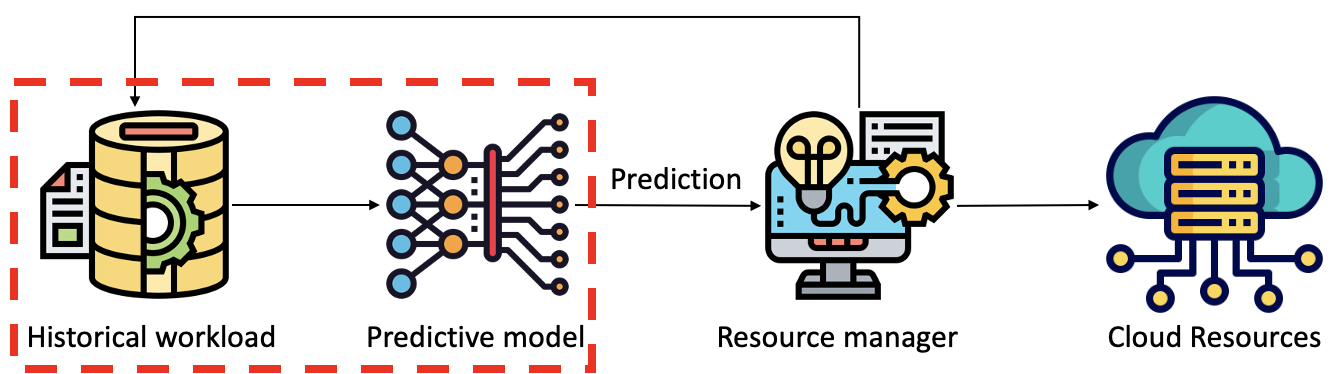
Predicting future resource demand in Cloud Computing is essential for optimizing the trade-off between serving customers' requests efficiently and minimizing the provisioning cost. Modelling prediction uncertainty is also desirable to better inform the resource decision-making process, but research in this field is under-investigated. In this paper, we propose univariate and bivariate Bayesian deep learning models that provide predictions of future workload demand and its uncertainty. We run extensive experiments on Google and Alibaba clusters, where we first train our models with datasets from different cloud providers and compare them with LSTM-based baselines. Results show that modelling the uncertainty of predictions has a positive impact on performance, especially on service level metrics, because uncertainty quantification can be tailored to desired target service levels that are critical in cloud applications. Moreover, we investigate whether our models benefit transfer learning capabilities across different domains, i.e. dataset distributions. Experiments on the same workload datasets reveal that acceptable transfer learning performance can be achieved within the same provider (because distributions are more similar). Also, domain knowledge does not transfer when the source and target domains are very different (e.g. from different providers), but this performance degradation can be mitigated by increasing the training set size of the source domain.
Motivation & Objective
- To develop uncertainty-aware workload forecasting models that capture both aleatoric and epistemic uncertainty in cloud resource demand predictions.
- To evaluate the performance of univariate and bivariate Bayesian neural networks (HBNN) and probabilistic LSTMs (LSTMD) on real-world cloud datasets from Google and Alibaba.
- To investigate transfer learning capabilities of uncertainty-aware models across different cloud provider datasets, especially in low-data or out-of-distribution scenarios.
- To assess whether uncertainty quantification improves cloud service-level metrics by enabling confidence-tailored resource allocation strategies.
- To determine the conditions under which transfer learning succeeds or fails in workload forecasting, particularly regarding domain similarity and source dataset size.
Proposed method
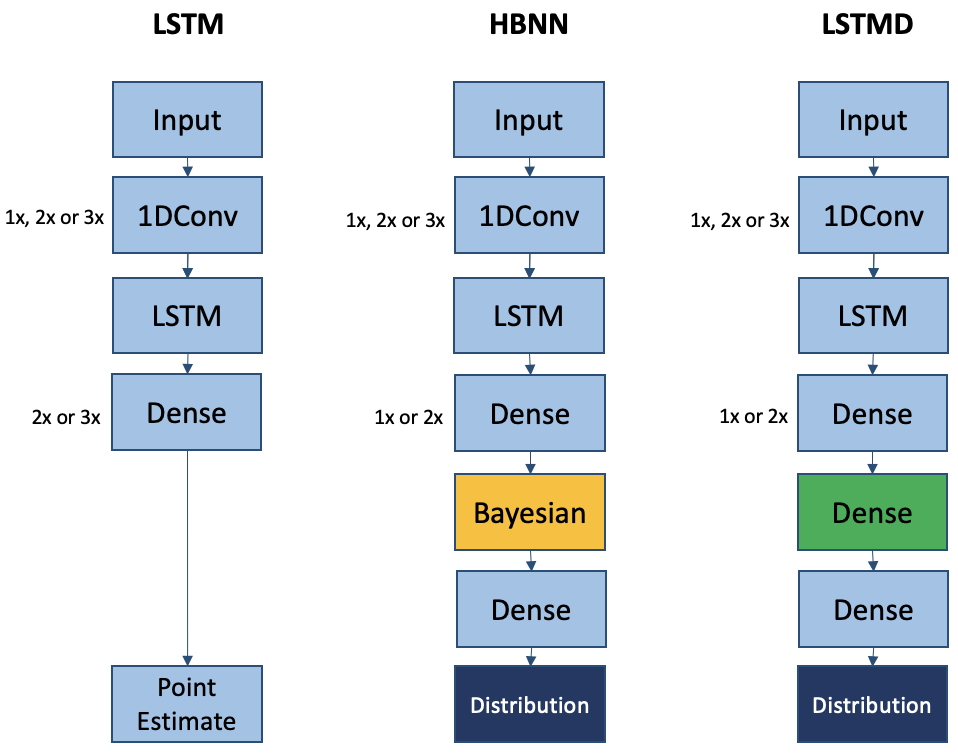
- Adapted Bayesian Neural Network (HBNN) and Probabilistic LSTM (LSTMD) architectures to predict joint distributions of CPU/GPU and memory usage, enabling uncertainty estimation.
- Enhanced model capacity by adding layers to improve representation learning on larger and bivariate training data, improving generalization.
- Trained models on multi-provider datasets (Google and Alibaba) to assess transfer learning performance in zero-shot and fine-tuning scenarios.
- Used confidence-based prediction intervals tailored to desired service levels, evaluating performance via service-level metrics rather than point-wise accuracy.
- Evaluated transfer learning by training on source domains (e.g., Google) and testing on target domains (e.g., Alibaba), measuring performance degradation with increasing domain divergence.
- Employed non-symmetrical loss functions and posterior approximation techniques to improve uncertainty estimation robustness.
Experimental results
Research questions
- RQ1Can uncertainty-aware deep learning models improve cloud workload forecasting performance beyond point estimates, especially in terms of service-level metrics?
- RQ2How does modeling both aleatoric and epistemic uncertainty impact prediction reliability and resource allocation decisions in cloud environments?
- RQ3Under what conditions does transfer learning succeed when transferring workload forecasting knowledge across different cloud providers or data distributions?
- RQ4Does increasing the size of the source domain mitigate performance degradation when transferring to a very different target domain?
- RQ5Can uncertainty-aware models be effectively deployed in real-world cloud systems with acceptable inference latency and scalability?
Key findings
- Modeling uncertainty significantly improves service-level metrics by enabling confidence-based resource allocation, even when point-wise accuracy metrics show no clear advantage.
- The bivariate HBNN trained on multiple datasets (M-B-HBNN) achieves the best trade-off between performance and deployment complexity.
- Transfer learning performance degrades substantially when source and target domains are from different cloud providers, especially with small source datasets.
- Fine-tuning does not consistently improve transfer performance, and knowledge transfer fails when source and target domains are too dissimilar.
- Acceptable transfer learning performance is achievable only when the source domain is large and sufficiently representative of the target domain’s diversity.
- The runtime of all models is efficient enough to support real-time deployment in production cloud environments.
Read this paper
Open the full text in the Nubint reader and ask about any passage as you read.
Read this paper on NubintThis review was generated by AI from the original paper. Please check the paper before citing it.