
[Paper Review] Foundation Models for Decision Making: Problems, Methods, and Opportunities
The paper surveys how foundation models can be adapted for decision making, outlining generative modeling, representation learning, and interactive agent paradigms, with open challenges and opportunities at the intersection of foundation models and sequential decision making.
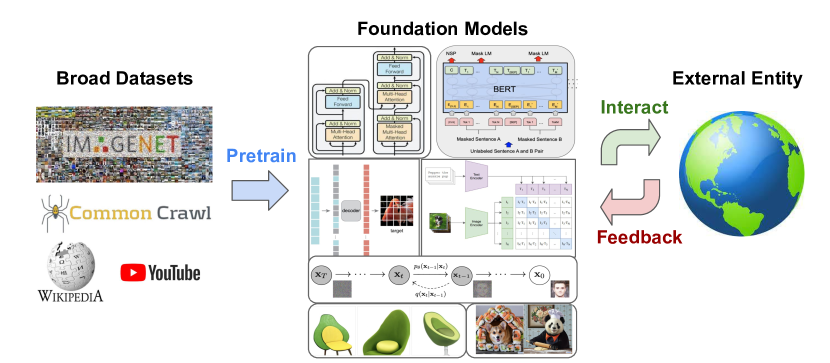
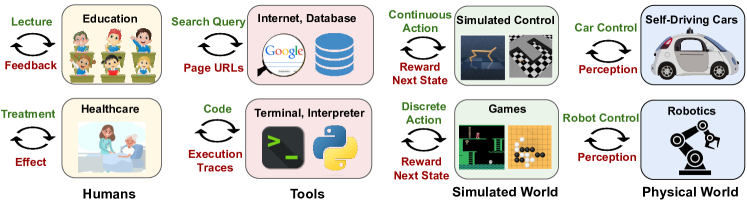
Foundation models pretrained on diverse data at scale have demonstrated extraordinary capabilities in a wide range of vision and language tasks. When such models are deployed in real world environments, they inevitably interface with other entities and agents. For example, language models are often used to interact with human beings through dialogue, and visual perception models are used to autonomously navigate neighborhood streets. In response to these developments, new paradigms are emerging for training foundation models to interact with other agents and perform long-term reasoning. These paradigms leverage the existence of ever-larger datasets curated for multimodal, multitask, and generalist interaction. Research at the intersection of foundation models and decision making holds tremendous promise for creating powerful new systems that can interact effectively across a diverse range of applications such as dialogue, autonomous driving, healthcare, education, and robotics. In this manuscript, we examine the scope of foundation models for decision making, and provide conceptual tools and technical background for understanding the problem space and exploring new research directions. We review recent approaches that ground foundation models in practical decision making applications through a variety of methods such as prompting, conditional generative modeling, planning, optimal control, and reinforcement learning, and discuss common challenges and open problems in the field.
Motivation & Objective
- Explain the scope and motivation for integrating foundation models with sequential decision making.
- Provide a technical framework and tools for understanding how foundation models can act as generative models of behavior and the world.
- Explore how foundation models can serve as representation learners for decision-making components.
- Discuss how language models can operate as agents and environments for interactive tasks.
- Identify open problems and opportunities to guide future research at this intersection.
Proposed method
- Review sequential decision making preliminaries including MDPs, RL, imitation learning, planning, and optimal control.
- Describe generative model families (latent variable, autoregressive, diffusion, energy-based) and their relevance to decision making.
- Explain how foundation models can be used as behavioral priors and as models of the environment.
- Discuss plug-and-play representations and language-augmented task specification for sequential decision making.
- Outline approaches where large language models act as agents, environments, or tools in interactive settings.
Experimental results
Research questions
- RQ1How can foundation models be grounded and adapted to interact with external entities in decision-making tasks?
- RQ2What are the core generative modeling approaches that enable foundation models to represent behaviors and world dynamics for sequential decision making?
- RQ3How can foundation models serve as representation learners for states, actions, rewards, and transitions in MDPs?
- RQ4What are the challenges and opportunities in using language models as agents, environments, and tool users in interactive tasks?
Key findings
- Foundation models offer behavioral priors and generalized policies by modeling diverse sequences of actions and goals.
- Generative modeling of world dynamics enables model-based planning and long-horizon reasoning in decision tasks.
- Large-scale behavior data and online interaction can scale generalist agents beyond task-specific policies.
- Representation learning with foundation models supports plug-and-play adaptation and cross-modal task specification.
- Language models can interact with humans and tools, functioning as agents and environments in sequential decision problems.
Read this paper
Open the full text in the Nubint reader and ask about any passage as you read.
Read this paper on NubintThis review was generated by AI from the original paper. Please check the paper before citing it.