
[Paper Review] FoundationPose-TensorRT
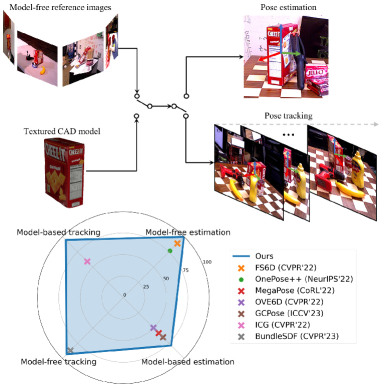
FoundationPose is a unified foundation model for 6D pose estimation and tracking of novel objects, usable in both model-based and model-free setups, with a neural implicit representation and large-scale synthetic data to enable test-time generalization without fine-tuning.
TensorRT-accelerated 6DoF object pose estimation and tracking based on FoundationPose. Given an RGB-D image, a 3D mesh of the object, and an initial segmentation mask, the model estimates the object pose and tracks it across subsequent frames. Credits The core inference code is derived from tao-toolkit-triton-apps, with the heavy Triton Inference Server dependencies removed and replaced by a direct TensorRT backend. The ONNX models are provided by isaac_ros_foundationpose. Setup 1. CUDA and TensorRT dependencies Install CUDA 12.4 + cuDNN 9.8 and TensorRT 10.9.0 into a local `deps/` folder: source scripts/deps.shactivate_deps This downloads and installs the dependencies locally - no system-wide installation required. The environment variables (`CUDA_HOME`, `TENSORRT_HOME`, `PATH`, `LD_LIBRARY_PATH`) are only active in the current shell session. Run `deactivate_deps` to restore the original environment. To use a different CUDA or TensorRT version, edit `scripts/deps.sh`. Make sure the PyTorch CUDA version matches (see step 2). 2. Python environment Create and activate a Python environment, e.g. with conda: conda create --name fp_tensorrt python=3.10conda activate fp_tensorrt Then install all Python dependencies (requires `activate_deps` to be active): source scripts/deps.sh && activate_depsbash scripts/setup.sh This installs PyTorch 2.5.0 (CUDA 12.4), nvdiffrast, pytorch3d, TensorRT Python bindings, and other required packages. 3. Model compilation Download the ONNX models from NVIDIA NGC and compile them into TensorRT engine files: bash scripts/convert_onnx.sh This produces weights/tensorrt/refiner_cs252.plan and weights/tensorrt/scorer_cs252.plan. chunk_size variable inside convert_onnx.sh controls the maximum batch size of the TensorRT engines (default: 252). A smaller value reduces VRAM usage, which is useful when tracking multiple objects simultaneously or on memory-constrained GPUs. To change it, edit the chunk_size variable before running and use the matching value in FoundationPoseWrapperConfig. Usage Demo Run the benchmark on the YCB mustard bottle sequence (demo data is downloaded automatically): source scripts/deps.sh && activate_depspython demo.py This runs initial pose estimation on the first frame and tracks the object across the remaining frames, printing per-frame poses and mean inference times. Python API from foundationpose_tensorrt import FoundationPoseWrapper, FoundationPoseWrapperConfig cfg = FoundationPoseWrapperConfig( downsample_width=None, # Set e.g. to 256 for faster inference at lower accuracy est_refine_iter=5, # Refinement iterations for initial pose estimation track_refine_iter=2, # Refinement iterations for tracking chunk_size=252, # Must match the `chunk_size` of the compiled TensorRT engine)wrapper = FoundationPoseWrapper(cfg=cfg) # Set camera intrinsics (3x3 numpy array)wrapper.set_camera_intrinsics(K) # Load object meshmesh = FoundationPoseWrapper.load_mesh("path/to/mesh.obj") # --- First frame ---wrapper.reset_scene(color, depth) # color: (H,W,3) uint8, depth: (H,W) float32 in meterspose = wrapper.add_object("object_name", mesh, mask) # mask: (H,W) bool # --- Subsequent frames ---poses = wrapper.step_scene(color, depth) # returns dict[name -> (4,4) numpy array] # Visualizevis = wrapper.render_results() # returns BGR image with projected bounding box and axes Poses are returned as 4x4 homogeneous transformation matrices (object-in-camera frame). Project structure scripts/ deps.sh # Install/activate CUDA, cuDNN, TensorRT locally setup.sh # Install Python dependencies convert_onnx.sh # Download ONNX models and compile to TensorRTsrc/foundationpose_tensorrt/ wrapper.py # High-level FoundationPoseWrapper API model.py # TensorRT engine wrapper and FoundationposeModel postprocessor.py # Rendering, cropping, and pose utilitiesweights/ onnx/ # Downloaded ONNX models tensorrt/ # Compiled TensorRT .plan filesdemo.py # Benchmark on YCB mustard data
Motivation & Objective
- Motivate robust 6D pose estimation and tracking of unseen objects across diverse scenarios.
- Develop a single framework that supports both model-based and model-free test-time setups for novel objects.
- Achieve strong generalization through synthetic data generation, large-scale training, and a unified architectural design.
- Bridge model-based and model-free gaps via a neural implicit object representation enabling novel view synthesis.
Proposed method
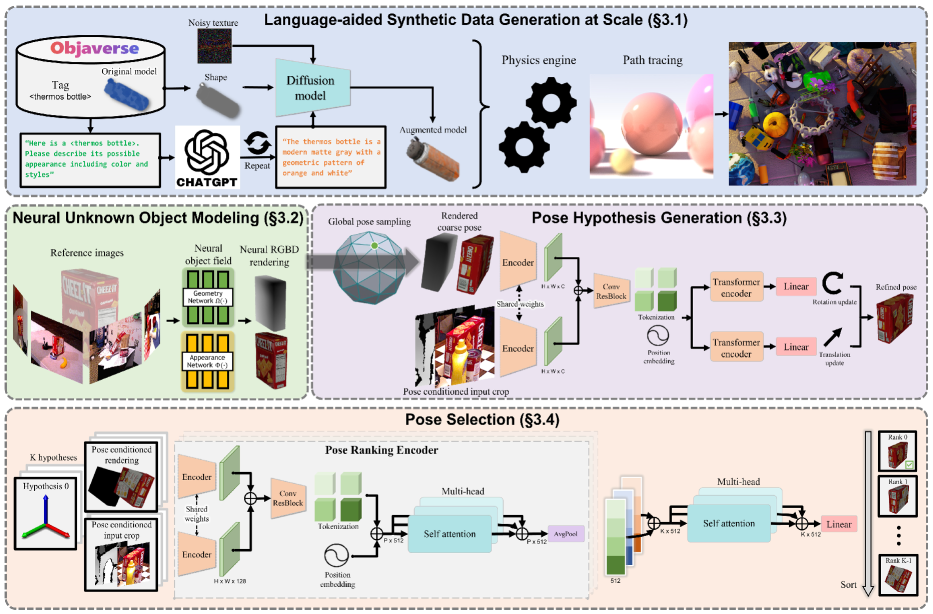
- Introduce an object-centric neural implicit (SDF-based) object field for RGBD rendering.
- Use LLM- and diffusion-assisted texture augmentation to diversify synthetic textures.
- Train a transformer-based pose refinement network that updates coarse pose hypotheses from rendered views.
- Implement a pose selection module with hierarchical pose comparison and contrastive ranking loss.
- Perform test-time inference with a small set of reference views to render and evaluate pose hypotheses.
- Provide model-agnostic rendering that serves as a drop-in replacement for traditional graphics pipelines.
Experimental results
Research questions
- RQ1Can a single unified framework perform 6D pose estimation and tracking for novel objects under both model-based and model-free setups?
- RQ2Does a neural implicit object representation enable effective novel view synthesis and robust pose estimation across diverse objects and textures?
- RQ3How far can synthetic data, aided by LLMs and diffusion models, generalize to unseen objects without fine-tuning?
- RQ4What benefits do hierarchical pose comparison and contrastive ranking provide for selecting accurate poses?
Key findings
- The proposed FoundationPose framework outperforms existing methods that are specialized for each task (pose estimation or tracking, model-based or model-free).
- The approach achieves competitive results with instance-level methods while operating under reduced assumptions (no fine-tuning on novel objects).
- A neural object field enables efficient RGBD rendering and effective pose hypothesis evaluation, bridging model-based and model-free setups.
- LLM- and diffusion-assisted texture augmentation significantly enhances data diversity for synthetic training, improving generalization.
- A pose refinement network with pose-conditioned cropping and a hierarchical pose ranking module yields accurate final poses without per-object fine-tuning.
Read this paper
Open the full text in the Nubint reader and ask about any passage as you read.
Read this paper on NubintThis review was generated by AI from the original paper. Please check the paper before citing it.