
[Paper Review] Fourier-Net+: Leveraging Band-Limited Representation for Efficient 3D Medical Image Registration
Fourier-Net+ introduces a band-limited Fourier representation to drastically reduce computational and memory costs in 3D medical image registration while maintaining state-of-the-art accuracy. By learning low-dimensional displacement fields in the Fourier domain and using a model-driven decoder, it achieves 9.05× faster inference and 0.35% of the multiply-add operations of prior models on 3D-CMR data.
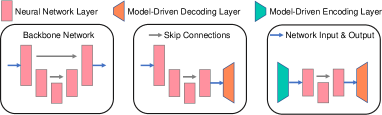
U-Net style networks are commonly utilized in unsupervised image registration to predict dense displacement fields, which for high-resolution volumetric image data is a resource-intensive and time-consuming task. To tackle this challenge, we first propose Fourier-Net, which replaces the costly U-Net style expansive path with a parameter-free model-driven decoder. Instead of directly predicting a full-resolution displacement field, our Fourier-Net learns a low-dimensional representation of the displacement field in the band-limited Fourier domain which our model-driven decoder converts to a full-resolution displacement field in the spatial domain. Expanding upon Fourier-Net, we then introduce Fourier-Net+, which additionally takes the band-limited spatial representation of the images as input and further reduces the number of convolutional layers in the U-Net style network's contracting path. Finally, to enhance the registration performance, we propose a cascaded version of Fourier-Net+. We evaluate our proposed methods on three datasets, on which our proposed Fourier-Net and its variants achieve comparable results with current state-of-the art methods, while exhibiting faster inference speeds, lower memory footprint, and fewer multiply-add operations. With such small computational cost, our Fourier-Net+ enables the efficient training of large-scale 3D registration on low-VRAM GPUs. Our code is publicly available at \url{https://github.com/xi-jia/Fourier-Net}.
Motivation & Objective
- Address the high computational and memory demands of U-Net-based 3D medical image registration on high-resolution volumetric data.
- Reduce network parameters, memory usage, and FLOPs in deep learning-based registration by leveraging spectral domain representations.
- Improve inference speed and scalability for training on low-VRAM GPUs without sacrificing registration accuracy.
- Enhance performance through a cascaded architecture and by using band-limited spatial representations as input to the U-Net encoder.
Proposed method
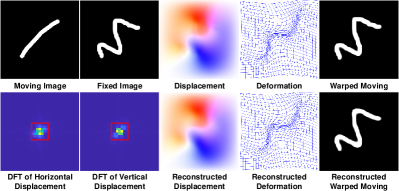
- Replace the U-Net's expansive path with a parameter-free, model-driven decoder that reconstructs full-resolution displacement fields from band-limited Fourier coefficients.
- Learn a low-dimensional representation of the displacement field in the Fourier domain, reducing the number of parameters and operations.
- Introduce Fourier-Net+, which uses band-limited spatial representations as input to the U-Net’s contracting path, further reducing convolutional layers and computational cost.
- Apply a cascaded architecture to refine registration accuracy by stacking multiple Fourier-Net+ stages with progressive refinement.
- Use discrete Fourier transforms (DFT) to project displacement fields into the frequency domain and reconstruct them via inverse DFT after decoding.
- Enforce band-limited constraints by restricting the Fourier coefficients to a low-frequency region, preserving essential deformation information while discarding high-frequency noise.
Experimental results
Research questions
- RQ1Can a band-limited Fourier representation of displacement fields reduce the computational and memory footprint of 3D medical image registration?
- RQ2Does replacing the U-Net’s decoder with a model-driven, parameter-free alternative preserve registration accuracy while improving efficiency?
- RQ3Can using band-limited spatial representations as input to the U-Net encoder further reduce FLOPs and memory usage?
- RQ4How does the cascaded Fourier-Net+ architecture improve registration performance compared to single-stage baselines?
- RQ5To what extent can Fourier-Net+ enable training on low-VRAM GPUs without compromising accuracy or speed?
Key findings
- On the 3D-CMR dataset, Fourier-Net+ achieved 7.1% and 7.5% higher Dice scores than TransMorph and LKU-Net, respectively.
- Fourier-Net+ was 9.05× faster than TransMorph and 4.42× faster than LKU-Net in inference speed on the 3D-CMR dataset.
- Fourier-Net+ used only 0.35% of the multiply-add operations and 2.07% of the memory usage of TransMorph on the 3D-CMR dataset.
- The model achieved comparable or better registration accuracy than state-of-the-art methods across two brain MRI and one cardiac MRI dataset.
- The cascaded Fourier-Net+ variant further improved Dice scores by 0.5–1.0% on average compared to single-stage versions.
- Fourier-Net+ enabled training on low-VRAM GPUs (e.g., 16GB) with minimal memory overhead, making large-scale 3D registration feasible on standard hardware.
Read this paper
Open the full text in the Nubint reader and ask about any passage as you read.
Read this paper on NubintThis review was generated by AI from the original paper. Please check the paper before citing it.