
[Paper Review] FourierGNN: Rethinking Multivariate Time Series Forecasting from a Pure Graph Perspective
FourierGNN reframes multivariate time series forecasting as predictions on a hypervariate graph and uses a Fourier Graph Operator to perform convolutions in Fourier space, achieving state-of-the-art accuracy with lower complexity.
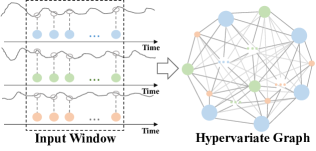
Multivariate time series (MTS) forecasting has shown great importance in numerous industries. Current state-of-the-art graph neural network (GNN)-based forecasting methods usually require both graph networks (e.g., GCN) and temporal networks (e.g., LSTM) to capture inter-series (spatial) dynamics and intra-series (temporal) dependencies, respectively. However, the uncertain compatibility of the two networks puts an extra burden on handcrafted model designs. Moreover, the separate spatial and temporal modeling naturally violates the unified spatiotemporal inter-dependencies in real world, which largely hinders the forecasting performance. To overcome these problems, we explore an interesting direction of directly applying graph networks and rethink MTS forecasting from a pure graph perspective. We first define a novel data structure, hypervariate graph, which regards each series value (regardless of variates or timestamps) as a graph node, and represents sliding windows as space-time fully-connected graphs. This perspective considers spatiotemporal dynamics unitedly and reformulates classic MTS forecasting into the predictions on hypervariate graphs. Then, we propose a novel architecture Fourier Graph Neural Network (FourierGNN) by stacking our proposed Fourier Graph Operator (FGO) to perform matrix multiplications in Fourier space. FourierGNN accommodates adequate expressiveness and achieves much lower complexity, which can effectively and efficiently accomplish the forecasting. Besides, our theoretical analysis reveals FGO's equivalence to graph convolutions in the time domain, which further verifies the validity of FourierGNN. Extensive experiments on seven datasets have demonstrated our superior performance with higher efficiency and fewer parameters compared with state-of-the-art methods.
Motivation & Objective
- Motivate forecasting with a unified spatiotemporal perspective that avoids mismatches between separate spatial/temporal networks.
- Propose a hypervariate graph data structure to represent all values across variates and timestamps as graph nodes.
- Develop FourierGNN with a Fourier Graph Operator to perform graph computations in Fourier space for efficiency.
- Theoretically analyze FourierGNN to establish equivalence with time-domain graph convolutions and demonstrate efficiency gains.
- Demonstrate strong empirical performance across seven real-world datasets with fewer parameters and faster training.
Proposed method
- Define a hypervariate graph where each element of the input window X_t in R^{N×T} is a graph node, resulting in a fully-connected NT-node graph.
- Introduce the Fourier Graph Operator (FGO) that computes kernel-weighted convolutions in Fourier space, enabling O(n log n) operations.
- Stack multiple FGOs to form FourierGNN, with outputs computed in Fourier space and transformed back to time domain via IDFT.
- Prove that FourierGNN’s recursive Fourier-space multiplications are equivalent to multi-order time-domain graph convolutions (Proposition 1).
- Instantiate FourierGNN for MTS forecasting by embedding nodes, applying DFT, performing FGOs, and projecting to future steps with fully-connected layers.
- Highlight efficiency by contrasting Fourier-domain computations with time-domain graph convolutions, achieving lower computational complexity.
Experimental results
Research questions
- RQ1Can a pure graph-based model capture both inter-series (spatial) and intra-series (temporal) dependencies without temporal networks?
- RQ2Does representing MTS data as a hypervariate graph enable more accurate and efficient forecasting than traditional two-network designs?
- RQ3Is the Fourier Graph Operator equivalent to time-domain graph convolutions, and does it offer practical complexity benefits?
- RQ4Can FourierGNN achieve state-of-the-art forecasting performance across diverse real-world datasets while using fewer parameters?
Key findings
- FourierGNN achieves state-of-the-art results across seven real-world datasets.
- On average, FourierGNN improves MAE by more than 9.4% and RMSE by more than 10.9% over best baselines.
- FourierGNN requires about 14.6% less training time and 20% fewer parameters than many lightweight GNN baselines.
- The model exhibits higher efficiency and scalability due to log-linear complexity in graph operations.
- Ablation studies show the importance of node embedding and multi-order diffusion for performance gains.
- Visualization indicates FourierGNN learns meaningful temporal and spatial dependencies reflected in learned adjacency patterns.

Read this paper
Open the full text in the Nubint reader and ask about any passage as you read.
Read this paper on NubintThis review was generated by AI from the original paper. Please check the paper before citing it.