
[Paper Review] Framelet Message Passing
This paper proposes Framelet Message Passing (FMP), a novel graph neural network framework that leverages multiscale framelet transforms to enable stable, non-oversmoothing message passing across multi-hop neighborhoods in a single layer. By integrating framelet coefficients from diverse scales and using neural ODEs for continuous message passing, FMP achieves state-of-the-art performance on node classification with low computational cost and provable stability.
Graph neural networks (GNNs) have achieved champion in wide applications. Neural message passing is a typical key module for feature propagation by aggregating neighboring features. In this work, we propose a new message passing based on multiscale framelet transforms, called Framelet Message Passing. Different from traditional spatial methods, it integrates framelet representation of neighbor nodes from multiple hops away in node message update. We also propose a continuous message passing using neural ODE solvers. It turns both discrete and continuous cases can provably achieve network stability and limit oversmoothing due to the multiscale property of framelets. Numerical experiments on real graph datasets show that the continuous version of the framelet message passing significantly outperforms existing methods when learning heterogeneous graphs and achieves state-of-the-art performance on classic node classification tasks with low computational costs.
Motivation & Objective
- Address the oversmoothing problem in deep graph neural networks caused by repeated spatial message passing.
- Overcome the limitation of traditional spatial and spectral GNNs in preserving multi-scale structural and feature information.
- Develop a message passing mechanism that integrates long-range neighborhood information efficiently without depth-related performance degradation.
- Ensure stability against input perturbations through framelet-based signal decomposition and controlled variance across scales.
- Achieve state-of-the-art performance on node classification tasks with reduced computational cost compared to existing methods.
Proposed method
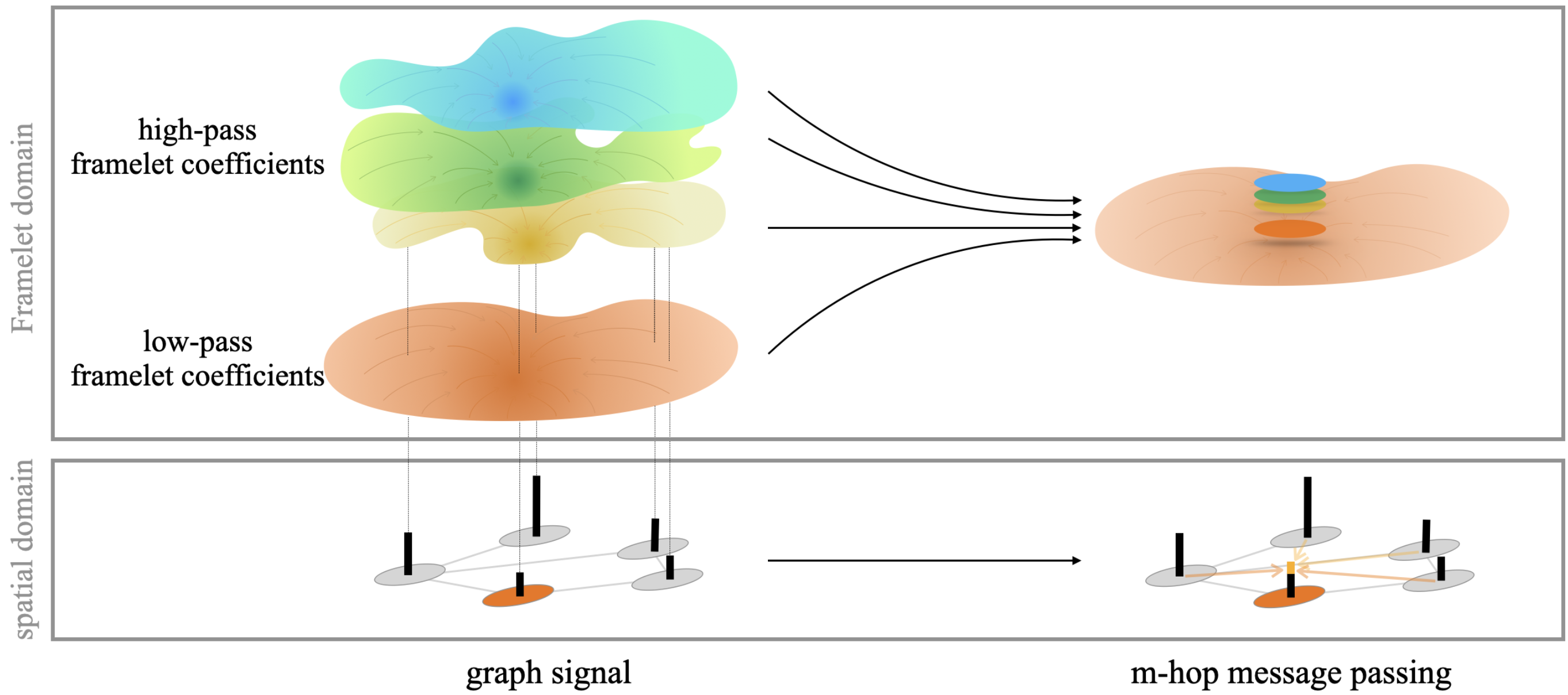
- Introduce graph framelet transforms to decompose node signals into multi-scale coefficients using undecimated framelet systems, preserving both low-pass (smooth) and high-pass (detailed) information.
- Design Framelet Message Passing (FMP) where each node aggregates features from its m-hop neighbors using framelet coefficients at the same scale, enabling multi-hop information integration in a single layer.
- Formulate continuous message passing via neural ODE solvers to ensure smooth, stable evolution of node representations over depth.
- Prove that FMP maintains non-decaying Dirichlet energy during propagation, preventing oversmoothing and ensuring stability under perturbations.
- Control variance in framelet coefficients across scales to ensure robustness to input noise and small feature perturbations.
- Combine framelet-based spectral representation with message passing to achieve a hybrid spatial-spectral learning scheme that mimics graph rewiring.
Experimental results
Research questions
- RQ1Can framelet-based message passing limit oversmoothing in deep GNNs by preserving multi-scale structural information?
- RQ2Does the proposed continuous FMP via neural ODEs ensure stability and prevent performance degradation in deep architectures?
- RQ3How does FMP compare to existing spatial and spectral GNNs in terms of node classification accuracy and computational efficiency?
- RQ4To what extent does framelet decomposition improve robustness to input perturbations in graph representation learning?
- RQ5Can FMP achieve state-of-the-art performance on standard node classification benchmarks while maintaining low computational cost?
Key findings
- The continuous version of Framelet Message Passing significantly outperforms existing methods on heterogeneous graph learning benchmarks.
- FMP achieves state-of-the-art performance on standard node classification tasks, including Cora, PubMed, and Citeseer, with competitive or superior accuracy.
- The proposed method maintains non-decaying Dirichlet energy during deep propagation, proving theoretical resistance to oversmoothing.
- FMP demonstrates provable stability under small input perturbations due to variance control in framelet coefficient decomposition across scales.
- FMP integrates m-hop neighborhood information in a single layer, reducing the need for deep stacks of spatial convolutions and lowering computational cost.
- Numerical experiments confirm that FMP preserves local details and long-range dependencies more effectively than standard MPNNs and spectral baselines.
Read this paper
Open the full text in the Nubint reader and ask about any passage as you read.
Read this paper on NubintThis review was generated by AI from the original paper. Please check the paper before citing it.