
[Paper Review] Freaky Leaky SMS: Extracting User Locations by Analyzing SMS Timings
This paper presents a novel timing side-channel attack that infers a mobile user's location by analyzing the round-trip delays of SMS Delivery Reports, even when messages are silent and undetected. The attack achieves up to 96% accuracy in identifying locations across different countries using machine learning on timing measurements collected via standard SMS interactions.
Short Message Service (SMS) remains one of the most popular communication channels since its introduction in 2G cellular networks. In this paper, we demonstrate that merely receiving silent SMS messages regularly opens a stealthy side-channel that allows other regular network users to infer the whereabouts of the SMS recipient. The core idea is that receiving an SMS inevitably generates Delivery Reports whose reception bestows a timing attack vector at the sender. We conducted experiments across various countries, operators, and devices to show that an attacker can deduce the location of an SMS recipient by analyzing timing measurements from typical receiver locations. Our results show that, after training an ML model, the SMS sender can accurately determine multiple locations of the recipient. For example, our model achieves up to 96% accuracy for locations across different countries, and 86% for two locations within Belgium. Due to the way cellular networks are designed, it is difficult to prevent Delivery Reports from being returned to the originator making it challenging to thwart this covert attack without making fundamental changes to the network architecture.
Motivation & Objective
- To investigate whether SMS Delivery Reports can be exploited as a timing side-channel to infer a user's geographic location.
- To demonstrate that this attack works passively, without requiring access to network infrastructure or specialized equipment.
- To evaluate the feasibility and accuracy of location inference across diverse cellular networks, countries, and operators.
- To analyze the robustness and stability of the timing-based location signature under varying network and temporal conditions.
- To discuss the challenges in mitigating such attacks due to fundamental design constraints in cellular networks.
Proposed method
- The attack leverages the round-trip time (RTT) between sending an SMS and receiving its Delivery Report as a timing signal correlated with the recipient’s location.
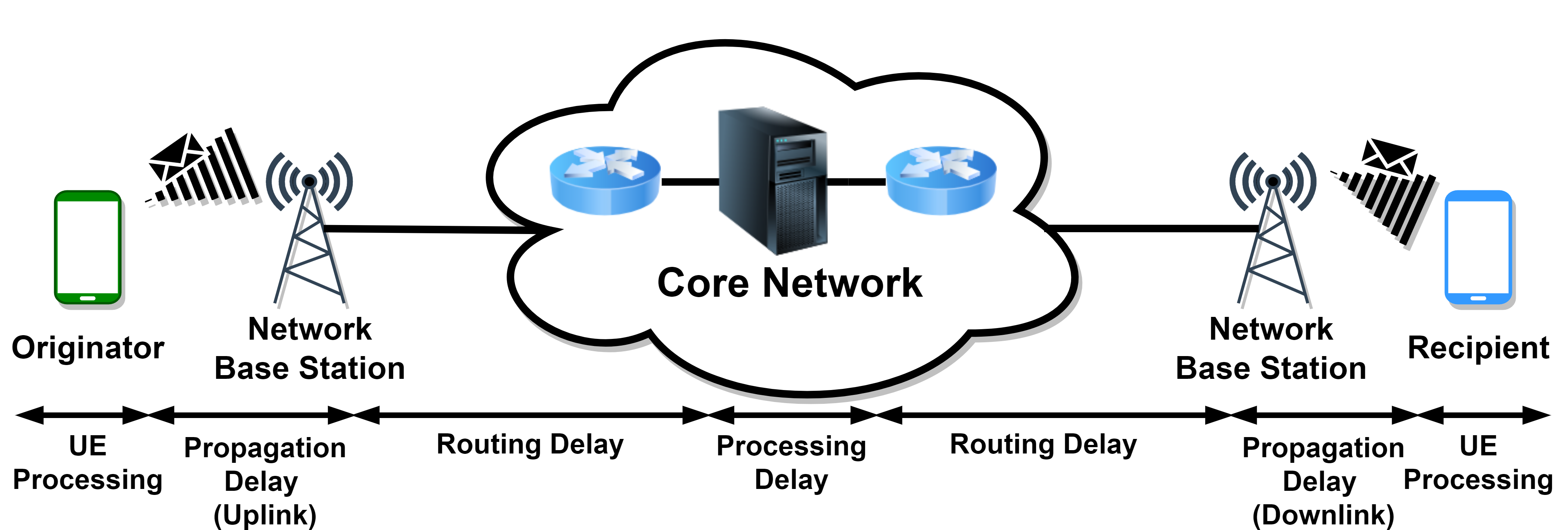
- Six timing-related features are extracted from RTT measurements, including propagation delay, network processing time, and routing path characteristics.
- A machine learning model is trained on RTT measurements collected from multiple devices, operators, and geographic regions to create location-specific timing signatures.
- The attacker sends silent SMS messages to the target and collects Delivery Report delays to build or match timing profiles.
- Experiments are conducted across nine countries on three continents, involving ten mobile network operators, to collect a large-scale dataset of RTT measurements.
- The system evaluates performance in both closed-world (known locations) and open-world (unknown locations) scenarios using classification models.

Experimental results
Research questions
- RQ1Can SMS Delivery Report timing be used as a reliable side-channel to infer the geographic location of a mobile user?
- RQ2How accurate is location inference using only RTT measurements from standard SMS interactions across different countries and operators?
- RQ3What are the dominant network and environmental factors that affect the reliability and stability of the timing side-channel?
- RQ4To what extent can this attack be executed passively and stealthily without detection or special access?
- RQ5What are the practical limitations and scalability of the attack in real-world cellular networks?
Key findings
- The attack achieves up to 96% accuracy in identifying a user’s location across different countries using only SMS Delivery Report timing measurements.
- Within Belgium, the model achieves 86% accuracy for distinguishing between two specific locations, demonstrating high precision in regional localization.
- Across multiple countries including Germany, the Netherlands, and the US, the model maintains over 70% accuracy for location classification in controlled scenarios.
- The timing side-channel remains stable over time and across different network operators, indicating consistent performance under real-world conditions.
- The attack is highly practical, as it requires only the victim’s phone number and a standard smartphone, with no need for network access or specialized hardware.
- Mitigation is extremely difficult due to the protocol-level design of SMS Delivery Reports, which are mandatory and cannot be disabled without architectural changes to cellular networks.
Read this paper
Open the full text in the Nubint reader and ask about any passage as you read.
Read this paper on NubintThis review was generated by AI from the original paper. Please check the paper before citing it.