
[Paper Review] FreeNeRF: Improving Few-shot Neural Rendering with Free Frequency Regularization
FreeNeRF introduces a simple yet effective frequency regularization technique that significantly improves few-shot neural rendering in NeRF by stabilizing training through input frequency control and near-camera density regularization. With just a single line of code change, it achieves state-of-the-art performance across Blender, DTU, and LLFF datasets without additional computation or external supervision.
Novel view synthesis with sparse inputs is a challenging problem for neural radiance fields (NeRF). Recent efforts alleviate this challenge by introducing external supervision, such as pre-trained models and extra depth signals, and by non-trivial patch-based rendering. In this paper, we present Frequency regularized NeRF (FreeNeRF), a surprisingly simple baseline that outperforms previous methods with minimal modifications to the plain NeRF. We analyze the key challenges in few-shot neural rendering and find that frequency plays an important role in NeRF's training. Based on the analysis, we propose two regularization terms. One is to regularize the frequency range of NeRF's inputs, while the other is to penalize the near-camera density fields. Both techniques are ``free lunches'' at no additional computational cost. We demonstrate that even with one line of code change, the original NeRF can achieve similar performance as other complicated methods in the few-shot setting. FreeNeRF achieves state-of-the-art performance across diverse datasets, including Blender, DTU, and LLFF. We hope this simple baseline will motivate a rethinking of the fundamental role of frequency in NeRF's training under the low-data regime and beyond.
Motivation & Objective
- Address the challenge of novel view synthesis from sparse inputs in neural radiance fields (NeRF), where standard NeRF overfits due to limited supervision.
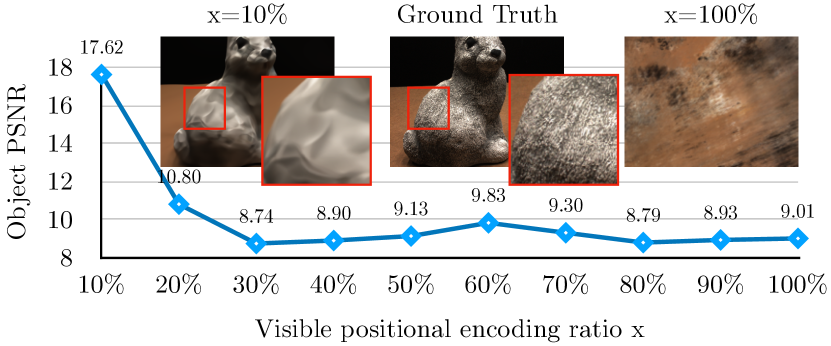
- Investigate the root cause of failure in few-shot NeRF training, particularly the role of high-frequency components in positional encoding.
- Develop a minimal, dependency-free, and overhead-free baseline that outperforms complex state-of-the-art methods in low-data regimes.
- Demonstrate that frequency and occlusion regularization can be applied with no computational cost while improving generalization and reducing artifacts like 'floaters'.
Proposed method
- Introduce a frequency regularization term that suppresses high-frequency components in positional encoding during early training, stabilizing optimization and preventing catastrophic overfitting.
- Apply a curriculum schedule where the frequency regularization is gradually turned off over a portion of training (e.g., 90% of total iterations), with the duration tuned per dataset.
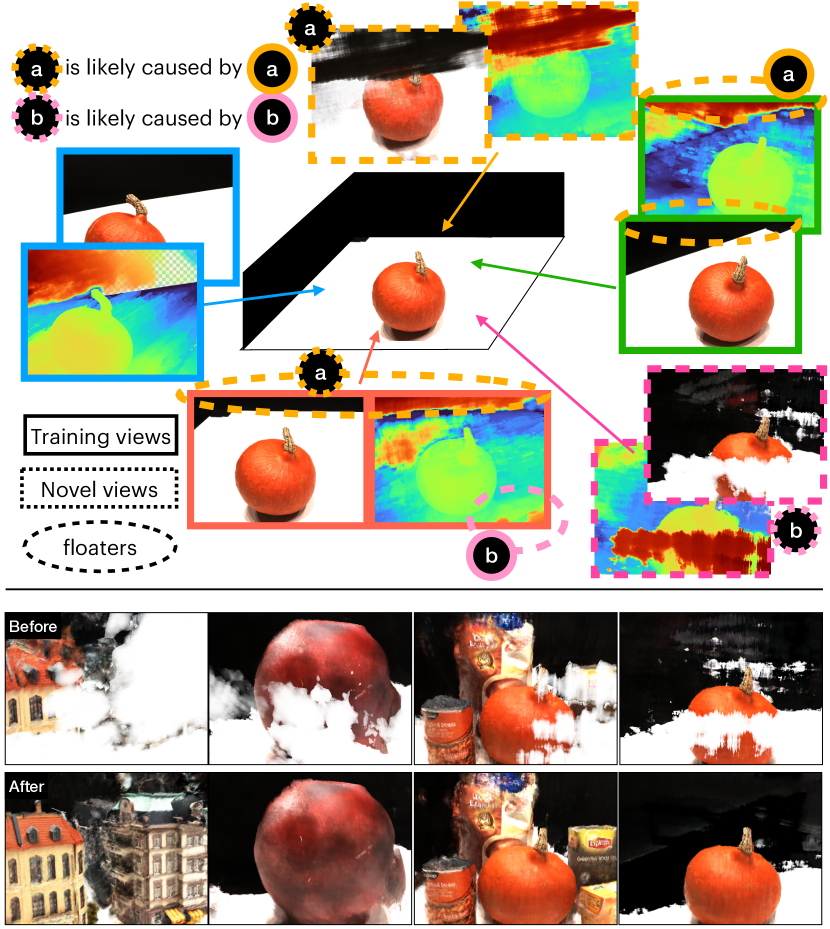
- Propose an occlusion regularization term that penalizes density values near the camera to reduce 'floater' artifacts caused by incorrect depth estimation in sparse views.
- Implement the regularization via a simple tensor mask: setting specific positional encoding dimensions to zero during training, requiring only one line of code modification.
- Use a learnable mask over the positional encoding embedding (e.g., `pos_enc[int(t/T*L)+3:] = 0`) to control the frequency range dynamically during training.
- Combine both regularizations without additional rendering or supervision, maintaining the original NeRF architecture and training pipeline with minimal modification.
Experimental results
Research questions
- RQ1Why does standard NeRF fail in few-shot settings, and what role does the frequency content of positional encoding play in this failure?
- RQ2Can a simple, lightweight regularization technique based on frequency control improve NeRF performance in low-data regimes without external supervision?
- RQ3How does near-camera density regularization affect artifact reduction (e.g., 'floaters') in sparse-view NeRF training?
- RQ4To what extent can a minimal modification—such as one line of code—achieve state-of-the-art performance compared to complex, multi-stage pipelines?
- RQ5Does frequency regularization generalize across diverse datasets like Blender, DTU, and LLFF, and how does it affect the trade-off between PSNR and LPIPS?
Key findings
- FreeNeRF achieves state-of-the-art performance on the DTU-3 and LLFF-3 benchmarks, with PSNR of 19.81 and 19.70 respectively, outperforming prior methods without additional supervision or computation.
- The 90% frequency regularization schedule yields the best results across datasets, demonstrating that a curriculum over frequency suppression improves training stability and generalization.
- Occlusion regularization consistently improves performance across datasets, with PSNR increasing from 17.40 (w/o) to 19.81 (with) on DTU-3, and reducing 'floater' artifacts near the camera.
- The method is dependency-free and overhead-free: it requires no pre-trained models, depth supervision, or additional patch rendering, making it practical for real-world deployment.
- Ablation studies show that simply adjusting the near bound has minimal impact compared to the proposed occlusion regularization, which actively penalizes problematic density regions.
- Despite high PSNR, longer frequency regularization durations can reduce LPIPS scores, indicating a trade-off between fidelity and perceptual quality, which can be mitigated via fine-tuning.
Read this paper
Open the full text in the Nubint reader and ask about any passage as you read.
Read this paper on NubintThis review was generated by AI from the original paper. Please check the paper before citing it.