
[Paper Review] FreeReg: Image-to-Point Cloud Registration Leveraging Pretrained Diffusion Models and Monocular Depth Estimators
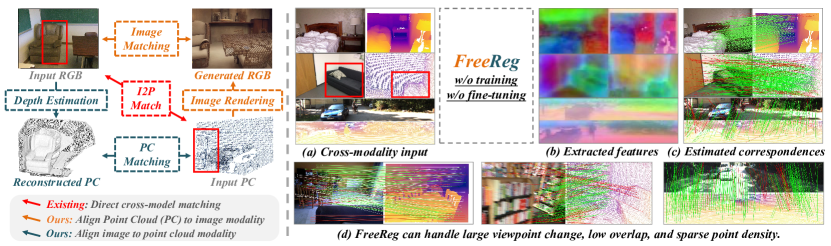
FreeReg proposes a novel image-to-point cloud registration method that bypasses cross-modality metric learning by leveraging pretrained diffusion models and monocular depth estimators to unify modality through semantic and geometric features. Without any task-specific training, it achieves state-of-the-art performance, improving inlier ratio by 20.6% and registration recall by 48.6% on public benchmarks.
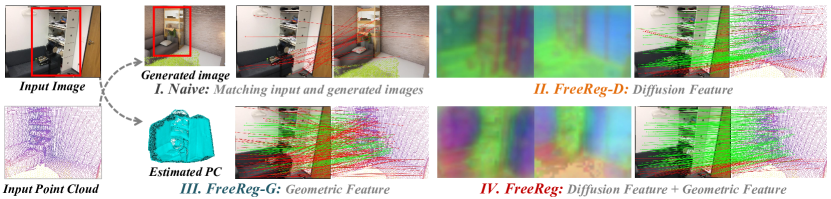
Matching cross-modality features between images and point clouds is a fundamental problem for image-to-point cloud registration. However, due to the modality difference between images and points, it is difficult to learn robust and discriminative cross-modality features by existing metric learning methods for feature matching. Instead of applying metric learning on cross-modality data, we propose to unify the modality between images and point clouds by pretrained large-scale models first, and then establish robust correspondence within the same modality. We show that the intermediate features, called diffusion features, extracted by depth-to-image diffusion models are semantically consistent between images and point clouds, which enables the building of coarse but robust cross-modality correspondences. We further extract geometric features on depth maps produced by the monocular depth estimator. By matching such geometric features, we significantly improve the accuracy of the coarse correspondences produced by diffusion features. Extensive experiments demonstrate that without any task-specific training, direct utilization of both features produces accurate image-to-point cloud registration. On three public indoor and outdoor benchmarks, the proposed method averagely achieves a 20.6 percent improvement in Inlier Ratio, a three-fold higher Inlier Number, and a 48.6 percent improvement in Registration Recall than existing state-of-the-arts.
Motivation & Objective
- To address the challenge of robust cross-modality feature matching between images and point clouds due to inherent modality differences.
- To overcome the limitations of existing metric learning-based methods, which suffer from poor convergence and limited generalization.
- To enable zero-shot image-to-point cloud registration by unifying modality through intermediate features from large-scale pretrained models.
- To improve correspondence accuracy by fusing semantic features from diffusion models with geometric features from monocular depth estimation.
- To demonstrate that direct use of pre-trained models can achieve SOTA performance without fine-tuning on the I2P task.
Proposed method
- Utilizes depth-to-image diffusion models (e.g., ControlNet) to generate image-like features from depth maps, creating semantically consistent features between images and point clouds.
- Extracts intermediate diffusion features from the diffusion model's encoder for both input RGB images and depth maps derived from point clouds.
- Applies a nearest-neighbor matcher with mutual check to establish coarse cross-modality correspondences using these semantic features.
- Employs a monocular depth estimator (e.g., Zoe-Depth) to predict metric depth maps from RGB images, enabling geometric feature extraction.
- Extracts geometric features from the predicted depth maps and matches them with features from the depth maps derived from point clouds.
- Fuses the resulting sparse semantic correspondences and dense geometric correspondences to produce accurate, dense pixel-to-point correspondences.
Experimental results
Research questions
- RQ1Can semantic consistency in intermediate features of pretrained diffusion models enable robust cross-modality correspondence without metric learning?
- RQ2Can monocular depth estimation improve the accuracy of coarse correspondences established via diffusion features?
- RQ3Can a zero-shot approach using only pre-trained models achieve state-of-the-art performance in image-to-point cloud registration?
- RQ4How does the fusion of semantic and geometric features affect registration accuracy across diverse indoor and outdoor scenes?
- RQ5What is the impact of depth estimation quality on the final registration performance when using Kabsch or PnP for pose estimation?
Key findings
- FreeReg achieves a 20.6% average improvement in Inlier Ratio and a 48.6% improvement in Registration Recall over existing SOTA methods on three public benchmarks.
- The method produces 3.0× more inlier correspondences on average, demonstrating significant gains in correspondence quality.
- On the KITTI-DC dataset, FreeReg with Kabsch estimation achieves 80.1% Registration Recall under loose thresholds (10°, 4m), outperforming prior methods.
- FreeReg-D, which uses only diffusion features, achieves 74.2% Registration Recall on 3DMatch, outperforming fully-supervised baselines like LCD and I2P-Matr.
- The fusion of diffusion and geometric features enables dense, accurate correspondences even in challenging cases with small overlaps, large viewpoint changes, and sparse point clouds.
- FreeReg demonstrates strong mono-modality registration capability: it achieves 87.9% Registration Recall on ScanNet and 94.7% on 3DMatch for depth map registration, outperforming FCGF and I2P-Matr in most settings.
Read this paper
Open the full text in the Nubint reader and ask about any passage as you read.
Read this paper on NubintThis review was generated by AI from the original paper. Please check the paper before citing it.