
[Paper Review] FreeSeg: Unified, Universal and Open-Vocabulary Image Segmentation
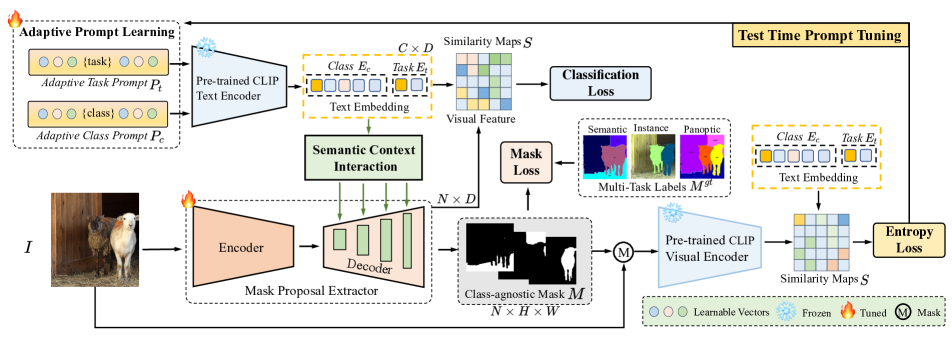
FreeSeg presents a single, unified model trained in one shot to perform open-vocabulary semantic, instance, and panoptic segmentation, using adaptive prompts and a two-stage framework with mask proposals and CLIP-based zero-shot classification.
Recently, open-vocabulary learning has emerged to accomplish segmentation for arbitrary categories of text-based descriptions, which popularizes the segmentation system to more general-purpose application scenarios. However, existing methods devote to designing specialized architectures or parameters for specific segmentation tasks. These customized design paradigms lead to fragmentation between various segmentation tasks, thus hindering the uniformity of segmentation models. Hence in this paper, we propose FreeSeg, a generic framework to accomplish Unified, Universal and Open-Vocabulary Image Segmentation. FreeSeg optimizes an all-in-one network via one-shot training and employs the same architecture and parameters to handle diverse segmentation tasks seamlessly in the inference procedure. Additionally, adaptive prompt learning facilitates the unified model to capture task-aware and category-sensitive concepts, improving model robustness in multi-task and varied scenarios. Extensive experimental results demonstrate that FreeSeg establishes new state-of-the-art results in performance and generalization on three segmentation tasks, which outperforms the best task-specific architectures by a large margin: 5.5% mIoU on semantic segmentation, 17.6% mAP on instance segmentation, 20.1% PQ on panoptic segmentation for the unseen class on COCO.
Motivation & Objective
- Address fragmentation in segmentation by proposing a unified, open-vocabulary framework that covers semantic, instance, and panoptic tasks.
- Train an all-in-one network in a one-shot manner to produce universal mask proposals across tasks.
- Incorporate adaptive prompt learning to encode task-aware and category-sensitive concepts for robust cross-task generalization.
Proposed method
- A two-stage framework: stage 1 learns universal mask proposals via one-shot multi-task training; stage 2 uses CLIP to classify masks with adaptive prompts.
- Adaptive prompt learning jointly encodes task and category information into text embeddings to form multi-granularity textual representations.
- Semantic context interaction via cross-attention aligns text embeddings with multi-scale visual features to improve cross-modal matching.
- Test-time prompt tuning optimizes the adaptive class prompt for unseen categories to improve open-vocabulary performance.
- Training losses combine mask supervision (Focal and Dice losses) with cross-entropy classification loss for text-guided masks.
- The framework uses Mask2Former as the mask proposal extractor and CLIP as the text-image alignment backbone.
Experimental results
Research questions
- RQ1Can a single, unified model achieve open-vocabulary segmentation across semantic, instance, and panoptic tasks without task-specific architectures?
- RQ2Does adaptive prompt learning improve generalization to unseen categories in open-vocabulary segmentation?
- RQ3Do semantic context interaction and test-time prompt tuning enhance cross-modal alignment and performance for unseen classes?
Key findings
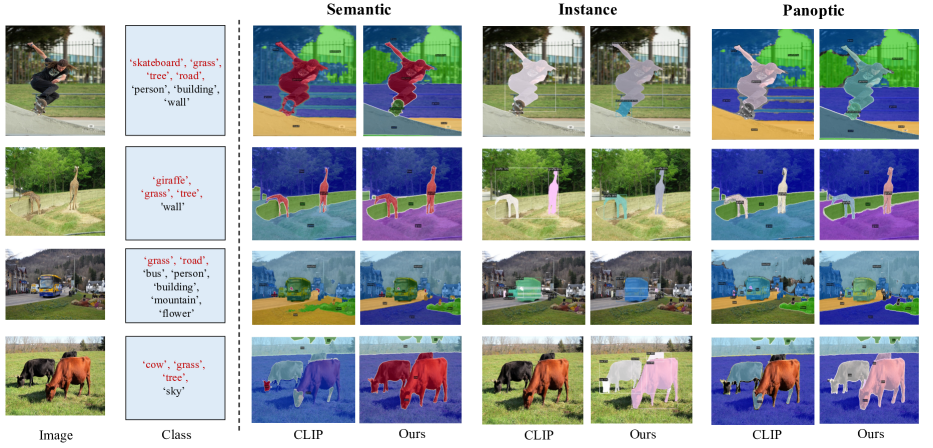
- FreeSeg achieves state-of-the-art results in open-vocabulary semantic segmentation on COCO and ADE20K, with 5.5% mIoU and 8.3% mIoU improvements over prior methods for unseen classes respectively.
- In open-vocabulary instance segmentation, FreeSeg attains 20.6% mAP on unseen COCO categories, surpassing the best prior method by 7.0% mAP.
- For open vocabulary panoptic segmentation, FreeSeg reaches 29.8% PQ, 79.2% SQ, and 37.6% RQ on unseen COCO categories, outperforming ZSSeg by large margins.
- Across cross-dataset generalization, FreeSeg outperforms baselines when trained on COCO or ADE20K and tested on other datasets (e.g., ADE20K and VOC2012).
- Ablation studies show adaptive prompts, semantic context interaction, and test-time prompt tuning collectively boost unseen-class performance and cross-task robustness.
Read this paper
Open the full text in the Nubint reader and ask about any passage as you read.
Read this paper on NubintThis review was generated by AI from the original paper. Please check the paper before citing it.