
[Paper Review] Frequency-aware Discriminative Feature Learning Supervised by Single-Center Loss for Face Forgery Detection
This paper proposes a frequency-aware discriminative feature learning framework (FDFL) for face forgery detection, combining a novel single-center loss (SCL) that enhances intra-class compactness of real faces and inter-class separability, along with an adaptive frequency feature generation module (AFFGM) for data-driven frequency clue mining. The method achieves state-of-the-art performance on all three versions of the FF++ dataset, with a 99.43% accuracy and 0.998 AUC on the most challenging c40 split.
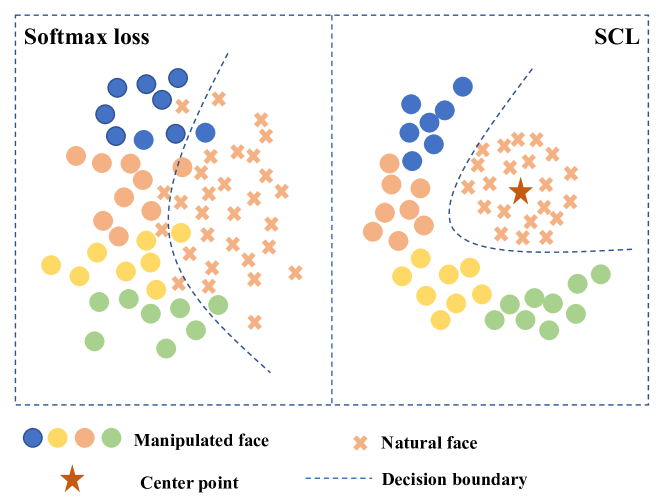
Face forgery detection is raising ever-increasing interest in computer vision since facial manipulation technologies cause serious worries. Though recent works have reached sound achievements, there are still unignorable problems: a) learned features supervised by softmax loss are separable but not discriminative enough, since softmax loss does not explicitly encourage intra-class compactness and interclass separability; and b) fixed filter banks and hand-crafted features are insufficient to capture forgery patterns of frequency from diverse inputs. To compensate for such limitations, a novel frequency-aware discriminative feature learning framework is proposed in this paper. Specifically, we design a novel single-center loss (SCL) that only compresses intra-class variations of natural faces while boosting inter-class differences in the embedding space. In such a case, the network can learn more discriminative features with less optimization difficulty. Besides, an adaptive frequency feature generation module is developed to mine frequency clues in a completely data-driven fashion. With the above two modules, the whole framework can learn more discriminative features in an end-to-end manner. Extensive experiments demonstrate the effectiveness and superiority of our framework on three versions of the FF++ dataset.
Motivation & Objective
- To address the limitation of softmax loss in learning discriminative features due to insufficient explicit constraints on intra-class compactness and inter-class separability.
- To overcome the reliance on fixed filter banks and hand-crafted features in frequency-based forgery detection, which limits adaptability to diverse forgery patterns.
- To develop a data-driven frequency feature extraction mechanism that captures subtle, forgery-specific artifacts across varying manipulation methods.
- To improve generalization and robustness in face forgery detection under different compression levels and unseen manipulation techniques.
Proposed method
- Introduces a single-center loss (SCL) that minimizes the distance between real face embeddings and a single center point while enforcing a margin between real and fake face distances to the center.
- SCL explicitly promotes intra-class compactness only for real faces, avoiding over-constraint on diverse fake face distributions, thus reducing optimization difficulty.
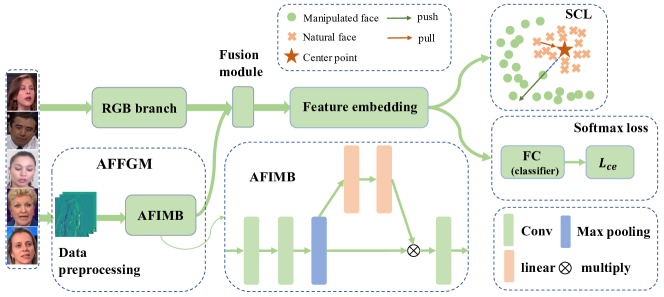
- Designs an adaptive frequency feature generation module (AFFGM) that learns frequency-specific representations through a learnable frequency preprocessing stage and an adaptive frequency information mining block.
- The AFFGM enables end-to-end learning of frequency-domain artifacts without relying on fixed filter banks, allowing the model to discover relevant frequency patterns from data.
- Combines SCL and AFFGM within a unified end-to-end training framework to jointly optimize discriminative feature learning and frequency-aware representation.
- Employs a Xception backbone for feature extraction, with SCL and AFFGM integrated as loss and feature engineering components respectively.
Experimental results
Research questions
- RQ1Can a metric learning loss that only constrains intra-class compactness for real faces improve feature discriminability and reduce optimization difficulty in face forgery detection?
- RQ2Can a data-driven, adaptive frequency feature generation module outperform hand-crafted or fixed filter-based frequency analysis in capturing subtle forgery artifacts?
- RQ3How does the proposed FDFL framework perform across different levels of video compression (c0, c23, c40) on the FF++ dataset?
- RQ4To what extent does the integration of SCL and AFFGM improve detection performance compared to baseline models and prior state-of-the-art methods?
- RQ5Does the framework generalize to unseen manipulation methods, and what are its limitations in such scenarios?
Key findings
- The proposed FDFL framework achieves a 99.43% accuracy, 0.998 AUC, and 0.924 pAUC 0.1 on the most challenging c40 version of the FF++ dataset, outperforming prior state-of-the-art methods.
- The single-center loss (SCL) alone improves AUC by 5.5% and pAUC 0.1 by 13.8% over the baseline, demonstrating its effectiveness in enhancing feature discriminability.
- The adaptive frequency feature generation module (AFFGM) contributes a 4.5% improvement in AUC and 11.7% in pAUC 0.1, showing its value in capturing frequency-domain artifacts.
- When combined, SCL and AFFGM yield the best performance (AUC: 0.924, pAUC 0.1: 0.810), confirming their complementary nature and synergy in the framework.
- On the c40 split, FDFL achieves a 6.4% AUC gain, 15.8% pAUC 0.1 gain, and 2.86% accuracy gain over the previous SOTA method, indicating strong robustness to heavy compression.
- The ablation study confirms that both SCL and AFFGM independently contribute significantly to performance, with the full model achieving the highest scores across all metrics.
Better researchstarts right now
From reading papers to final review, dramatically reduce your research time.
No credit card · Free plan available
This review was created by AI and reviewed by human editors.