
[Paper Review] Frequency-Constrained Resilient Scheduling of Microgrid: A Distributionally Robust Approach
This paper proposes a distributionally robust microgrid scheduling model that explicitly models frequency dynamics and uncertainty in renewable generation and load shedding during islanding events. By analytically deriving frequency constraints and reformulating them into second-order cone form, the model enables optimal synthetic inertia provision from inverter-based generators, reducing operational costs by up to 50% compared to base cases while ensuring frequency security under uncertainty.
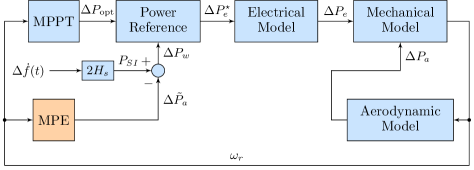
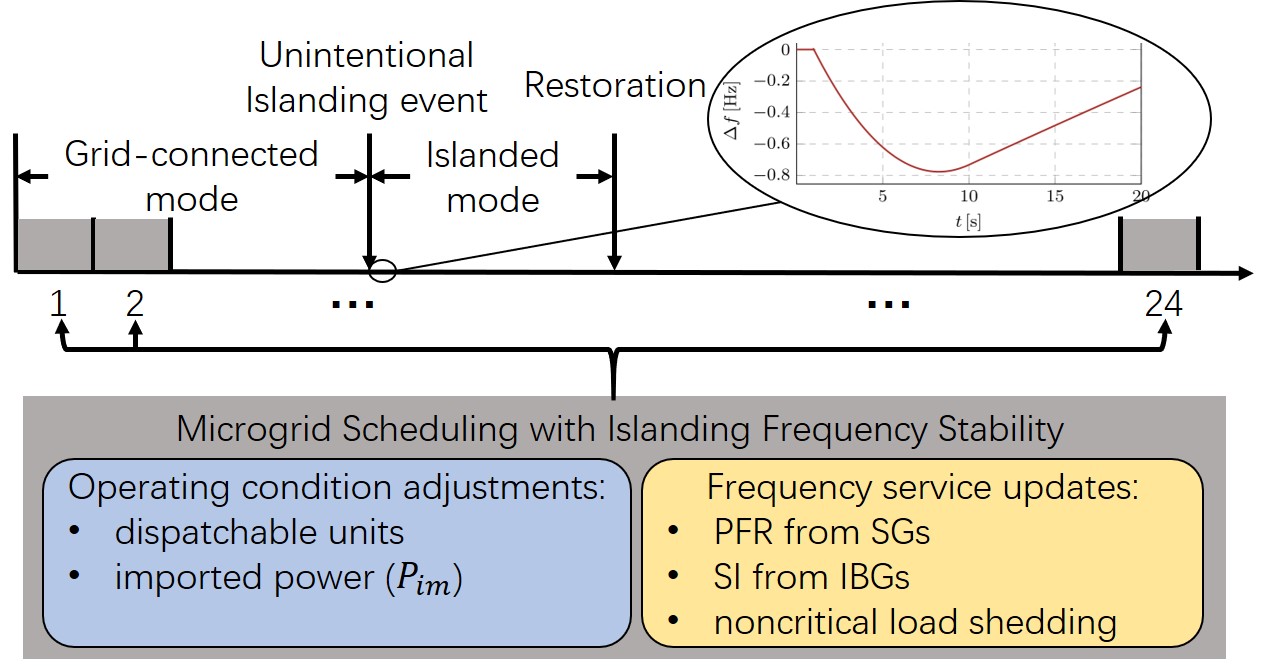
In order to prevent the potential frequency instability due to the high Power Electronics (PE) penetration under an unintentional islanding event, this paper presents a novel microgrid scheduling model which explicitly models the system frequency dynamics as well as the long/short term uncertainty associated with renewable energy resources and load. Synthetic Inertia (SI) control is applied to regulating the active power output of the Inverter-Based Generators (IBGs) to support the post-islanding frequency evaluation. The uncertainty associated with the noncritical load shedding is explicitly modeled based on the distributionally robust formulation to ensure resilient operation during islanding events. The resulted frequency constraints are derived analytically and reformulated into Second-Order Cone (SOC) form, which are further incorporated into the microgrid scheduling model, enabling optimal SI provision of Renewable Energy Sources (RESs) from the micorgrid perspective. With the SOC relaxation of the AC power flow constraints, the overall problem is constructed as a mixed-integer SOC Programming (MISOCP). The effectiveness of the proposed model is demonstrated based on modified IEEE 14-bus system.
Motivation & Objective
- To address the lack of frequency dynamics modeling in microgrid scheduling under islanding conditions.
- To incorporate uncertainty in noncritical load shedding without assuming a known probability distribution.
- To enable optimal synthetic inertia provision from renewable sources to enhance post-islanding frequency stability.
- To develop a computationally tractable optimization framework that ensures resilience and low operational cost.
- To balance risk and cost in microgrid operation under uncertain load shedding during islanding events.
Proposed method
- The paper models microgrid frequency dynamics after an islanding event as a step disturbance, deriving analytical expressions for frequency metrics including the nadir.
- It applies a distributionally robust optimization framework using an ambiguity set to model uncertainty in noncritical load shedding, avoiding reliance on specific distributional assumptions.
- The nonlinear nadir constraint is reformulated into a second-order cone (SOC) form to enable convex optimization, ensuring computational tractability.
- The AC power flow constraints are approximated using SOC relaxation, integrating with the frequency and uncertainty models into a mixed-integer second-order cone program (MISOCP).
- The model is implemented and validated on a modified IEEE 14-bus system, with case studies comparing base case, synthetic inertia, and uncertainty levels.
- Chebyshev’s inequality is used to bound the deviation of the frequency nadir, ensuring conservative yet accurate constraints under distributional ambiguity.
Experimental results
Research questions
- RQ1How can frequency dynamics after an unintentional islanding event be analytically modeled and incorporated into microgrid scheduling?
- RQ2What is the impact of uncertainty in noncritical load shedding on microgrid frequency security and operational cost?
- RQ3How can synthetic inertia from inverter-based generators be optimally scheduled to reduce reliance on conventional generators and lower costs?
- RQ4To what extent does the distributionally robust approach improve resilience compared to traditional stochastic or chance-constrained methods?
- RQ5How do varying uncertainty levels and confidence thresholds affect the trade-off between operational cost and risk in islanded microgrid operation?
Key findings
- The proposed model reduces microgrid operational cost by approximately 50% compared to the base case by enabling optimal synthetic inertia and load shedding.
- With higher synthetic inertia capacity (160 MW), the microgrid can import more power from the main grid, reducing reliance on conventional generators and lowering costs.
- The total synthetic inertia from renewable sources varies between 23 and 94 MWs/Hz, with an inverse relationship observed between synthetic inertia and conventional generator output.
- At low net demand periods (e.g., t ∈ [12,16] h), more synthetic inertia is scheduled due to lower inertia from conventional generators.
- When uncertainty in load shedding exceeds 0.27–0.38, operational costs plateau at the level of a no-load-shedding scenario, indicating diminishing returns from conservative uncertainty modeling.
- Reducing the confidence level from 0.95 to 0.90 decreases the average operational cost by about 10%, highlighting a key trade-off between risk and cost.
Read this paper
Open the full text in the Nubint reader and ask about any passage as you read.
Read this paper on NubintThis review was generated by AI from the original paper. Please check the paper before citing it.