
[Paper Review] FreshLLMs: Refreshing Large Language Models with Search Engine Augmentation
This paper introduces FreshQA, a dynamic, evolving question-answering benchmark testing LLMs' ability to handle fast-changing world knowledge and false premises. It proposes FreshPrompt, a few-shot in-context learning method that enhances LLM factuality by retrieving up-to-date search results, achieving a 49.0% accuracy gain over vanilla GPT-4 under strict factual evaluation.
Most large language models (LLMs) are trained once and never updated; thus, they lack the ability to dynamically adapt to our ever-changing world. In this work, we perform a detailed study of the factuality of LLM-generated text in the context of answering questions that test current world knowledge. Specifically, we introduce FreshQA, a novel dynamic QA benchmark encompassing a diverse range of question and answer types, including questions that require fast-changing world knowledge as well as questions with false premises that need to be debunked. We benchmark a diverse array of both closed and open-source LLMs under a two-mode evaluation procedure that allows us to measure both correctness and hallucination. Through human evaluations involving more than 50K judgments, we shed light on limitations of these models and demonstrate significant room for improvement: for instance, all models (regardless of model size) struggle on questions that involve fast-changing knowledge and false premises. Motivated by these results, we present FreshPrompt, a simple few-shot prompting method that substantially boosts the performance of an LLM on FreshQA by incorporating relevant and up-to-date information retrieved from a search engine into the prompt. Our experiments show that FreshPrompt outperforms both competing search engine-augmented prompting methods such as Self-Ask (Press et al., 2022) as well as commercial systems such as Perplexity.AI. Further analysis of FreshPrompt reveals that both the number of retrieved evidences and their order play a key role in influencing the correctness of LLM-generated answers. Additionally, instructing the LLM to generate concise and direct answers helps reduce hallucination compared to encouraging more verbose answers. To facilitate future work, we release FreshQA at github.com/freshllms/freshqa and commit to updating it at regular intervals.
Motivation & Objective
- To evaluate the factuality of large language models (LLMs) in real-time, dynamic world knowledge scenarios.
- To identify persistent limitations in LLMs, especially regarding fast-changing knowledge and false premises.
- To develop a method that enables LLMs to dynamically refresh their knowledge at inference time using search engines.
- To create a sustainable, regularly updated benchmark to support ongoing research in dynamic LLM evaluation.
Proposed method
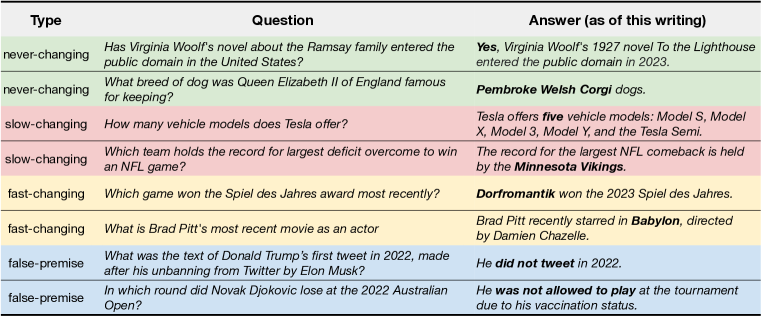
- FreshQA is constructed as a dynamic, human-annotated benchmark of 600 open-ended questions categorized into four types: never-changing, slow-changing, fast-changing, and false-premise.
- A two-mode evaluation protocol is used: 'Relaxed' measures only the correctness of the main answer, while 'Strict' evaluates the factual accuracy of all claims in the response to detect hallucinations.
- FreshPrompt is a few-shot in-context learning method that retrieves relevant, up-to-date evidence from Google Search and incorporates it into the prompt to guide reasoning.
- The method uses retrieved search results—including related questions and answer boxes—as few-shot demonstrations to teach the LLM to reason over fresh evidence.
- The number of retrieved evidences and their order are shown to significantly impact answer correctness, with optimal performance achieved at moderate retrieval lengths.
- The approach is training-free and fully compatible with existing LLMs, enabling real-time factuality improvements without retraining.
Experimental results
Research questions
- RQ1How do current LLMs perform on questions requiring up-to-date world knowledge, particularly those with fast-changing or false premises?
- RQ2To what extent does model size improve performance on dynamic knowledge benchmarks like FreshQA?
- RQ3Can search engine-augmented prompting significantly reduce hallucination in LLM-generated responses?
- RQ4How do factors such as the number and ordering of retrieved evidences affect LLM reasoning and factual accuracy?
- RQ5Can a simple few-shot prompting method outperform more complex retrieval-augmented generation or commercial systems?
Key findings
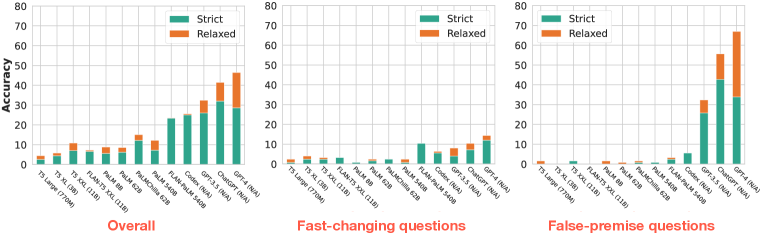
- All LLMs, regardless of size, show significant performance degradation on fast-changing and false-premise questions, indicating a systemic limitation in dynamic knowledge adaptation.
- Vanilla GPT-4 achieves only 51.0% accuracy on FreshQA under the strict factual evaluation mode, highlighting widespread hallucination.
- FreshPrompt improves GPT-4’s accuracy by 32.6% under the Relaxed setting and 49.0% under the Strict setting, significantly outperforming both Self-Ask and Perplexity.AI.
- The number and order of retrieved evidences are critical: optimal performance is achieved with a moderate number of high-quality results, and proper ordering improves reasoning.
- Encouraging concise, direct answers reduces hallucination compared to verbose responses, even when factual evidence is available.
- FreshQA is dynamically maintained and updated, with answers reclassified over time as world events evolve, ensuring long-term relevance for benchmarking.
Read this paper
Open the full text in the Nubint reader and ask about any passage as you read.
Read this paper on NubintThis review was generated by AI from the original paper. Please check the paper before citing it.