
[Paper Review] From Assistive Technologies to Metaverse: Technologies in Inclusive Higher Education for Students with Specific Learning Difficulties
This paper reviews emerging technologies—AI, XR, IoT, digital twins, and the metaverse—for inclusive higher education for students with specific learning difficulties (SLDs). It proposes a roadmap integrating these technologies, especially federated learning and explainable AI, to enhance accessibility, privacy, and personalized support, enabling equitable academic participation.
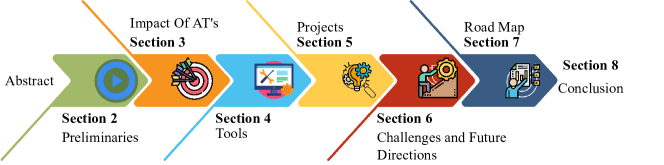
The development of new technologies and their expanding use in a wide range of educational environments are driving the transformation of higher education. Assistive technologies are a subset of cutting-edge technology that can help students learn more effectively and make education accessible to everyone. Assistive technology can enhance, maintain, or improve the capacities of students with learning difficulties. Students with learning difficulties will be greatly benefited from the use of assistive technologies. If these technologies are used effectively, students with learning difficulties can compete with their peers and complete their academic tasks. We aim to conduct this review to better understand the role of assistive technologies in providing inclusive higher education for students with learning difficulties. The review begins with the introduction of learning difficulties and their causes; inclusive education and the need for assistive technologies; the reasoning for conducting this review; and a summary of related reviews on assistive technologies for students with learning difficulties in inclusive higher education. Then, we discuss the preliminaries for the learning difficulties type and assistive technology. Later, we discuss the effects of assistive technology on inclusive higher education for students with learning difficulties. Additionally, we discuss related projects and support tools available in inclusive higher education for students with learning difficulties. We also explore the challenges and possible solutions related to using assistive technology in higher education to provide inclusive education for students with learning difficulties. We conclude the review with a discussion of potential promising future directions.
Motivation & Objective
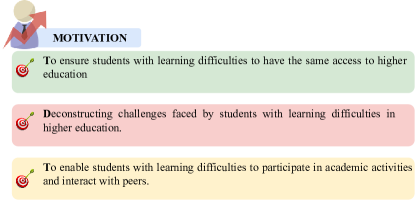
- To examine the role of emerging technologies in enabling inclusive higher education for students with specific learning difficulties (SLDs).
- To identify key assistive technologies—such as AI, XR, IoT, digital twins, and the metaverse—that can support SLD students in higher education settings.
- To analyze challenges in deploying assistive technologies, including data privacy, algorithmic bias, and accessibility in underdeveloped regions.
- To propose solutions such as federated learning and explainable AI (XAI) to improve trust, transparency, and data security in assistive systems.
- To provide a strategic roadmap for integrating advanced technologies into higher education to ensure equitable access and academic success for SLD students.
Proposed method
- Conducted a systematic literature review of journal articles and conference papers on assistive technologies for students with SLDs in higher education.
- Categorized technologies into AI, XR (including VR/AR), IoT, digital twins, and the metaverse based on their functionality and integration potential.
- Evaluated existing assistive technology projects and tools, focusing on their design, implementation, and reported outcomes in higher education contexts.
- Identified key challenges such as data privacy, lack of transparency in AI decisions (black-box nature), and unequal access in developing countries.
- Proposed technical solutions: federated learning to preserve data privacy by keeping data on local devices, and XAI to improve model interpretability and user trust.
- Developed a strategic roadmap outlining the integration of advanced technologies into higher education systems to support SLD students effectively.
Experimental results
Research questions
- RQ1How can emerging technologies such as AI, XR, IoT, digital twins, and the metaverse enhance inclusive higher education for students with specific learning difficulties?
- RQ2What are the primary challenges in deploying assistive technologies for SLD students in higher education, particularly regarding data privacy and algorithmic transparency?
- RQ3How can federated learning and explainable AI (XAI) mitigate privacy and trust issues in AI-driven assistive systems for students with learning difficulties?
- RQ4What is the current state of research and implementation of assistive technologies in higher education for SLD students compared to primary education?
- RQ5What strategic roadmap can guide the integration of advanced assistive technologies into higher education systems to ensure accessibility and equity?
Key findings
- AI and human-computer interaction (HCI) are the most widely researched and implemented assistive technologies in higher education for students with learning difficulties.
- XR technologies such as virtual reality (VR) and augmented reality (AR) show strong potential for improving student engagement, social integration, and experiential learning.
- IoT-based assistive systems can provide real-time monitoring and adaptive support through sensors, enhancing accessibility and responsiveness in learning environments.
- Digital twins and the metaverse are emerging as transformative tools, enabling virtual simulation and risk-free practice of real-world challenges before physical application.
- Federated learning can preserve student data privacy by training models on-device without centralizing sensitive information, addressing a major concern in AI-based assistive systems.
- Explainable AI (XAI) increases transparency and trust in AI recommendations by clarifying decision-making processes, reducing bias, and improving accountability in educational technology.
Better researchstarts right now
From reading papers to final review, dramatically reduce your research time.
No credit card · Free plan available
This review was created by AI and reviewed by human editors.