
[Paper Review] From Blurry to Brilliant Detection: YOLO-Based Aerial Object Detection with Super Resolution
A two-stage B2BDet approach combines a custom SRGAN-based super-resolution step with a modified SR-YOLOv5 detector to enhance small-object detection in aerial imagery, achieving state-of-the-art mAP on VisDrone and strong results on NWPU-VHR10, SeaDroneSee, and VEDAI.
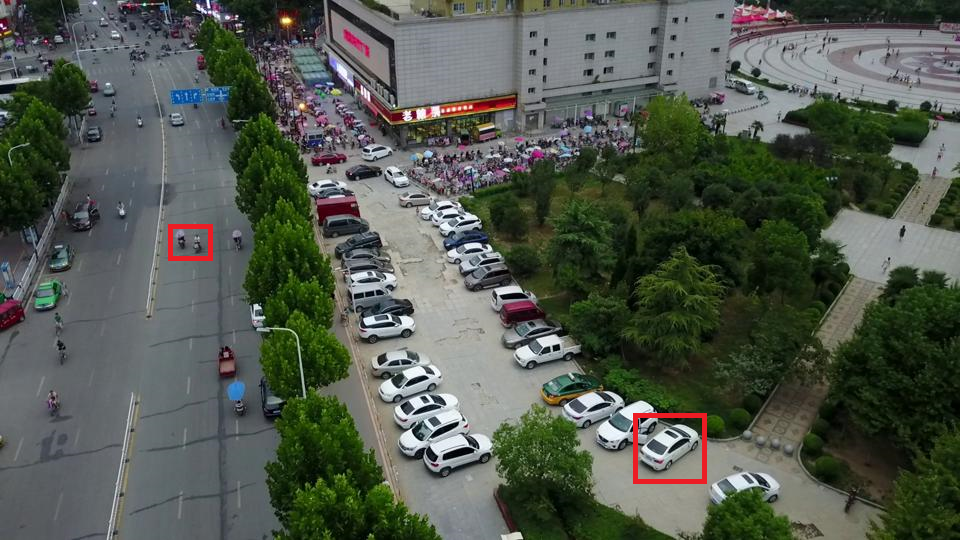
Aerial object detection presents challenges from small object sizes, high density clustering, and image quality degradation from distance and motion blur. These factors create an information bottleneck where limited pixel representation cannot encode sufficient discriminative features. B2BDet addresses this with a two-stage framework that applies domain-specific super-resolution during inference, followed by detection using an enhanced YOLOv5 architecture. Unlike training-time super-resolution approaches that enhance learned representations, our method recovers visual information from each input image. The approach combines aerial-optimized SRGAN fine-tuning with architectural innovations including an Efficient Attention Module (EAM) and Cross-Layer Feature Pyramid Network (CLFPN). Evaluation across four aerial datasets shows performance gains, with VisDrone achieving 52.5% mAP using only 27.7M parameters. Ablation studies show that super-resolution preprocessing contributes +2.6% mAP improvement while architectural enhancements add +2.9%, yielding +5.5% total improvement over baseline YOLOv5. The method achieves computational efficiency with 53.8% parameter reduction compared to recent approaches while achieving strong small object detection performance.
Motivation & Objective
- Address the challenge of small, densely clustered objects in aerial imagery.
- Improve image quality via a domain-specific super-resolution preprocessor.
- Develop a lightweight SR-YOLOv5 detector tailored for aerial scenes.
- Evaluate on diverse aerial datasets to demonstrate generalization.
Proposed method
- Propose a two-stage B2BDet pipeline: SR pre-processing followed by SR-YOLOv5 detection.
- Develop a custom SRGAN tailored for aerial imagery to upsample and enhance low-resolution inputs.
- Design SR-YOLOv5 with a reduced CSPDarknet53 backbone, C3STR transformer modules, FPN neck, and SPP+BottleneckCSP heads for small-object detection.
- Train SRGAN and detector with aerial-domain data, using data augmentation, anchor tuning, and compound scaling.
- Evaluate with mean average precision (mAP) and multi-scale input testing across datasets.
Experimental results
Research questions
- RQ1Can a domain-specific super-resolution stage improve small-object detection in aerial images?
- RQ2Does a tailored, lightweight SR-YOLOv5 detector outperform existing aerial detection architectures on small, dense objects?
- RQ3How does the B2BDet pipeline perform across VisDrone, NWPU-VHR10, SeaDroneSee, and VEDAI datasets?
Key findings
- On VisDrone, B2BDet achieves 52.5% mAP, surpassing SCA-YOLO (47.4%) and YOLOv4 (30.7%).
- NWPU-VHR10 results reach 90.5% overall mAP across 10 classes (airplane 99.5%, vehicle 96.9%).
- SeaDroneSee achieves 76% overall mAP with high scores for boat (96.3%) and jetski (93.4%).
- VEDAI achieves 77.5% overall mAP, with cars at 89.3%.
- SR-YOLOv5 footprint remains lightweight despite performance gains (270 layers, 27.7M parameters, 109.5 GFLOPs).
- The approach improves detection of small, densely clustered objects and demonstrates the importance of dataset choice and architectural adaptation.
Read this paper
Open the full text in the Nubint reader and ask about any passage as you read.
Read this paper on NubintThis review was generated by AI from the original paper. Please check the paper before citing it.