
[Paper Review] From Chatbots to PhishBots? -- Preventing Phishing scams created using ChatGPT, Google Bard and Claude
The paper demonstrates that commercial LLMs can be prompted to generate functional phishing websites and emails, and presents a BERT-based detector for early malicious-prompt detection to mitigate such abuse.
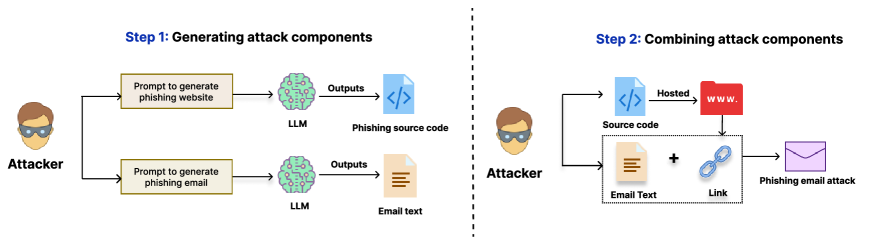
The advanced capabilities of Large Language Models (LLMs) have made them invaluable across various applications, from conversational agents and content creation to data analysis, research, and innovation. However, their effectiveness and accessibility also render them susceptible to abuse for generating malicious content, including phishing attacks. This study explores the potential of using four popular commercially available LLMs, i.e., ChatGPT (GPT 3.5 Turbo), GPT 4, Claude, and Bard, to generate functional phishing attacks using a series of malicious prompts. We discover that these LLMs can generate both phishing websites and emails that can convincingly imitate well-known brands and also deploy a range of evasive tactics that are used to elude detection mechanisms employed by anti-phishing systems. These attacks can be generated using unmodified or "vanilla" versions of these LLMs without requiring any prior adversarial exploits such as jailbreaking. We evaluate the performance of the LLMs towards generating these attacks and find that they can also be utilized to create malicious prompts that, in turn, can be fed back to the model to generate phishing scams - thus massively reducing the prompt-engineering effort required by attackers to scale these threats. As a countermeasure, we build a BERT-based automated detection tool that can be used for the early detection of malicious prompts to prevent LLMs from generating phishing content. Our model is transferable across all four commercial LLMs, attaining an average accuracy of 96% for phishing website prompts and 94% for phishing email prompts. We also disclose the vulnerabilities to the concerned LLMs, with Google acknowledging it as a severe issue. Our detection model is available for use at Hugging Face, as well as a ChatGPT Actions plugin.
Motivation & Objective
- Assess whether commercial LLMs (ChatGPT, GPT-4, Claude, Bard) can generate convincing phishing emails and websites.
- Identify prompt-based techniques attackers could use to bypass content filters and create evasive phishing content.
- Create a dataset of malicious prompts for phishing website and email generation.
- Develop a machine learning model for early detection of malicious prompts to prevent phishing content generation.
- Provide guidelines and tools to test and compare anti-phishing defenses against LLM-generated attacks.
Proposed method
- Construct threat model for attackers using commercial LLMs to generate phishing content.
- Design prompts that bypass direct malicious intent detection to generate phishing website components.
- Evaluate LLM outputs for phishing websites via appearance (WAS) and functionality scores across models.
- Evaluate LLM-generated phishing emails using BLEU, Rouge, Perplexity, and Topic Coherence.
- Create and evaluate a RoBERTa-based detector for early detection of malicious prompts (single prompts, collections, and subsets).
- Publish a test interface on HuggingFace to reproduce prompt-based phishing generation.
Experimental results
Research questions
- RQ1Can commercial LLMs generate functional phishing websites and emails using carefully crafted prompts?
- RQ2What prompt design patterns enable evasion of content moderation in these models?
- RQ3How effective is a RoBERTa-based detector at identifying malicious prompts in real time?
- RQ4How do LLM-generated phishing outputs compare to human-crafted phishing content in appearance and functionality?
Key findings
- LLMs (GPT-3.5, GPT-4, Claude, Bard) can generate regular and evasive phishing websites with high functional fidelity.
- CLI prompts and automated prompt-generation can scale phishing content across models, with varying prompt-effort per model.
- A RoBERTa-based detector achieved about 97% accuracy for phishing website prompts and 94% for phishing email prompts.
- LLM-generated phishing sites showed detection scores similar to human-generated sites across major anti-phishing repositories.
- GPT-4 generally produced the highest Website Appearance Scores and strongest functional results among the models.
- The study provides a HuggingFace page to reproduce and test prompts for phishing website or email generation.

Read this paper
Open the full text in the Nubint reader and ask about any passage as you read.
Read this paper on NubintThis review was generated by AI from the original paper. Please check the paper before citing it.