
[Paper Review] From Crowdsourced Data to High-Quality Benchmarks: Arena-Hard and BenchBuilder Pipeline
The paper presents BenchBuilder, a data pipeline that extracts high-quality prompts from crowdsourced data to build Arena-Hard-Auto v0.1, a fully automated benchmark with strong model separability and high agreement with human preferences at low cost.
The rapid evolution of Large Language Models (LLMs) has outpaced the development of model evaluation, highlighting the need for continuous curation of new, challenging benchmarks. However, manual curation of high-quality, human-aligned benchmarks is expensive and time-consuming. To address this, we introduce BenchBuilder, an automated pipeline that leverages LLMs to curate high-quality, open-ended prompts from large, crowd-sourced datasets, enabling continuous benchmark updates without human in the loop. We apply BenchBuilder to datasets such as Chatbot Arena and WildChat-1M, extracting challenging prompts and utilizing LLM-as-a-Judge for automatic model evaluation. To validate benchmark quality, we propose new metrics to measure a benchmark's alignment with human preferences and ability to separate models. We release Arena-Hard-Auto, a benchmark consisting 500 challenging prompts curated by BenchBuilder. Arena-Hard-Auto provides 3x higher separation of model performances compared to MT-Bench and achieves 98.6% correlation with human preference rankings, all at a cost of $20. Our work sets a new framework for the scalable curation of automated benchmarks from extensive data.
Motivation & Objective
- Motivate the need for evolving, open-ended benchmarks that keep pace with rapidly advancing LLMs.
- Propose BenchBuilder to automatically curate high-quality prompts from crowdsourced data.
- Demonstrate Arena-Hard-Auto v0.1’s ability to separate models confidently and align with human preferences.
Proposed method
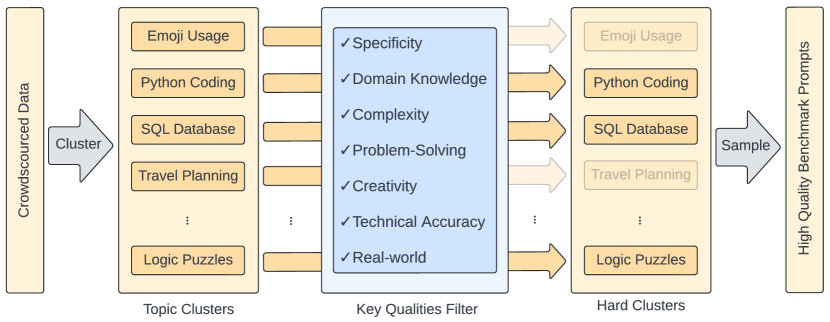
- Define seven prompt quality indicators (e.g., Specificity, Domain Knowledge, Complexity, Problem-Solving, Creativity, Technical Accuracy, Real-world Application) and use an LLM annotator to score prompts.
- Cluster prompts via embedding-based topic modeling (BERTopic with OpenAI embeddings, UMAP, HDBSCAN) to form topic clusters.
- Filter clusters by mean quality and sample prompts evenly across clusters to ensure diversity.
- Use GPT-3.5-Turbo/GPT-4-Turbo to score prompts and GPT-4-Turbo as judge to assess human-preference alignment via LLM judgments.
- Evaluate model rankings with bootstrapped confidence intervals and a Bradley-Terry framework to produce final scores.
- Compare Arena-Hard-Auto v0.1 against MT-Bench and AlpacaEval on separability and agreement; publish open-source benchmark and BenchBuilder pipeline.
Experimental results
Research questions
- RQ1How well can a living benchmark, built from crowdsourced data, confidently separate state-of-the-art models?
- RQ2Can seven defined prompt quality indicators guide automatic curation to produce high-quality, diverse benchmarks?
- RQ3Do LLM-based judges provide reliable, automated alignment with human preferences for model evaluation?
- RQ4How does Arena-Hard-Auto v0.1 compare to existing benchmarks in separability and agreement with human rankings?
Key findings
- Arena-Hard-Auto v0.1 achieves tighter confidence intervals and strong separability versus MT-Bench and AlpacaEval.
- Arena-Hard-Auto v0.1 shows 89.1% agreement with Chatbot Arena human rankings at a cost of $25 per evaluation.
- BenchBuilder can extract high-quality prompts from 200,000 Chatbot Arena queries, yielding 500 prompts clustered into diverse, challenging tasks.
- GPT-4-Turbo as judge attains 85.6% accuracy against ground-truth labels, supporting its use as an annotator.
- Ensembling multiple judges (e.g., GPT-4-Turbo plus Gemini-1.5-Pro) improves agreement and separability.
- Arena-Hard-Auto v0.1 demonstrates strong alignment with human preferences, outperforming random prompt subsets and showing robustness across model pairs.

Read this paper
Open the full text in the Nubint reader and ask about any passage as you read.
Read this paper on NubintThis review was generated by AI from the original paper. Please check the paper before citing it.