
[Paper Review] From Zero to Hero: Harnessing Transformers for Biomedical Named Entity Recognition in Zero- and Few-shot Contexts
This paper proposes a novel zero- and few-shot biomedical Named Entity Recognition (NER) method that transforms multi-class token classification into binary classification using a PubMedBERT-based model fine-tuned on diverse biomedical entities. It achieves state-of-the-art F1 scores of 35.44% (zero-shot), 50.10% (one-shot), 69.94% (10-shot), and 79.51% (100-shot), outperforming prior transformer-based methods and matching GPT-3 performance with 1,000× fewer parameters.
Supervised named entity recognition (NER) in the biomedical domain depends on large sets of annotated texts with the given named entities. The creation of such datasets can be time-consuming and expensive, while extraction of new entities requires additional annotation tasks and retraining the model. To address these challenges, this paper proposes a method for zero- and few-shot NER in the biomedical domain. The method is based on transforming the task of multi-class token classification into binary token classification and pre-training on a large amount of datasets and biomedical entities, which allow the model to learn semantic relations between the given and potentially novel named entity labels. We have achieved average F1 scores of 35.44% for zero-shot NER, 50.10% for one-shot NER, 69.94% for 10-shot NER, and 79.51% for 100-shot NER on 9 diverse evaluated biomedical entities with fine-tuned PubMedBERT-based model. The results demonstrate the effectiveness of the proposed method for recognizing new biomedical entities with no or limited number of examples, outperforming previous transformer-based methods, and being comparable to GPT3-based models using models with over 1000 times fewer parameters. We make models and developed code publicly available.
Motivation & Objective
- Address the high cost and effort of annotating large-scale biomedical NER datasets by enabling recognition of new entities with no or few labeled examples.
- Overcome limitations of existing zero- and few-shot NER methods in the biomedical domain, which often lack domain-specific adaptation.
- Develop a method that generalizes across diverse biomedical entity types (e.g., genes, drugs, diseases) using semantic transfer from pre-training.
- Enable efficient model adaptation with minimal fine-tuning, reducing dependency on large annotated corpora.
Proposed method
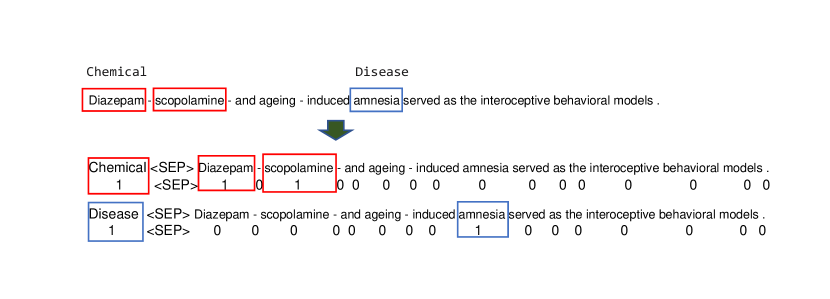
- Transforms multi-class NER into a series of binary token classification tasks by conditioning each prediction on the target entity class.
- Uses a PubMedBERT-based transformer model pre-trained on a large collection of biomedical datasets and 26 diverse entity types.
- Applies prompt engineering to inject the entity class name into the input sequence, enabling zero-shot inference for unseen classes.
- Fine-tunes the base zero-shot model on few-shot examples to improve performance, with minimal computational cost.
- Employs a binary cross-entropy loss function for each class-specific classification head, allowing scalable inference per entity type.
- Validates the model using three strategies: unseen classes only, seen classes only, and mixed validation, to assess zero-shot generalization.
Experimental results
Research questions
- RQ1Can a single pre-trained transformer model achieve effective zero-shot NER across diverse biomedical entity types without any labeled examples for the target class?
- RQ2How does the performance of the proposed method scale with increasing numbers of few-shot examples (1, 10, 100)?
- RQ3Does pre-training on a broad set of biomedical datasets and entity types improve zero-shot generalization compared to standard fine-tuning?
- RQ4How does the model’s performance compare to GPT-3-based approaches in terms of F1 score and parameter efficiency?
- RQ5What validation strategies best reflect real-world zero-shot NER performance when the true test classes are unknown?
Key findings
- The proposed method achieves an average F1 score of 35.44% on 9 diverse biomedical entity types in the zero-shot setting, setting a new SOTA for zero-shot biomedical NER.
- With only one labeled example per class, the model reaches a 50.10% F1 score, demonstrating strong few-shot generalization capability.
- Performance improves significantly with more few-shot examples, reaching 69.94% F1 at 10-shot and 79.51% at 100-shot, approaching performance of full-dataset BERT models.
- The method outperforms previous transformer-based zero- and few-shot NER approaches in the biomedical domain and matches GPT-3-level performance with 1,000× fewer parameters.
- The base zero-shot model shows instability during inference, likely due to non-convex optimization, suggesting a need for improved training dynamics in future work.
- Validation using only unseen classes during evaluation leads to better model selection for zero-shot generalization, though it is less practical in real-world settings.
Read this paper
Open the full text in the Nubint reader and ask about any passage as you read.
Read this paper on NubintThis review was generated by AI from the original paper. Please check the paper before citing it.