
[Paper Review] Frontier AI Regulation: Managing Emerging Risks to Public Safety
The paper argues for regulatory building blocks and initial safety standards to govern frontier AI models that may pose severe public-safety risks, emphasizing lifecycle regulation, visibility, and compliance.
Advanced AI models hold the promise of tremendous benefits for humanity, but society needs to proactively manage the accompanying risks. In this paper, we focus on what we term "frontier AI" models: highly capable foundation models that could possess dangerous capabilities sufficient to pose severe risks to public safety. Frontier AI models pose a distinct regulatory challenge: dangerous capabilities can arise unexpectedly; it is difficult to robustly prevent a deployed model from being misused; and, it is difficult to stop a model's capabilities from proliferating broadly. To address these challenges, at least three building blocks for the regulation of frontier models are needed: (1) standard-setting processes to identify appropriate requirements for frontier AI developers, (2) registration and reporting requirements to provide regulators with visibility into frontier AI development processes, and (3) mechanisms to ensure compliance with safety standards for the development and deployment of frontier AI models. Industry self-regulation is an important first step. However, wider societal discussions and government intervention will be needed to create standards and to ensure compliance with them. We consider several options to this end, including granting enforcement powers to supervisory authorities and licensure regimes for frontier AI models. Finally, we propose an initial set of safety standards. These include conducting pre-deployment risk assessments; external scrutiny of model behavior; using risk assessments to inform deployment decisions; and monitoring and responding to new information about model capabilities and uses post-deployment. We hope this discussion contributes to the broader conversation on how to balance public safety risks and innovation benefits from advances at the frontier of AI development.
Motivation & Objective
- Motivate proactive governance of frontier AI models that could have dangerous, emergent capabilities.
- Identify three core regulatory challenges: unexpected capabilities, deployment safety, and rapid proliferation.
- Propose a tripartite regulatory framework: safety standards development, regulatory visibility, and compliance mechanisms.
- Advise on balancing innovation with safety through a multi-stakeholder process and potential government intervention.
Proposed method
- Define frontier AI models as highly capable foundation models with potentially dangerous capabilities.
- Outline three regulatory challenges: unexpected capabilities, deployment safety, and proliferation.
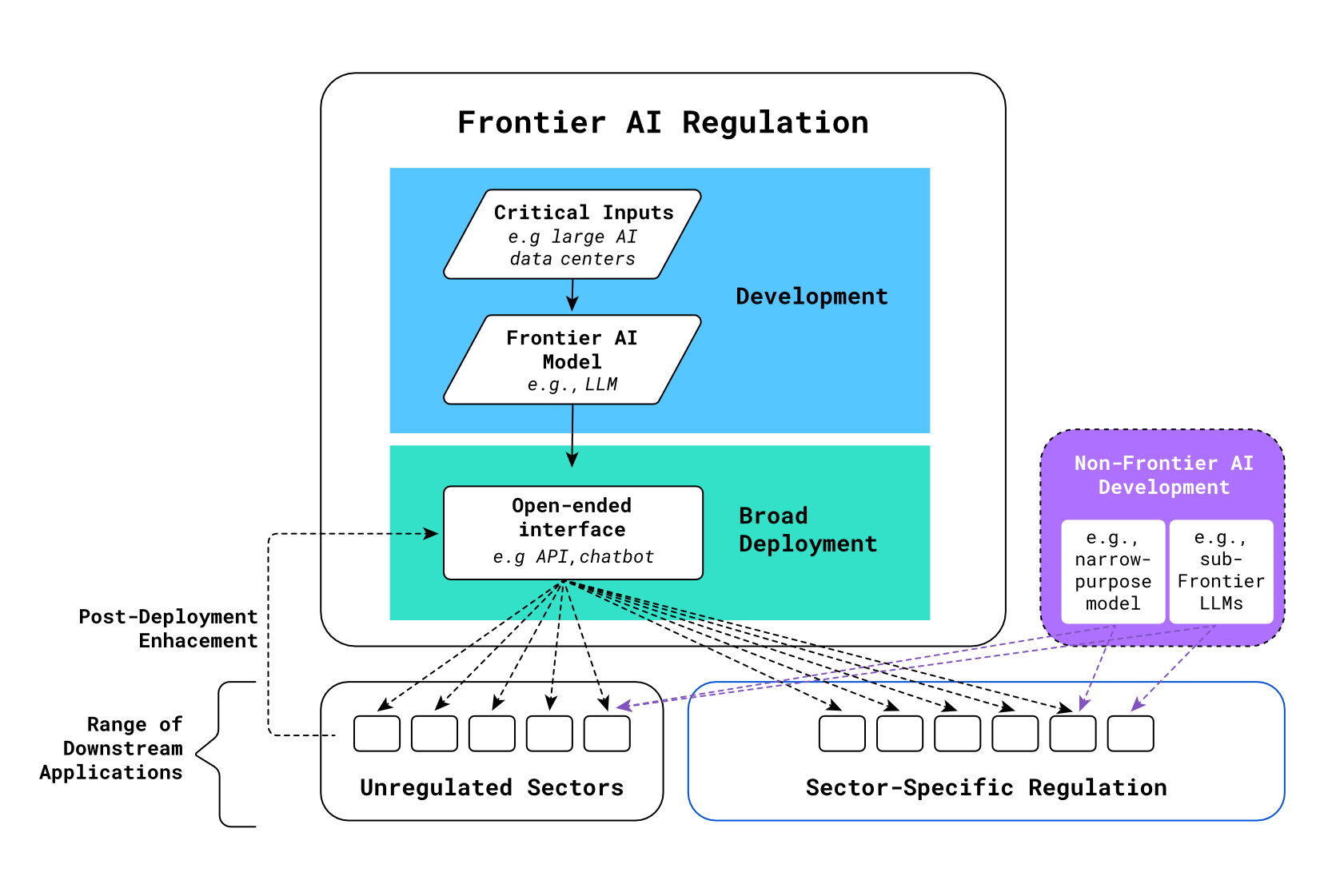
- Propose building blocks: institutionalize safety standards, increase regulatory visibility, ensure compliance (self-regulation, enforcement, licensure).
- Suggest an initial set of safety standards: risk assessments, external scrutiny, deployment protocols based on risk, and post-deployment monitoring.
Experimental results
Research questions
- RQ1What regulatory strategies are needed to govern frontier AI models with dangerous capabilities?
- RQ2How can safety standards be developed and updated in fast-moving frontier AI contexts?
- RQ3What mechanisms provide regulators visibility into frontier AI development and deployment?
- RQ4What compliance approaches (self-regulation, supervision, licensure) are appropriate for frontier AI?
Key findings
- Self-regulation alone is insufficient to manage frontier AI risks; government involvement is likely required.
- A regulatory trio is proposed: safety-standard development, visibility into development processes, and enforcement/compliance mechanisms.
- An initial set of safety standards is outlined, including risk assessments, external scrutiny, deployment protocols, and post-deployment monitoring.
- Regulation should balance safeguarding public safety with not stifling innovation, and be adaptable to rapid AI progress.
- Frontier AI regulation should be part of a broader policy portfolio addressing AI risks and benefits.
![Figure 2: Certain capabilities seem to emerge suddenly 22 22 22 Chart from [ 63 ] . But see [ 67 ] for a skeptical view on emergence. For a response to the skeptical view, see [ 66 ] and Appendix B.](https://ar5iv.labs.arxiv.org/html/2307.03718/assets/emerge.png)
Better researchstarts right now
From reading papers to final review, dramatically reduce your research time.
No credit card · Free plan available
This review was created by AI and reviewed by human editors.