
[Paper Review] FSCE: Few-Shot Object Detection via Contrastive Proposal Encoding
FSCE introduces a contrastive proposal encoding branch to the RoI head, using a supervised contrastive loss to improve few-shot object detection, achieving state-of-the-art results on PASCAL VOC and COCO across all shot settings.
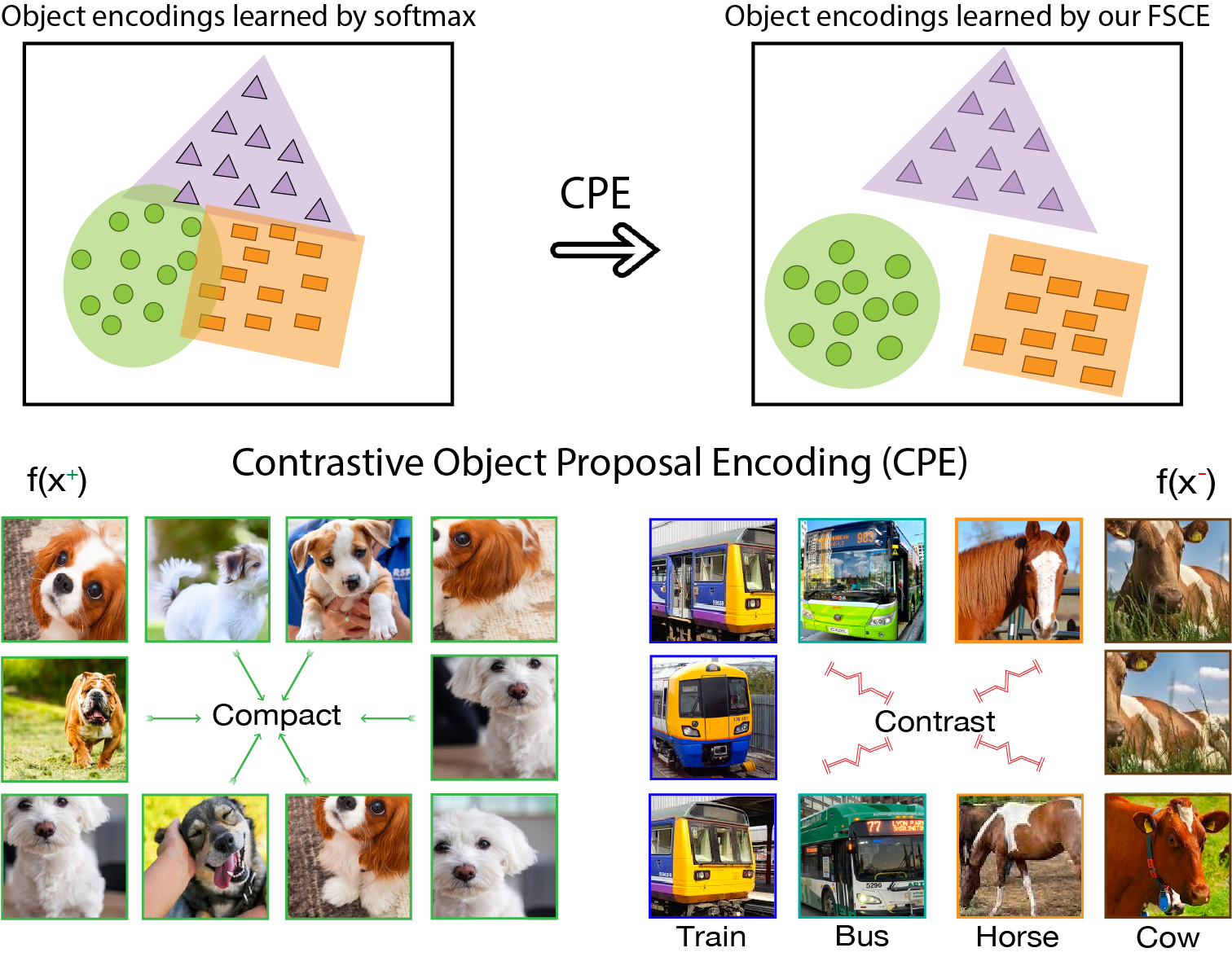
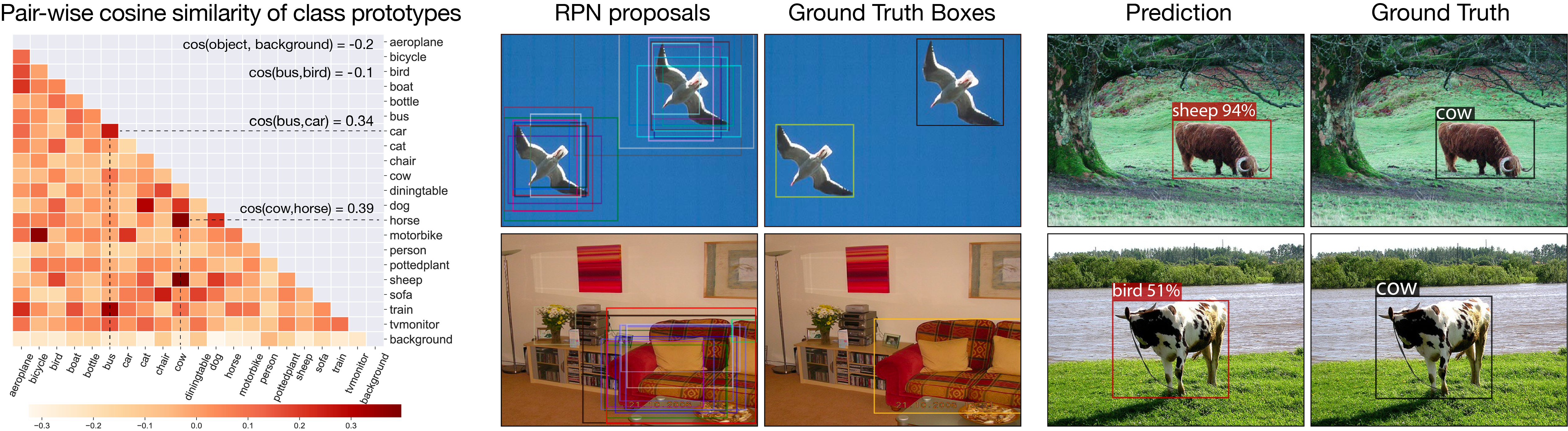
Emerging interests have been brought to recognize previously unseen objects given very few training examples, known as few-shot object detection (FSOD). Recent researches demonstrate that good feature embedding is the key to reach favorable few-shot learning performance. We observe object proposals with different Intersection-of-Union (IoU) scores are analogous to the intra-image augmentation used in contrastive approaches. And we exploit this analogy and incorporate supervised contrastive learning to achieve more robust objects representations in FSOD. We present Few-Shot object detection via Contrastive proposals Encoding (FSCE), a simple yet effective approach to learning contrastive-aware object proposal encodings that facilitate the classification of detected objects. We notice the degradation of average precision (AP) for rare objects mainly comes from misclassifying novel instances as confusable classes. And we ease the misclassification issues by promoting instance level intra-class compactness and inter-class variance via our contrastive proposal encoding loss (CPE loss). Our design outperforms current state-of-the-art works in any shot and all data splits, with up to +8.8% on standard benchmark PASCAL VOC and +2.7% on challenging COCO benchmark. Code is available at: https: //github.com/MegviiDetection/FSCE
Motivation & Objective
- Motivate improving FSOD by learning robust, discriminative object proposal representations under extreme data scarcity.
- Leverage intra-class compactness and inter-class separation through supervised contrastive learning on region proposals.
- Integrate a contrastive proposal encoding loss (CPE) into the Faster R-CNN framework without overhauling the training pipeline.
- Demonstrate state-of-the-art performance across 1, 2, 3, 5, 10, and 30-shot settings on standard benchmarks.
Proposed method
- Extend Faster R-CNN with a parallel contrastive branch in the RoI head that encodes proposals via a small MLP head into contrastive features.
- Use a cosine similarity-based classifier on RoI features and a temperature-scaled loss to align with the contrastive objective.
- Define a CPE loss that enforces within-class compactness and between-class separation for proposals, weighted by IoU-based proposal consistency.
- Adopt a two-stage training protocol: train on base classes, then fine-tune with a balanced mix of novel and base data while freezing the backbone.
- Balance multi-task learning by combining L_rpn, L_cls, L_reg with lambda*L_CPE during fine-tuning.
- Show that the method works with a simple, negligible-cost contrastive head that can be plugged into two-stage detectors.
Experimental results
Research questions
- RQ1Can instance-level contrastive learning on region proposals reduce misclassification of novel objects as confusable base classes in FSOD?
- RQ2Does learning contrastive-aware proposal embeddings improve the separation between similar object categories in a data-scarce regime?
- RQ3What is the impact of IoU-based proposal consistency control on the effectiveness of the CPE loss?
Key findings
- FSCE achieves state-of-the-art results across all-shot settings on PASCAL VOC and COCO.
- On VOC, FSCE yields up to +8.8 AP over prior SOTA on Novel Split 3 and +the method maintains base class performance.
- On COCO, FSCE achieves +2.7 AP75 over prior SOTA.
- Ablations show switching to a strong baseline by jointly fine-tuning RPN and RoI features substantially boosts novel-object performance.
- The CPE loss tightens intra-class proposals and enlarges inter-class margins, as evidenced by t-SNE visualizations and quantitative gains.
- The proposed IoU-based proposal consistency control (phi and g) improves robustness, especially in very low-shot scenarios.
Read this paper
Open the full text in the Nubint reader and ask about any passage as you read.
Read this paper on NubintThis review was generated by AI from the original paper. Please check the paper before citing it.