
[Paper Review] FSGS: Real-Time Few-shot View Synthesis using Gaussian Splatting
FSGS proposes a real-time few-shot novel view synthesis framework using 3D Gaussian Splatting, enabling photo-realistic rendering from as few as three views. It introduces Proximity-guided Gaussian Unpooling to densify sparse SfM points and integrates monocular depth priors via online augmented views, achieving 203 FPS with state-of-the-art PSNR (19.54) and SSIM (0.539) on mobile-captured datasets.
Novel view synthesis from limited observations remains an important and persistent task. However, high efficiency in existing NeRF-based few-shot view synthesis is often compromised to obtain an accurate 3D representation. To address this challenge, we propose a few-shot view synthesis framework based on 3D Gaussian Splatting that enables real-time and photo-realistic view synthesis with as few as three training views. The proposed method, dubbed FSGS, handles the extremely sparse initialized SfM points with a thoughtfully designed Gaussian Unpooling process. Our method iteratively distributes new Gaussians around the most representative locations, subsequently infilling local details in vacant areas. We also integrate a large-scale pre-trained monocular depth estimator within the Gaussians optimization process, leveraging online augmented views to guide the geometric optimization towards an optimal solution. Starting from sparse points observed from limited input viewpoints, our FSGS can accurately grow into unseen regions, comprehensively covering the scene and boosting the rendering quality of novel views. Overall, FSGS achieves state-of-the-art performance in both accuracy and rendering efficiency across diverse datasets, including LLFF, Mip-NeRF360, and Blender. Project website: https://zehaozhu.github.io/FSGS/.
Motivation & Objective
- To address the challenge of achieving high-fidelity, real-time novel view synthesis from extremely limited input views (as few as three).
- To overcome the limitations of existing NeRF-based methods that suffer from high training and rendering costs, even in few-shot settings.
- To improve geometric accuracy and scene coverage in sparse initialization scenarios using 3D Gaussians.
- To leverage monocular depth priors effectively during optimization to guide geometric consistency and reduce overfitting.
- To enable practical deployment in real-world applications such as mobile VR/AR and autonomous systems.
Proposed method
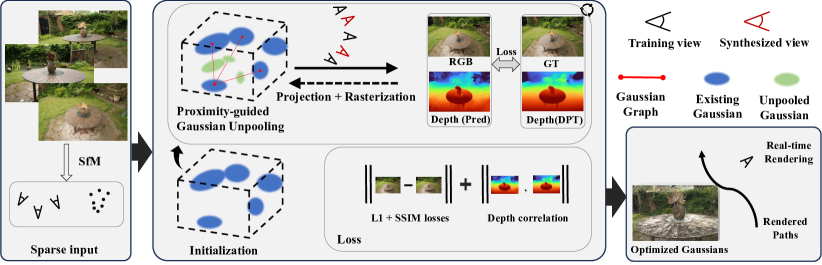
- Proposes Proximity-guided Gaussian Unpooling to iteratively densify 3D Gaussians by placing new Gaussians at representative locations based on proximity to existing ones.
- Introduces a differentiable depth rasterizer to back-propagate depth priors from pre-trained monocular depth estimators into the Gaussian optimization process.
- Uses online augmented pseudo-views to enhance depth supervision and improve geometric regularization during training.
- Integrates a multi-term loss combining photometric loss and depth correlation (Pearson correlation) to balance appearance and geometry.
- Employs a dynamic optimization strategy with adaptive densification and pruning based on opacity and proximity thresholds.
- Leverages COLMAP for initial SfM reconstruction and uses a pre-trained depth model to generate depth priors for both real and pseudo-view inputs.
Experimental results
Research questions
- RQ1Can a 3D Gaussian Splatting-based framework achieve real-time rendering speed while maintaining high visual fidelity in few-shot novel view synthesis?
- RQ2How can sparse initial SfM point clouds be effectively densified to cover unseen regions without overfitting?
- RQ3To what extent can monocular depth priors improve geometric accuracy and generalization in low-viewpoint scenarios?
- RQ4Can online pseudo-view augmentation enhance the optimization of 3D Gaussians in the absence of multi-view supervision?
- RQ5How does the proposed method compare to state-of-the-art NeRF and 3D-GS baselines in terms of rendering quality and speed on real-world mobile-captured data?
Key findings
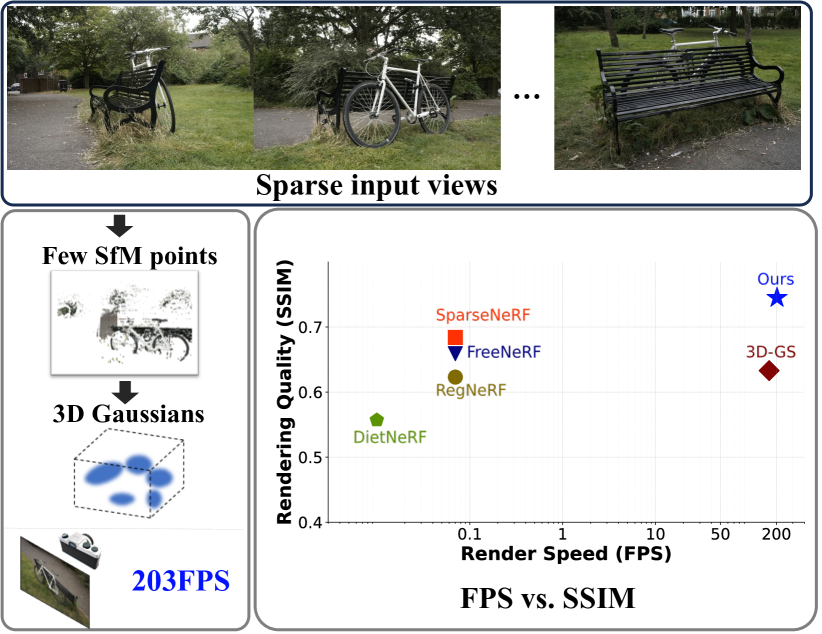
- FSGS achieves 203 FPS rendering speed, a 2900× speedup over SparseNeRF, enabling real-time inference on consumer hardware.
- On mobile-captured datasets with only three training views, FSGS achieves a PSNR of 19.54 and SSIM of 0.539, outperforming all baselines in both metrics.
- The method improves SSIM from 0.684 to 0.745 compared to SparseNeRF, demonstrating significant gains in visual quality.
- FSGS produces sharper depth maps with finer geometric details than 3D-GS, which tends to oversmooth distant regions.
- The integration of depth priors via pseudo-views reduces aliasing artifacts and improves geometric continuity, especially in unobserved regions.
- FSGS outperforms FreeNeRF and SparseNeRF in depth quality, with fewer artifacts and better reconstruction of complex scene structures.
Read this paper
Open the full text in the Nubint reader and ask about any passage as you read.
Read this paper on NubintThis review was generated by AI from the original paper. Please check the paper before citing it.