
[Paper Review] Full Event Particle-Level Unfolding with Variable-Length Latent Variational Diffusion
Introduces a variable-length latent diffusion model (Particle VLD) to perform full-event, particle-level unfolding conditioned on detector-level data, demonstrated on semi-leptonic t t̄ production at the LHC.
The measurements performed by particle physics experiments must account for the imperfect response of the detectors used to observe the interactions. One approach, unfolding, statistically adjusts the experimental data for detector effects. Recently, generative machine learning models have shown promise for performing unbinned unfolding in a high number of dimensions. However, all current generative approaches are limited to unfolding a fixed set of observables, making them unable to perform full-event unfolding in the variable dimensional environment of collider data. A novel modification to the variational latent diffusion model (VLD) approach to generative unfolding is presented, which allows for unfolding of high- and variable-dimensional feature spaces. The performance of this method is evaluated in the context of semi-leptonic top quark pair production at the Large Hadron Collider.
Motivation & Objective
- Motivate unfolding detector effects without relying on expensive simulations.
- Enable full-event unfolding in variable-dimensional collider data (varying object counts).
- Extend variational latent diffusion (VLD) to handle variable observables and multiplicity.
- Evaluate performance on realistic LHC-like semi-leptonic t t̄ events with SM and BSM injections.
Proposed method
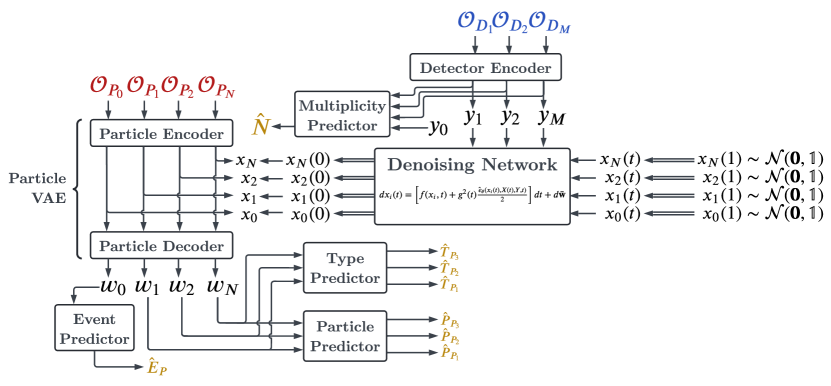
- Adapts Variational Latent Diffusion (VLD) to variable-length outputs by introducing a multiplicity predictor for the number of particle-level objects.
- Uses a Particle VAE with a transformer-based encoder/decoder to map variable-length particle objects into a latent space.
- Employs a detector encoder to map detector-level observables into a conditioning latent space for X|Y generation.
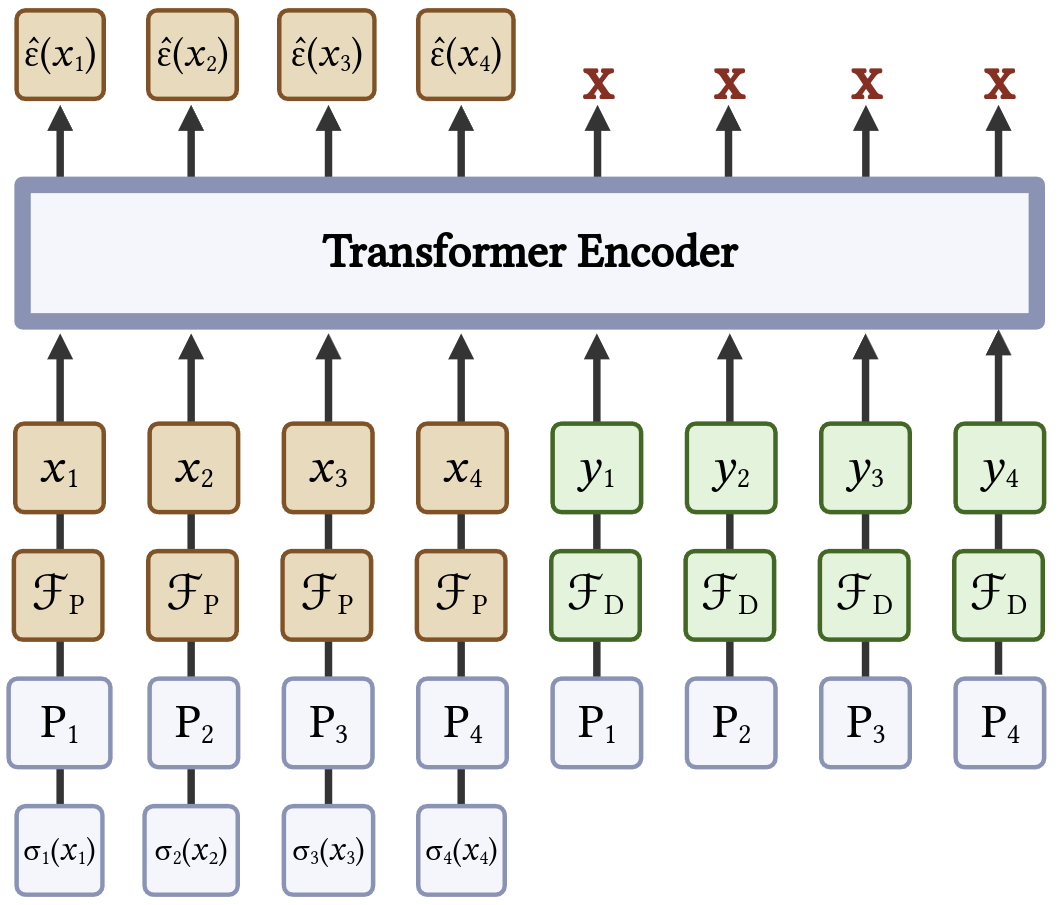
- Implements an element-wise, object-wise diffusion process with per-object noise schedules and a set-conditioned denoising network.
- Incorporates a gamma-distributed multiplicity sample to handle variable event sizes during unfolding.
Experimental results
Research questions
- RQ1Can full-event particle-level unfolding be achieved when the number of final-state objects is variable?
- RQ2Does conditioning on detector-level observations enable accurate reconstruction of particle-level kinematics across variable dimensionality?
- RQ3How does the method perform for SM datasets and when the truth distributions are perturbed (BSM injections)?
- RQ4What is the impact of prior choices on unfolded distributions and can an iterative prior-reweighting approach mitigate it?
Key findings
- The method enables unfolding to particle-level observables with variable multiplicity, demonstrated on semi-leptonic t t̄ events.
- Unfolded lepton and jet kinematic distributions show excellent agreement with true particle-level distributions, with some edge-region discrepancies.
- Table-based metrics (Wasserstein, Energy, KL) generally show unfolded distributions closer to truth than detector distributions for most observables.
- The approach supports physics injections (BSM) to test robustness against prior distribution shifts.
- The diffusion model uses per-object noise schedules and a context-aware denoising network that leverages information from both particle-level X and detector-level Y.
Read this paper
Open the full text in the Nubint reader and ask about any passage as you read.
Read this paper on NubintThis review was generated by AI from the original paper. Please check the paper before citing it.