
[Paper Review] FunLess: Functions-as-a-Service for Private Edge Cloud Systems
FunLess is a serverless FaaS platform for private edge cloud systems that leverages WebAssembly (Wasm) as a lightweight, secure, and portable runtime to enable efficient function execution on resource-constrained devices. It achieves comparable performance to container-based FaaS platforms like OpenFaaS, Fission, and Knative, while significantly reducing memory footprint and enabling full deployment on edge devices such as Raspberry Pi 3B+ without requiring container runtimes or orchestration stacks.
We present FunLess, a Function-as-a-Service (FaaS) platform tailored for the private edge cloud system. FunLess responds to recent trends that advocate for extending the coverage of serverless computing to private edge cloud systems and enhancing latency, security, and privacy while improving resource usage. Unlike existing solutions that rely on containers for function invocation, FunLess leverages WebAssembly (Wasm) as its runtime environment. Wasm's lightweight, sandboxed runtime is crucial to have functions run on constrained devices at the edge. Moreover, the advantages of using Wasm in FunLess include a consistent development and deployment environment for users and function portability (write once, run everywhere) We validate FunLess under different deployment scenarios, characterised by the presence/absence of constrained-resource devices (Raspberry Pi 3B+) and the (in)accessibility of container orchestration technologies - Kubernetes. We compare FunLess with three production-ready, widely adopted open-source FaaS platforms - OpenFaaS, Fission, and Knative. Our benchmarks confirm that FunLess is a proper solution for FaaS private edge cloud systems since it achieves performance comparable to the considered FaaS alternatives while it is the only fully-deployable alternative on constrained-resource devices, thanks to its small memory footprint.
Motivation & Objective
- Address the growing need for serverless computing in private and edge cloud environments to reduce latency, enhance security, and improve resource efficiency.
- Overcome the limitations of container-based FaaS platforms—such as high memory and CPU overhead—on resource-constrained edge devices like Raspberry Pi.
- Enable true 'write once, run everywhere' portability and consistent deployment across heterogeneous edge devices using WebAssembly as the execution runtime.
- Provide a minimal, bare-metal FaaS solution that eliminates dependency on heavyweight orchestration tools like Kubernetes.
- Mitigate cold start performance issues through Wasm’s fast startup times and low memory footprint, making function caching feasible on edge devices.
Proposed method
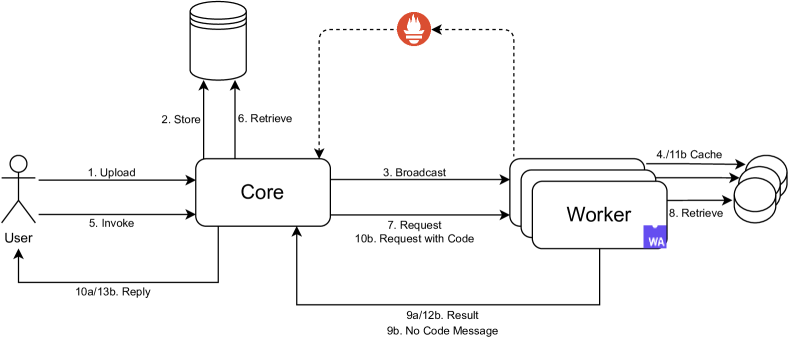
- Design and implement FunLess as a FaaS platform with a Wasm-based function execution engine, replacing traditional container runtimes.
- Use WebAssembly's lightweight, sandboxed execution environment to ensure strong isolation, security, and fast initialization of functions.
- Deploy FunLess directly on bare-metal edge devices (e.g., Raspberry Pi 3B+) without requiring Docker or Kubernetes, minimizing resource consumption.
- Support function portability across heterogeneous devices by leveraging Wasm’s 'write once, run everywhere' model and standardized runtime interface.
- Integrate with existing Wasm runtimes (e.g., Wasmtime) and plan for future extensions such as WASI support, HTTP, garbage collection, and multi-threading.
- Evaluate performance across diverse deployment scenarios, including edge-only, cloud-only, and hybrid configurations, with and without container orchestration.
Experimental results
Research questions
- RQ1Can a Wasm-based FaaS platform achieve comparable performance to established container-based FaaS platforms (OpenFaaS, Fission, Knative) in private edge cloud environments?
- RQ2To what extent does using WebAssembly reduce memory and CPU overhead compared to container-based FaaS on resource-constrained edge devices?
- RQ3Can FunLess enable full deployment on low-resource edge devices (e.g., Raspberry Pi 3B+) without requiring container runtimes or orchestration tools like Kubernetes?
- RQ4How effective is FunLess in mitigating cold start delays through Wasm’s fast startup and low memory footprint?
- RQ5What is the impact of Wasm’s portability and consistent runtime on simplifying deployment and enabling cross-device function execution in heterogeneous edge systems?
Key findings
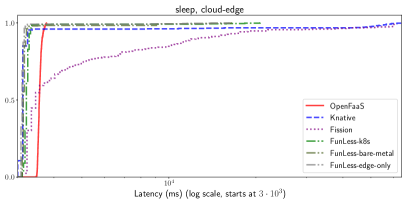
- FunLess achieves performance comparable to OpenFaaS, Fission, and Knative in representative cloud and edge benchmarks, confirming its viability as a FaaS solution for private edge systems.
- FunLess demonstrates a significantly smaller memory footprint than container-based platforms, enabling full deployment on resource-constrained devices like the Raspberry Pi 3B+.
- FunLess is the only evaluated FaaS platform that can be fully deployed on Raspberry Pi 3B+ without container runtimes or orchestration stacks, due to its bare-metal Wasm-based architecture.
- The use of WebAssembly enables fast function startup times and efficient caching, effectively mitigating cold start issues on edge devices.
- FunLess supports portable, consistent function execution across heterogeneous devices through Wasm’s 'write once, run everywhere' model, simplifying deployment and reducing platform-specific configuration.
- FunLess outperforms container-based platforms in scenarios requiring minimal resource usage, particularly in edge deployments where memory and CPU are constrained.
Read this paper
Open the full text in the Nubint reader and ask about any passage as you read.
Read this paper on NubintThis review was generated by AI from the original paper. Please check the paper before citing it.