
[Paper Review] FusionFormer: A Multi-sensory Fusion in Bird's-Eye-View and Temporal Consistent Transformer for 3D Object Detection
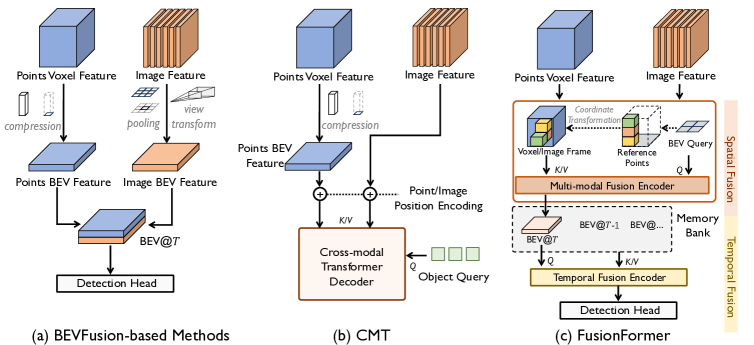
FusionFormer proposes an end-to-end multi-sensory fusion transformer for 3D object detection that avoids explicit bird's-eye-view (BEV) transformation by using a uniform sampling strategy to fuse 2D image and 3D voxel features directly, leveraging deformable attention and residual structures for robustness. It achieves state-of-the-art performance with 72.6% mAP and 75.1% NDS on nuScenes without test-time augmentation.
Multi-sensor modal fusion has demonstrated strong advantages in 3D object detection tasks. However, existing methods that fuse multi-modal features require transforming features into the bird's eye view space and may lose certain information on Z-axis, thus leading to inferior performance. To this end, we propose a novel end-to-end multi-modal fusion transformer-based framework, dubbed FusionFormer, that incorporates deformable attention and residual structures within the fusion encoding module. Specifically, by developing a uniform sampling strategy, our method can easily sample from 2D image and 3D voxel features spontaneously, thus exploiting flexible adaptability and avoiding explicit transformation to the bird's eye view space during the feature concatenation process. We further implement a residual structure in our feature encoder to ensure the model's robustness in case of missing an input modality. Through extensive experiments on a popular autonomous driving benchmark dataset, nuScenes, our method achieves state-of-the-art single model performance of 72.6% mAP and 75.1% NDS in the 3D object detection task without test time augmentation.
Motivation & Objective
- To address the performance degradation caused by explicit transformation of 3D voxel features into BEV space in existing multi-modal fusion methods.
- To enable flexible, direct fusion of 2D image and 3D point cloud features without relying on monocular depth estimation or Z-axis compression.
- To improve feature representation by using sparse point cloud features as depth references for image feature transformation.
- To enhance model robustness in the presence of missing modality inputs through residual learning.
- To integrate temporal consistency via a plug-and-play temporal fusion module for historical frame integration.
Proposed method
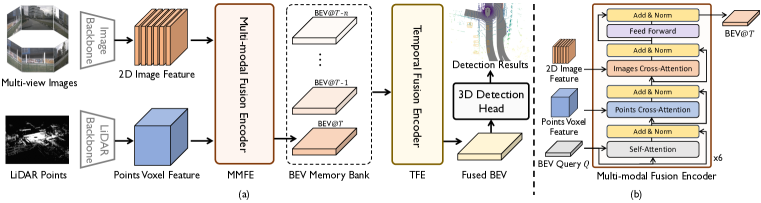
- Introduces a uniform sampling strategy that enables simultaneous sampling from 2D image features and 3D voxel features during fusion, avoiding explicit BEV transformation.
- Employs deformable attention mechanisms to allow BEV queries to interact with both image and point cloud features using depth references from 3D voxels.
- Incorporates residual structures in the fusion encoder to maintain performance when one modality is missing during inference.
- Designs a temporal fusion module that aggregates BEV features from previous frames to improve temporal consistency.
- Utilizes a multi-head attention-based transformer decoder for object query refinement and detection head prediction.
- Supports camera-only 3D detection by replacing LiDAR features with monocular depth estimation outputs, demonstrating method flexibility.
Experimental results
Research questions
- RQ1Can direct fusion of 2D image and 3D voxel features in their native forms outperform BEV-transformation-based fusion in 3D object detection?
- RQ2Does using 3D voxel features as depth references improve the accuracy of image feature transformation in BEV space?
- RQ3Can a unified sampling strategy effectively handle heterogeneous modalities (2D and 3D) in a single fusion module?
- RQ4How does residual learning in the fusion encoder affect robustness to missing modality inputs?
- RQ5To what extent does temporal fusion of historical BEV features improve detection consistency and performance?
Key findings
- FusionFormer achieves state-of-the-art performance with 72.6% mAP and 75.1% NDS on the nuScenes benchmark using a single model without test-time augmentation.
- Using voxel features instead of BEV features for LiDAR input improves mAP by 1.4 percentage points and reduces mATE by 1.3 points, indicating better preservation of 3D structural information.
- The proposed fusion module outperforms simple addition and concatenation by 3.5 mAP and 2.8 NDS, demonstrating superior feature fusion capability.
- The model maintains strong performance under modality dropout, achieving 65.2% mAP and 69.8% NDS when image data is missing, and 64.1% mAP and 68.5% NDS when LiDAR data is missing, confirming robustness.
- Visualization shows that FusionFormer generates more focused BEV features on target objects, especially for distant or sparse objects, compared to BEVFormer.
- The camera-only variant of FusionFormer, using monocular depth estimation, achieves 68.9% mAP and 71.3% NDS, demonstrating strong performance with only camera inputs.
Read this paper
Open the full text in the Nubint reader and ask about any passage as you read.
Read this paper on NubintThis review was generated by AI from the original paper. Please check the paper before citing it.