
[Paper Review] FwdLLM: Efficient FedLLM using Forward Gradient
FwdLLM introduces BP-free training with forward gradients and PEFT to enable practical federated fine-tuning of LLMs on mobile devices, achieving large-speedups and memory reductions.
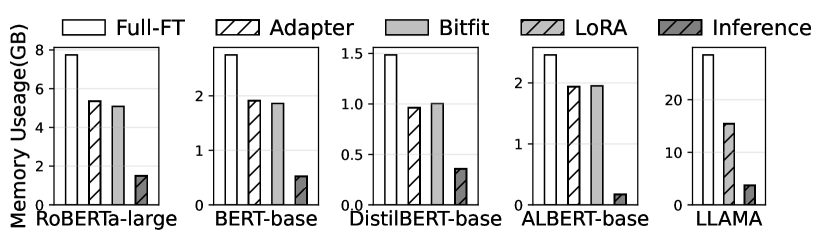
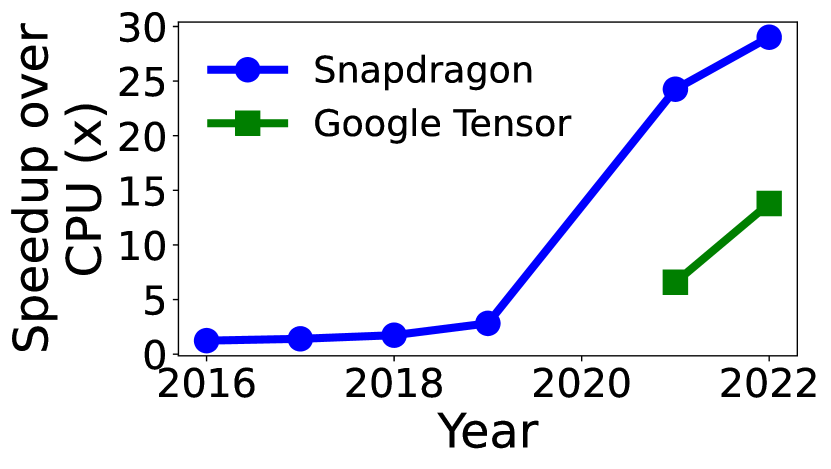
Large Language Models (LLMs) are transforming the landscape of mobile intelligence. Federated Learning (FL), a method to preserve user data privacy, is often employed in fine-tuning LLMs to downstream mobile tasks, an approach known as FedLLM. Though recent efforts have addressed the network issue induced by the vast model size, they have not practically mitigated vital challenges concerning integration with mobile devices, such as significant memory consumption and sluggish model convergence. In response to these challenges, this work introduces FwdLLM, an innovative FL protocol designed to enhance the FedLLM efficiency. The key idea of FwdLLM to employ backpropagation (BP)-free training methods, requiring devices only to execute ``perturbed inferences''. Consequently, FwdLLM delivers way better memory efficiency and time efficiency (expedited by mobile NPUs and an expanded array of participant devices). FwdLLM centers around three key designs: (1) it combines BP-free training with parameter-efficient training methods, an essential way to scale the approach to the LLM era; (2) it systematically and adaptively allocates computational loads across devices, striking a careful balance between convergence speed and accuracy; (3) it discriminatively samples perturbed predictions that are more valuable to model convergence. Comprehensive experiments with five LLMs and three NLP tasks illustrate FwdLLM's significant advantages over conventional methods, including up to three orders of magnitude faster convergence and a 14.6x reduction in memory footprint. Uniquely, FwdLLM paves the way for federated learning of billion-parameter LLMs such as LLaMA on COTS mobile devices -- a feat previously unattained.
Motivation & Objective
- Motivate the practicality challenges of FedLLM on mobile devices due to memory, accelerator, and scalability constraints.
- Propose BP-free training via perturbed inferences to reduce on-device memory and computation.
- Integrate PEFT methods with forward-gradient training to scale to large LLMs.
- Develop adaptive perturbation pacing and discriminative perturbation sampling to accelerate convergence.
- Demonstrate on-device feasibility and quantify performance gains across multiple models and tasks.
Proposed method
- Use forward gradient as an unbiased estimator of the true gradient to enable BP-free training.
- Combine BP-free training with parameter-efficient fine-tuning (PEFT) methods like LoRa and Adapter.
- Implement a variance-controlled pacing mechanism that aggregates gradients only when forward-gradient variance is below a threshold.
- Discriminatively sample perturbations that have high cosine similarity to the true gradient, filtering out low-value perturbations.
- Employ an automatic offline PEFT profiler to select suitable PEFT methods per model based on gradient similarity.
- Utilize a cloud-device scheduling workflow to manage perturbations and device participation adaptively.
Experimental results
Research questions
- RQ1Can BP-free forward-gradient training with PEFT enable practical FedLLM on mobile devices?
- RQ2How can perturbation pacing and sampling be automated to balance convergence speed and computation cost?
- RQ3What memory, time, and accuracy improvements are achievable relative to full-model fine-tuning and PEFT baselines?
- RQ4Is it feasible to federate-benchmark billion-parameter LLMs (e.g., LLaMA) on COTS mobile hardware?
Key findings
- Up to 217.3× faster convergence compared with full-model fine-tuning.
- Memory footprint reduced by up to 14.6× versus strong baselines.
- On-device training times drop from 10.9–97.9 hours to 0.2–0.8 hours (per described setups).
- Average speedup of 10.6× with BP-free + PEFT over baselines, with 2.0×–93.4× range.
- Demonstrates fine-tuning of a 7B LLaMA model on consumer smartphones within 10 minutes when quantized to INT4.
- Discriminative perturbation sampling and variance-controlled pacing are shown to significantly impact convergence efficiency.
Read this paper
Open the full text in the Nubint reader and ask about any passage as you read.
Read this paper on NubintThis review was generated by AI from the original paper. Please check the paper before citing it.