
[Paper Review] Gaia Data Release 3. Astrometric binary star processing
This paper presents the astrometric processing of 4.1 million binary star candidates in Gaia Data Release 3, employing acceleration, orbital, and Variability-Induced Mover (VIM) models to detect and characterize unresolved binaries. It identifies 338,215 acceleration solutions, 165,500 orbital solutions, and 869 VIM solutions, significantly expanding the astrometric binary catalog beyond previous surveys and enabling large-scale statistical studies of binary systems.
Context.The Gaia Early Data Release 3 contained the positions, parallaxes and proper motions of 1.5 billion sources, among which some did not fit well the "single star" model. Binarity is one of the causes of this. Aims. Four million of these stars were selected and various models were tested to detect binary stars and to derive their parameters. Methods. A preliminary treatment was used to discard the partially resolved double stars and to correct the transits for perspective acceleration. It was then investigated whether the measurements fit well with an acceleration model with or without jerk. The orbital model was tried when the fit of any acceleration model was beyond our acceptance criteria. A Variability-Induced Mover (VIM) model was also tried when the star was photometrically variable. A final selection has been made in order to keep only solutions that probably correspond to the real nature of the stars. Results. At the end, 338,215 acceleration solutions, about 165,500 orbital solutions and 869 VIM solutions were retained. In addition, formulae for calculating the uncertainties of the Campbell orbital elements from orbital solutions expressed in Thiele-Innes elements are given in an appendix.
Motivation & Objective
- To detect and characterize unresolved astrometric binary stars in Gaia DR3 using multi-model fitting.
- To reduce contamination from partially resolved double stars through photometric and astrometric filtering criteria.
- To develop a robust selection pipeline that distinguishes between acceleration, orbital, and variability-induced motion models.
- To provide reliable astrometric solutions for statistical studies of binary star populations.
- To deliver uncertainty formulae for Campbell orbital elements derived from Thiele-Innes elements.
Proposed method
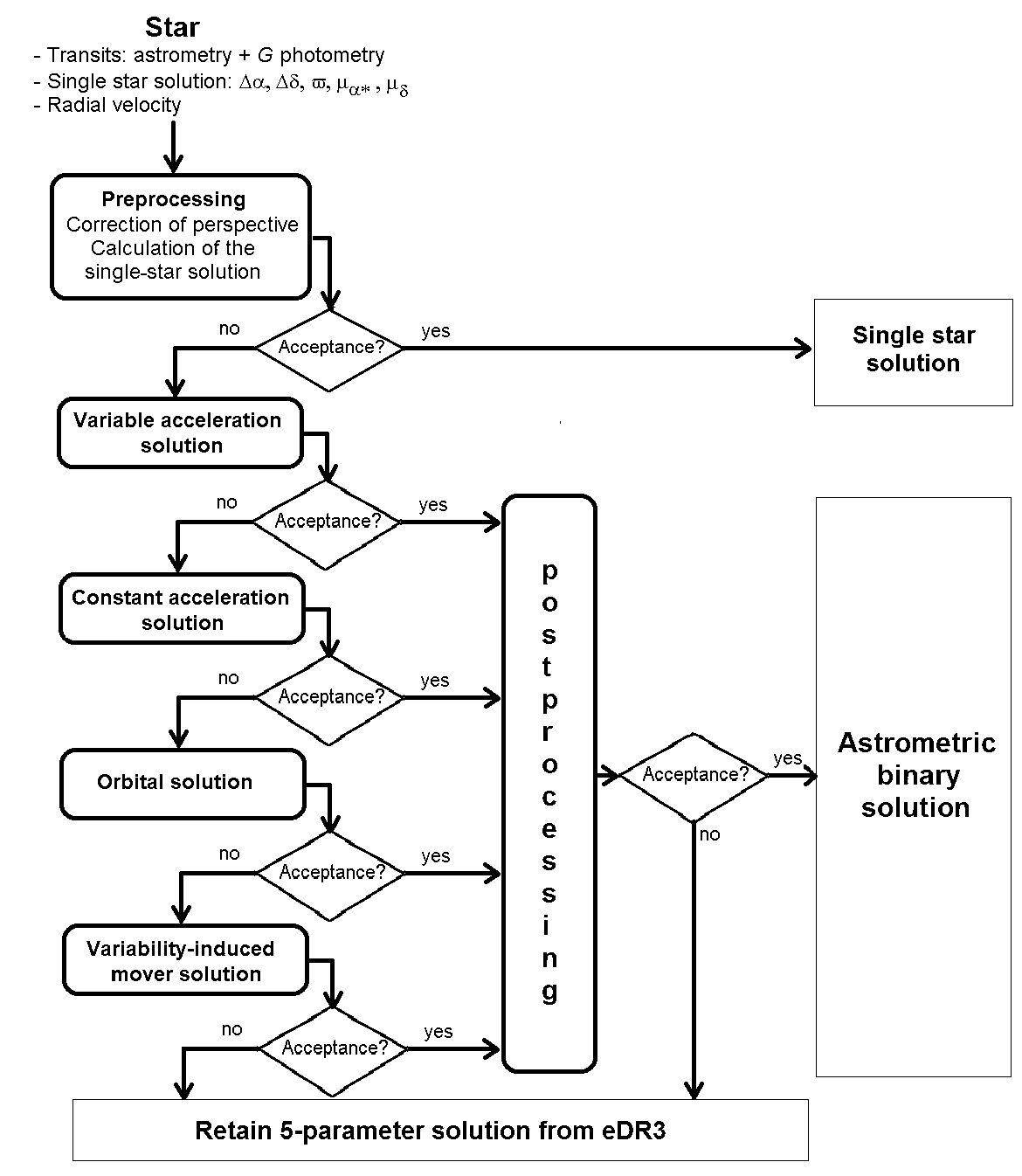
- A multi-stage processing cascade was applied, starting with filtering out partially resolved double stars using IPD-based metrics ($ipd\_frac\_multi\_peak \leq 2$, $ipd\_gof\_harmonic\_amplitude < 0.1$).
- Photometric flux excess factor $C^{*}$ was used to reject stars with anomalous $G$-band magnitude behavior, applying $|C^{*}| < 1.645\sigma_{C^{*}}$ for 90% confidence.
- Acceleration models were tested first, followed by orbital models when acceleration fits exceeded acceptance thresholds.
- The Variability-Induced Mover (VIM) model was applied only to photometrically variable stars with one dominant component.
- Solutions were validated using median distance between photocenter and variable component, with high $F_2$ thresholds to limit false positives.
- Uncertainties for Campbell orbital elements were derived from Thiele-Innes elements via analytical formulae provided in an appendix.
Experimental results
Research questions
- RQ1What fraction of Gaia DR3 stars with high RUWE and long observation baselines are best explained by astrometric acceleration rather than single-star motion?
- RQ2How effective are photometric and IPD-based criteria in filtering out partially resolved double stars before binary modeling?
- RQ3What is the relative performance and reliability of acceleration, orbital, and VIM models in detecting unresolved binaries?
- RQ4To what extent do VIM models successfully recover systems with one photometrically variable component?
- RQ5How do selection thresholds and model acceptance criteria affect the completeness and purity of the final binary catalog?
Key findings
- The final catalog contains 338,215 acceleration solutions, 165,500 orbital solutions, and 869 VIM solutions, representing a major expansion over previous astrometric binary catalogs.
- The filtering pipeline reduced the initial 36.5 million candidates to 4,115,743 stars by applying IPD and $C^{*}$-based selection criteria.
- VIM solutions are rare (869), limited to fixed-component models, and likely undercounted due to late-stage application in the processing cascade.
- High $F_2$ thresholds and the $c$-coefficient in the acceptance test effectively suppress VIMF solutions with two variable components, reducing contamination.
- Statistical checks confirm minimal contamination: acceleration solutions do not show orbital motion in proper motions, and VIM solutions do not produce orbital solutions with 90° inclination.
- The appendix provides analytical formulae to compute uncertainties of Campbell orbital elements from Thiele-Innes elements, enabling consistent error propagation.
Better researchstarts right now
From reading papers to final review, dramatically reduce your research time.
No credit card · Free plan available
This review was created by AI and reviewed by human editors.