
[Paper Review] GAIA: Rethinking Action Quality Assessment for AI-Generated Videos
This paper introduces GAIA, a large-scale, causally reasoned dataset of 9,180 AI-generated video-action pairs with 971,244 human ratings, enabling comprehensive evaluation of action quality in text-to-video generation. It reveals that existing automatic evaluation methods correlate poorly with human judgment, exposing a critical gap in current AQA benchmarks and models for AI-generated videos.
Assessing action quality is both imperative and challenging due to its significant impact on the quality of AI-generated videos, further complicated by the inherently ambiguous nature of actions within AI-generated video (AIGV). Current action quality assessment (AQA) algorithms predominantly focus on actions from real specific scenarios and are pre-trained with normative action features, thus rendering them inapplicable in AIGVs. To address these problems, we construct GAIA, a Generic AI-generated Action dataset, by conducting a large-scale subjective evaluation from a novel causal reasoning-based perspective, resulting in 971,244 ratings among 9,180 video-action pairs. Based on GAIA, we evaluate a suite of popular text-to-video (T2V) models on their ability to generate visually rational actions, revealing their pros and cons on different categories of actions. We also extend GAIA as a testbed to benchmark the AQA capacity of existing automatic evaluation methods. Results show that traditional AQA methods, action-related metrics in recent T2V benchmarks, and mainstream video quality methods perform poorly with an average SRCC of 0.454, 0.191, and 0.519, respectively, indicating a sizable gap between current models and human action perception patterns in AIGVs. Our findings underscore the significance of action quality as a unique perspective for studying AIGVs and can catalyze progress towards methods with enhanced capacities for AQA in AIGVs.
Motivation & Objective
- To address the lack of comprehensive, diverse, and human-annotated benchmarks for assessing action quality in AI-generated videos (AIGVs).
- To investigate how well state-of-the-art text-to-video (T2V) models generate visually rational and physically plausible actions across diverse action categories.
- To evaluate the performance of existing automatic action quality assessment (AQA) methods against human perception in AIGVs.
- To identify the limitations of current AQA metrics and video quality assessment approaches in capturing human perception of action quality in generated content.
- To establish a new benchmark for future development of robust, human-aligned AQA methods tailored to the unique challenges of AIGVs.
Proposed method
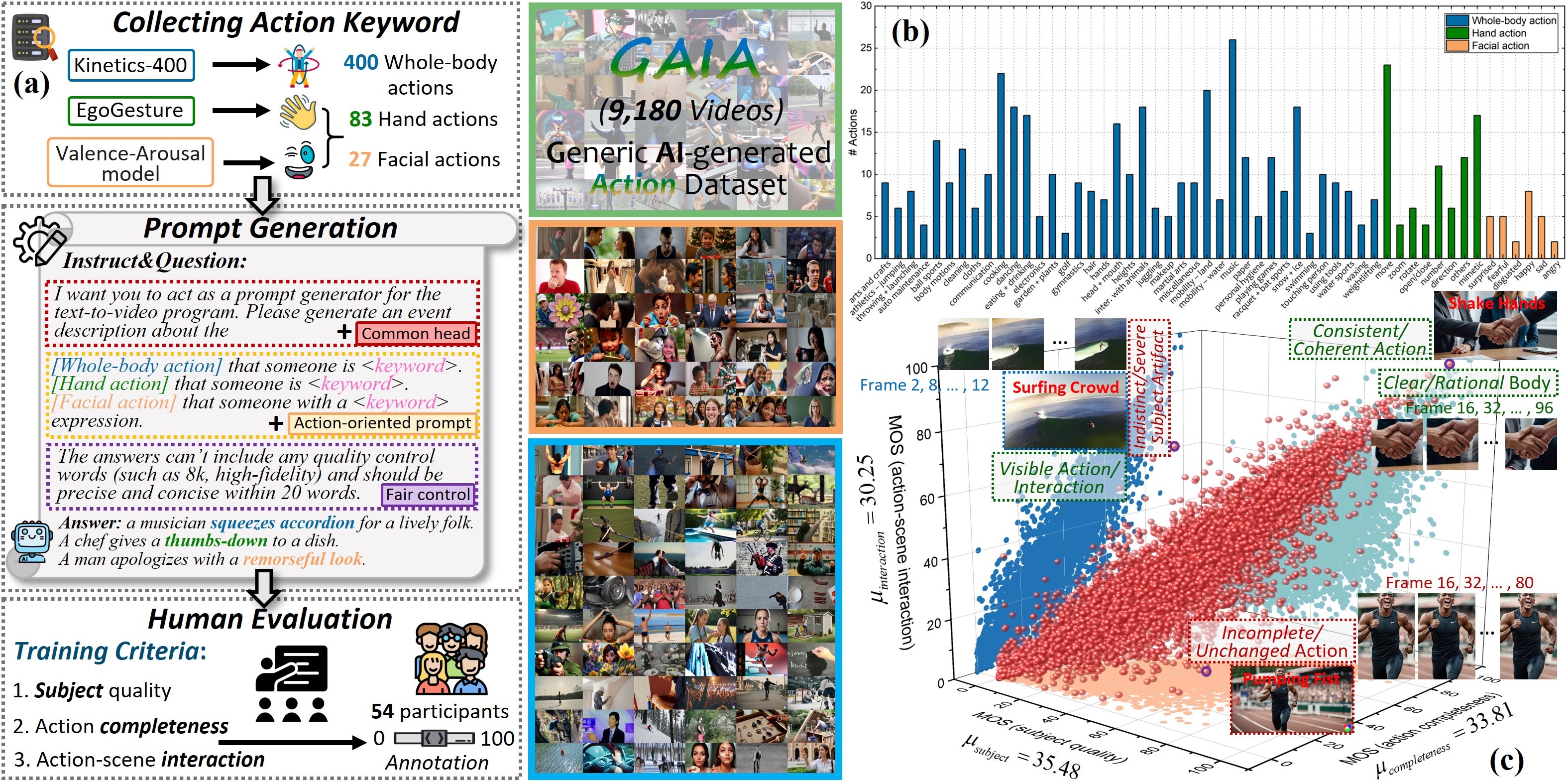
- GAIA is constructed through a large-scale, subjective evaluation involving 54 participants, using a novel causal reasoning-based framework to assess action quality along three dimensions: subject quality, action completeness, and action-scene interaction.
- The dataset comprises 9,180 AI-generated video clips from 18 diverse T2V models, spanning lab-based and commercial platforms, covering 83 whole-body, 27 hand, and 27 facial actions.
- Human raters provide mean opinion scores (MOS) across 971,244 ratings, enabling fine-grained, multi-dimensional assessment of action quality.
- The study extends GAIA into a benchmark to evaluate 12 existing AQA and video quality metrics, comparing their correlation with human judgments.
- The evaluation framework emphasizes perceptual realism, physical plausibility, and contextual coherence, reflecting human cognitive reasoning in action perception.
- The method enables systematic analysis of T2V model strengths and weaknesses across action categories, revealing model-specific failure modes in motion, object, and body consistency.
Experimental results
Research questions
- RQ1How well do current text-to-video models generate visually rational and physically plausible actions across diverse action categories?
- RQ2To what extent do existing automatic action quality assessment (AQA) methods correlate with human perception in AI-generated videos?
- RQ3What are the key failure modes of T2V models in generating actions, particularly in terms of body articulation, object consistency, and motion plausibility?
- RQ4How does a causally grounded, multi-dimensional human evaluation framework improve the reliability and granularity of action quality assessment in AIGVs?
- RQ5Can GAIA serve as a robust benchmark to identify and quantify the limitations of existing AQA and video quality metrics in generative video scenarios?
Key findings
- The GAIA dataset contains 9,180 AI-generated video-action pairs with 971,244 human ratings, covering 83 whole-body, 27 hand, and 27 facial action categories, enabling fine-grained evaluation of action quality.
- Existing AQA methods, including pose-based and vision-based models pre-trained on real-world action datasets, show poor correlation with human judgments in AIGVs, indicating a significant performance gap.
- Action-related metrics in current T2V benchmarks and mainstream video quality assessment (VQA) methods also correlate weakly with human perception, underscoring their inadequacy for evaluating AIGV action quality.
- T2V models exhibit systematic weaknesses in generating actions involving complex body motions, object interactions, and physically implausible movements, such as aberrant limb counts or irrational object shapes.
- The study reveals that models trained on real-world data fail to generalize to the diverse and unstable artifacts common in diffusion-based AIGVs, highlighting the need for domain-specific AQA training.
- GAIA provides a foundational benchmark that exposes critical shortcomings in current evaluation pipelines and paves the way for developing more human-aligned, causally informed AQA methods for generative video.
Read this paper
Open the full text in the Nubint reader and ask about any passage as you read.
Read this paper on NubintThis review was generated by AI from the original paper. Please check the paper before citing it.