
[Paper Review] GazeSAM: What You See is What You Segment
GazeSAM combines eye-tracking with the Segment Anything Model (SAM) to enable real-time medical image segmentation by radiologists, using gaze data as prompts.
This study investigates the potential of eye-tracking technology and the Segment Anything Model (SAM) to design a collaborative human-computer interaction system that automates medical image segmentation. We present the extbf{GazeSAM} system to enable radiologists to collect segmentation masks by simply looking at the region of interest during image diagnosis. The proposed system tracks radiologists' eye movement and utilizes the eye-gaze data as the input prompt for SAM, which automatically generates the segmentation mask in real time. This study is the first work to leverage the power of eye-tracking technology and SAM to enhance the efficiency of daily clinical practice. Moreover, eye-gaze data coupled with image and corresponding segmentation labels can be easily recorded for further advanced eye-tracking research. The code is available in \url{https://github.com/ukaukaaaa/GazeSAM}.
Motivation & Objective
- Propose a collaborative human-computer interaction system that integrates eye-tracking with SAM for real-time medical image segmentation.
- Leverage screen-based eye-tracking data as input prompts to SAM to generate segmentation masks on demand.
- Support both 2D and 3D medical images and facilitate coarse and refined segmentation workflows.
- Provide a user-friendly interface that records eye-tracking data alongside segmentation masks for further research.
Proposed method
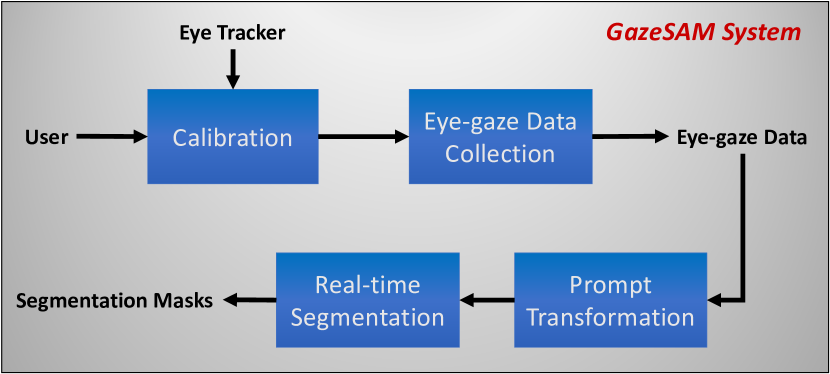
- Use a Tobii Pro Nano screen-based eye tracker at 60 Hz with five-point calibration to collect gaze coordinates.
- Transform eye-gaze coordinates from screen space to image coordinate space via a coordinate mapping function f(·).
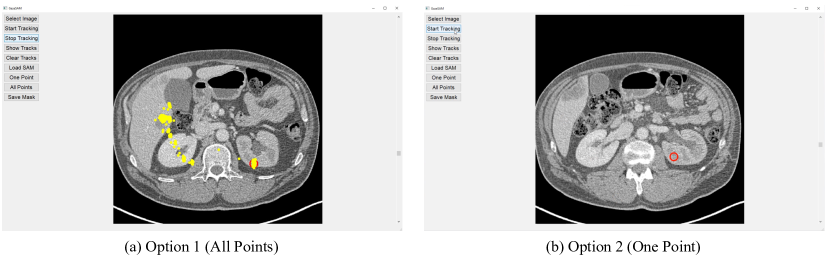
- Offer two eye-gaze prompt options for SAM: (i) whole gaze trajectory as a sequence of points, and (ii) the last gaze point for coarse segmentation.
- Feed the transformed gaze prompt and a pre-computed image embedding into SAM to generate segmentation masks in near real-time.
- Provide a user interface that visualizes gaze, tracks, and live segmentation, with options to save masks and refine via additional gaze prompts.
- Discuss system limitations and potential improvements, including fine-tuning SAM on medical data.
Experimental results
Research questions
- RQ1Can eye-gaze data be effectively used as a prompt to SAM for real-time segmentation of medical images?
- RQ2How do 2D and 3D medical images fare under gaze-driven segmentation in SAM within a clinical workflow?
- RQ3What are the practical benefits and limitations of using screen-based eye-tracking for interactive medical image annotation?
Key findings
- The GazeSAM system enables real-time segmentation mask generation driven by radiologists’ eye gaze.
- Two gaze-prompt options are supported: a full gaze-sequence prompt and a last-point prompt for coarse segmentation.
- A screen-based eye tracker (Tobii Pro Nano) is used with calibration to collect gaze data for prompting SAM.
- The approach supports both 2D and 3D medical images and allows iterative refinement by adjusting gaze prompts.
- The method demonstrates potential to improve radiologists’ workflow efficiency and to collect gaze data for future eye-tracking research.
- The study discusses limitations of SAM on medical images and suggests fine-tuning SAM on medical datasets as a potential improvement.
Read this paper
Open the full text in the Nubint reader and ask about any passage as you read.
Read this paper on NubintThis review was generated by AI from the original paper. Please check the paper before citing it.