
[Paper Review] GDformer: Going Beyond Subsequence Isolation for Multivariate Time Series Anomaly Detection
GDformer introduces a global dictionary-enhanced cross-attention Transformer with prototypes to learn series-wide normal representations for unsupervised anomaly detection in multivariate time series, achieving state-of-the-art results across five benchmarks.
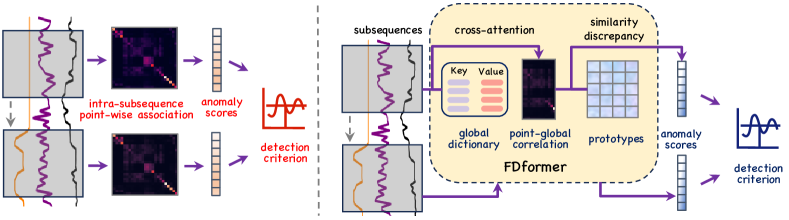
Unsupervised anomaly detection of multivariate time series is a challenging task, given the requirements of deriving a compact detection criterion without accessing the anomaly points. The existing methods are mainly based on reconstruction error or association divergence, which are both confined to isolated subsequences with limited horizons, hardly promising unified series-level criterion. In this paper, we propose the Global Dictionary-enhanced Transformer (GDformer) with a renovated dictionary-based cross attention mechanism to cultivate the global representations shared by all normal points in the entire series. Accordingly, the cross-attention maps reflect the correlation weights between the point and global representations, which naturally leads to the representation-wise similarity-based detection criterion. To foster more compact detection boundary, prototypes are introduced to capture the distribution of normal point-global correlation weights. GDformer consistently achieves state-of-the-art unsupervised anomaly detection performance on five real-world benchmark datasets. Further experiments validate the global dictionary has great transferability among various datasets. The code is available at https://github.com/yuppielqx/GDformer.
Motivation & Objective
- Motivate unsupervised anomaly detection for multivariate time series beyond subsequence isolation.
- Learn global representations shared by normal points across the entire series.
- Provide a compact, similarity-based anomaly detection criterion using prototypes.
- Demonstrate transferability of the learned global dictionary across datasets.
Proposed method
- Replace standard self-attention with a dictionary-based cross-attention mechanism that uses a global Key/Value dictionary of size N per layer.
- Introduce a similarity-evaluation branch with P prototypes to capture normal point–global correlation patterns.
- Combine reconstruction loss with a similarity-discrepancy loss to train both the dictionary and prototypes (L_total = L_c - lambda L_s).
- Compute AnomalyScore from cross-attention similarity to prototypes and apply a series-level threshold for detection.
- Input subsequences are masked with a fixed probability, normalized, and embedded before transformer layers.
Experimental results
Research questions
- RQ1Can a global dictionary and cross-attention learn series-level normal representations that improve anomaly detection over horizon-limited subsequences?
- RQ2Do prototypes capturing the distribution of normal cross-attention weights enable a compact, reliable series-level detection criterion?
- RQ3Are dictionary-based approaches transferable across datasets, indicating shared normal temporal patterns?
Key findings
- GDformer achieves state-of-the-art unsupervised anomaly detection on five real-world benchmarks.
- The global dictionary enables low-complexity cross-attention (O(TN)) compared to O(T^2) for standard self-attention, improving efficiency.
- Prototypes plus a similarity-discrepancy loss significantly improve F1 scores compared to reconstruction-only or single-criterion baselines.
- Ablation shows the combination of cross-attention with multi-layer similarity loss yields the best performance.
- Transfer experiments show the global dictionary and prototypes transfer well across datasets, indicating shared normal patterns.
Read this paper
Open the full text in the Nubint reader and ask about any passage as you read.
Read this paper on NubintThis review was generated by AI from the original paper. Please check the paper before citing it.