
[Paper Review] GELU Activation Function in Deep Learning: A Comprehensive Mathematical Analysis and Performance
The paper provides a rigorous mathematical analysis of the GELU activation function and compares its performance to other activations using a residual CNN on CIFAR-10/100 and STL-10, demonstrating GELU's favorable properties and effectiveness.
Selecting the most suitable activation function is a critical factor in the effectiveness of deep learning models, as it influences their learning capacity, stability, and computational efficiency. In recent years, the Gaussian Error Linear Unit (GELU) activation function has emerged as a dominant method, surpassing traditional functions such as the Rectified Linear Unit (ReLU) in various applications. This study presents a rigorous mathematical investigation of the GELU activation function, exploring its differentiability, boundedness, stationarity, and smoothness properties in detail. Additionally, we conduct an extensive experimental comparison of the GELU function against a broad range of alternative activation functions, utilizing a residual convolutional network trained on the CIFAR-10, CIFAR-100, and STL-10 datasets as the empirical testbed. Our results demonstrate the superior performance of GELU compared to other activation functions, establishing its suitability for a wide range of deep learning applications. This comprehensive study contributes to a more profound understanding of the underlying mathematical properties of GELU and provides valuable insights for practitioners aiming to select activation functions that optimally align with their specific objectives and constraints in deep learning.
Motivation & Objective
- Investigate the mathematical properties of GELU, including differentiability, boundedness, stationarity, and smoothness.
- Understand how GELU interacts with normalization methods to influence training dynamics.
- Empirically compare GELU against diverse activation functions on standard image datasets.
- Explore implications for activation function selection in deep learning practice.
Proposed method
- Present a formal mathematical description of deep networks and activation functions.
- Derive and analyze the GELU derivative to establish differentiability and gradient behavior.
- Examine boundedness, upper bounds with normalization, and Lipschitz continuity of GELU.
- Evaluate the effect of GELU with various normalization techniques (BN, LN, GN) in a residual CNN.
- Conduct empirical comparisons of GELU against other activations on CIFAR-10, CIFAR-100, and STL-10.
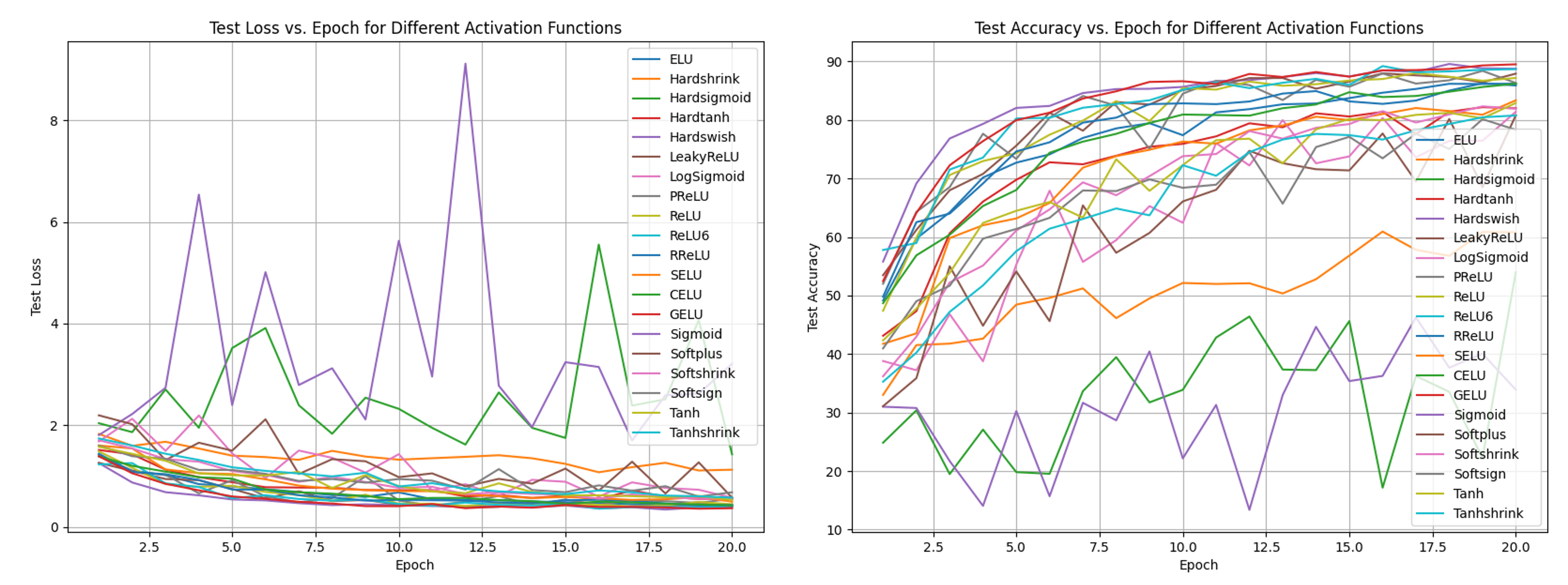
Experimental results
Research questions
- RQ1What are the precise differentiability, boundedness, stationarity, and smoothness properties of GELU?
- RQ2How does GELU interact with normalization methods to affect training stability and gradient propagation?
- RQ3How does GELU compare empirically to alternative activation functions on standard image classification benchmarks?
Key findings
- GELU is differentiable everywhere and has a bounded negative region with an upper growth controlled by normalization.
- The derivative of GELU can be expressed in closed form, supporting stable gradient-based optimization.
- Normalization prior to GELU yields an upper bound on activations, contributing to stable training.
- GELU demonstrates favorable performance compared to other activations on CIFAR-10, CIFAR-100, and STL-10 across a residual CNN baseline.
- GELU achieves Lipschitz continuity with a bound on its derivative, contributing to a well-behaved optimization landscape.
Read this paper
Open the full text in the Nubint reader and ask about any passage as you read.
Read this paper on NubintThis review was generated by AI from the original paper. Please check the paper before citing it.