
[Paper Review] GenCast: Diffusion-based ensemble forecasting for medium-range weather
GenCast is an ML-based diffusion model that generates 15-day global weather ensembles at 1°×1° resolution, outperforming ENS on multiple probabilistic metrics while being computationally efficient. It produces physically consistent, spatio-temporally coherent forecasts for 84 variables.
Weather forecasts are fundamentally uncertain, so predicting the range of probable weather scenarios is crucial for important decisions, from warning the public about hazardous weather, to planning renewable energy use. Here, we introduce GenCast, a probabilistic weather model with greater skill and speed than the top operational medium-range weather forecast in the world, the European Centre for Medium-Range Forecasts (ECMWF)'s ensemble forecast, ENS. Unlike traditional approaches, which are based on numerical weather prediction (NWP), GenCast is a machine learning weather prediction (MLWP) method, trained on decades of reanalysis data. GenCast generates an ensemble of stochastic 15-day global forecasts, at 12-hour steps and 0.25 degree latitude-longitude resolution, for over 80 surface and atmospheric variables, in 8 minutes. It has greater skill than ENS on 97.4% of 1320 targets we evaluated, and better predicts extreme weather, tropical cyclones, and wind power production. This work helps open the next chapter in operational weather forecasting, where critical weather-dependent decisions are made with greater accuracy and efficiency.
Motivation & Objective
- Motivate probabilistic forecasting for decision-making under uncertainty in high-impact domains.
- Address limitations of RMSE-focused ML models by modeling joint spatio-temporal distributions and physical consistency.
- Develop a diffusion-based generative model to produce ensembles of weather trajectories.
- Train on reanalysis data to produce global forecasts for 84 variables over 15 days at 1°1° resolution.
Proposed method
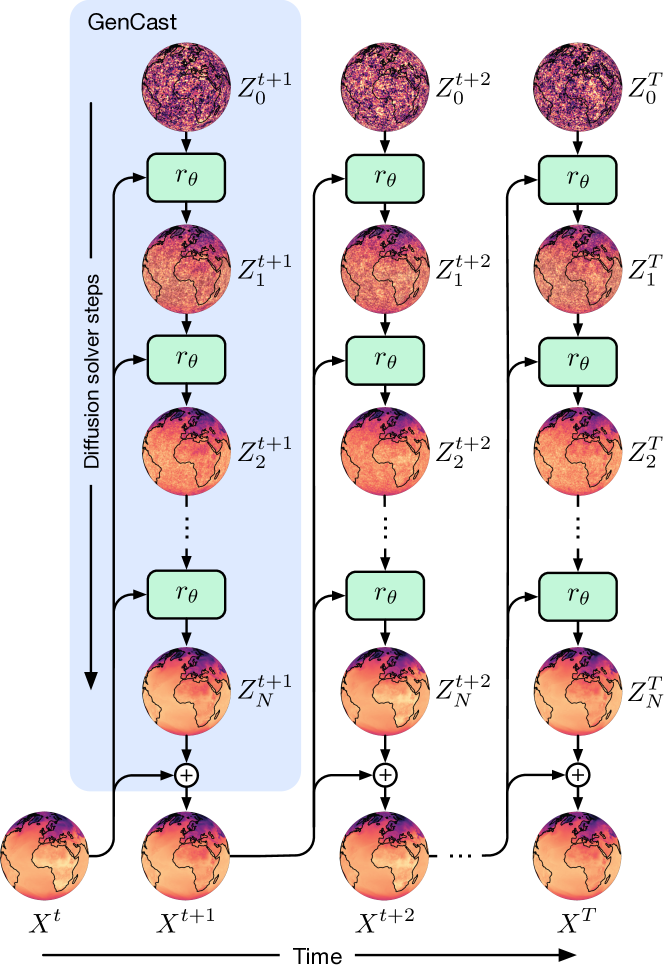
- Model p(X^t|X^{t-2:t-1}) with a diffusion denoiser that predicts residuals Z^t with respect to X^{t-1}.
- Use residual sampling X^t = X^{t-1} + S Z^t (precipitation: X^t = S Z^t).
- Adopt a sparse Transformer Processor on a refined icosahedral mesh to handle spatio-temporal conditioning.
- Train D_theta with a weighted MSE objective over variables, levels, and area-weighted grid cells.
- Sample with an ODE-based solver (DPMSolver++) over 20 steps per forecast timestep to produce 15-day trajectories.
- Initialize ensembles from ERA5 reanalysis (plus ERA5-EDA perturbations) for probabilistic sampling.
Experimental results
Research questions
- RQ1Can a diffusion-based ML model generate probabilistic, physically consistent weather ensembles at 1°1° resolution for up to 15 days?
- RQ2Does GenCast achieve higher skill and reliability than the operational ENS ensemble on CRPS, Ensemble-Mean RMSE, and extreme-event metrics?
- RQ3Do ML-based ensembles preserve physically plausible spectral properties compared with traditional NWP ensembles?
- RQ4What is the computational efficiency of GenCast relative to traditional NWP ensembles when generating long-range forecasts?
- RQ5How do GenCast ensembles perform in extreme-event prediction (Brier scores) across multiple variables and lead times?
Key findings
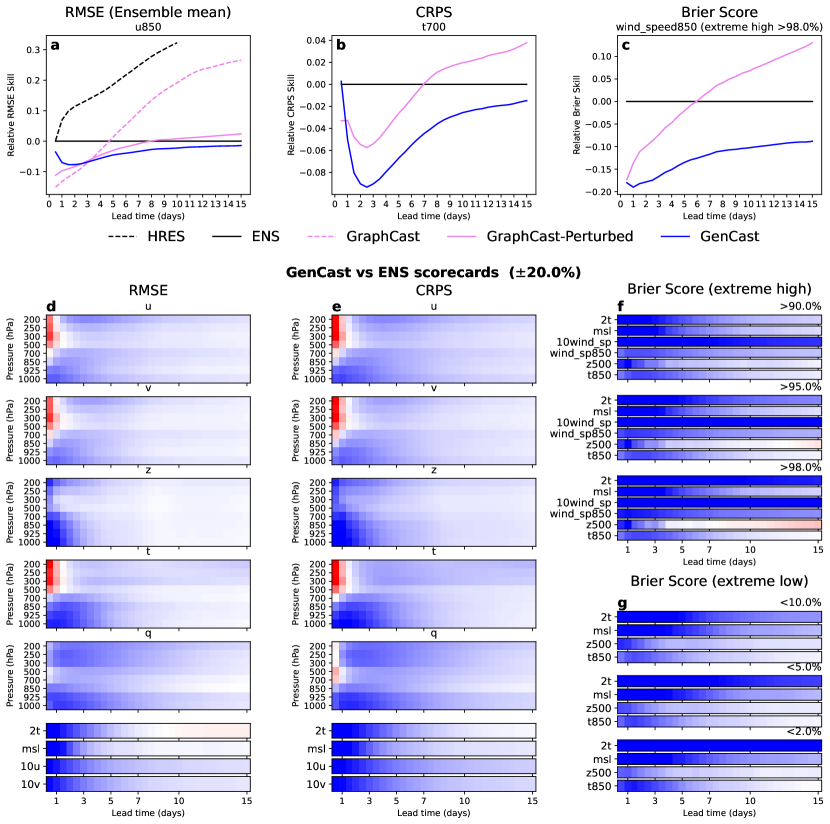
- GenCast outperforms ENS on CRPS for 97.3% of cases and on Ensemble-Mean RMSE for 96.4% of cases across lead times up to 15 days.
- GenCast yields mean CRPS improvements of 4.8% for atmospheric variables and 7.9% for surface variables; RMSE improvements are 3.5% (atmospheric) and 5.4% (surface).
- GenCast maintains reliability and physically consistent power spectra, preserving high-frequency content closer to ground truth than GraphCast-Perturbed.
- GenCast demonstrates sharp, diverse ensemble members with spatio-temporal coherence, avoiding the blurring typical of RMSE-trained models.
- Extreme-event prediction (Brier scores) shows GenCast outperforms ENS in 97.6% of cases with an average 12.6% improvement across tested events.
Better researchstarts right now
From reading papers to final review, dramatically reduce your research time.
No credit card · Free plan available
This review was created by AI and reviewed by human editors.