
[Paper Review] General In-Hand Object Rotation with Vision and Touch
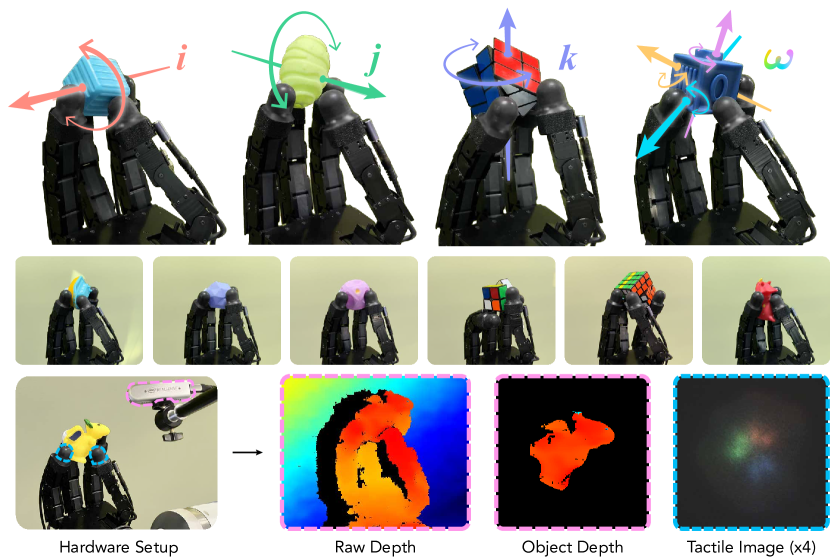
RotateIt is a vision-and-touch-augmented reinforcement learning system that enables generalizable, fingertip-based in-hand object rotation across multiple axes. Trained in simulation with privileged shape and physical property information, it distills this knowledge into a visuotactile transformer that infers object properties from noisy real-world visual and tactile inputs, achieving robust sim-to-real transfer without fine-tuning on diverse real-world objects including those unseen during training.
We introduce RotateIt, a system that enables fingertip-based object rotation along multiple axes by leveraging multimodal sensory inputs. Our system is trained in simulation, where it has access to ground-truth object shapes and physical properties. Then we distill it to operate on realistic yet noisy simulated visuotactile and proprioceptive sensory inputs. These multimodal inputs are fused via a visuotactile transformer, enabling online inference of object shapes and physical properties during deployment. We show significant performance improvements over prior methods and the importance of visual and tactile sensing.
Motivation & Objective
- To enable generalizable, multi-axis in-hand object rotation using only fingertip-based manipulation.
- To address the challenge of sim-to-real transfer in dexterous manipulation by leveraging multimodal sensory inputs.
- To reduce reliance on privileged information in real-world deployment by learning to infer object properties from vision and touch.
- To demonstrate that vision and tactile sensing are essential for accurate shape understanding and stable manipulation of complex, non-spherical objects.
- To develop a system that generalizes to diverse real-world objects without retraining or human demonstrations.
Proposed method
- Train an oracle policy in simulation using ground-truth object shape and physical property representations (extrinsics) for efficient multi-axis rotation.
- Use a visuotactile transformer to estimate the privileged extrinsic encoding $\hat{\mathbf{z}}_t$ from sequences of proprioceptive, visual (depth), and tactile (contact location) inputs.
- Distill the oracle policy into a real-world policy by training the visuotactile transformer to minimize regression loss between $\mathbf{z}_t$ and $\hat{\mathbf{z}}_t$.
- Use Segment Anything for foreground object segmentation in cluttered real-world scenes.
- Deploy the distilled policy directly to the real world using tactile images from an omnidirectional vision-based touch sensor and real-time inference.
- Train a multi-axis policy jointly using imitation learning from single-axis oracles and a shared reward function, enabling generalization across rotation axes.
Experimental results
Research questions
- RQ1Can a vision-and-touch-augmented policy achieve stable, generalizable in-hand rotation across multiple axes in the real world without fine-tuning?
- RQ2How do visual and tactile sensing contribute to accurate object shape and physical property inference during real-world manipulation?
- RQ3What is the impact of multimodal sensory fusion on sim-to-real transfer performance in dexterous in-hand manipulation?
- RQ4Can a single multi-axis policy generalize across different rotation axes as well as task-specific single-axis policies?
- RQ5How does the absence of privileged information affect policy performance, and can vision and touch compensate for this?
Key findings
- RotateIt successfully performs multi-axis in-hand rotation (up to $2\pi$ radians) on diverse real-world objects—including boxes, spheres, cylinders, and irregular shapes—within 20 seconds without fine-tuning.
- The system achieves sim-to-real transfer robustly, even when real-world physics and object geometries differ from simulation, demonstrating strong generalization.
- Policies trained without vision and touch fail to maintain stability and cannot complete rotation tasks, highlighting the critical role of multimodal sensing.
- The visuotactile transformer enables accurate inference of object properties from noisy sensory inputs, with performance on par with single-axis oracles when trained via imitation learning.
- The distilled multi-axis policy performs comparably to single-axis oracles (e.g., 105.21 ± 9.27 vs. 110.19 ± 8.26 in episode rotation reward), confirming effective generalization.
- Object shape understanding improves significantly with vision and touch: spherical and cuboidal objects are distinguished via proprioception alone, but irregular shapes like pears require additional sensory input.

Read this paper
Open the full text in the Nubint reader and ask about any passage as you read.
Read this paper on NubintThis review was generated by AI from the original paper. Please check the paper before citing it.