
[Paper Review] General SIS diffusion process with indirect spreading pathways on a hypergraph
This paper proposes a generalized SIS diffusion model on directed hypergraphs that captures both direct pairwise and indirect higher-order interactions via polynomial and general interaction functions. It establishes that higher-order interactions can induce bistability even when the basic reproduction number R₀ < 1, and demonstrates that coexisting equilibria in bi-virus systems are typically unstable, with solutions converging to either healthy or dominant endemic states.
While conventional graphs only characterize pairwise interactions, higher-order networks (hypergraph, simplicial complex) capture multi-body interactions, which is a potentially more suitable modeling framework for a complex real system. However, the introduction of higher-order interactions brings new challenges for the rigorous analysis of such systems on a higher-order network. In this paper, we study a series of SIS-type diffusion processes with both indirect and direct pathways on a directed hypergraph. In a concrete case, the model we propose is based on a specific choice (polynomial) of interaction function (how several agents influence each other when they are in a hyperedge). Then, by the same choice of interaction function, we further extend the system and propose a bi-virus competing model on a directed hypergraph by coupling two single-virus models together. Finally, the most general model in this paper considers an abstract interaction function under single-virus and bi-virus settings. For the single-virus model, we provide the results regarding healthy state and endemic equilibrium. For the bi-virus setting, we further give an analysis of the existence and stability of the healthy state, dominant endemic equilibria, and coexisting equilibria. All theoretical results are finally supported by some numerical examples.
Motivation & Objective
- To model SIS-type diffusion processes on hypergraphs that include both direct pairwise and indirect higher-order interactions.
- To analyze the stability and existence of healthy and endemic equilibria in single-virus and bi-virus systems under general interaction functions.
- To investigate how higher-order interactions—beyond pairwise links—affect system dynamics, particularly the emergence of bistability and coexistence behavior.
- To extend prior work on hypergraph epidemic models by incorporating non-linear, non-polynomial interaction functions and proving convergence to equilibria under irreducibility and monotonicity.
- To provide theoretical and numerical support for the global behavior of such systems, including conditions for stability and instability of equilibria.
Proposed method
- Formalizes a generalized SIS model on a directed hypergraph using a polynomial interaction function to describe multi-agent influence over hyperedges.
- Introduces a bi-virus competing model by coupling two single-virus systems, with separate infection rates and higher-order interaction terms.
- Analyzes the system using tools from monotone dynamical systems theory, proving that all systems are irreducible and monotone.
- Derives conditions for the existence and stability of the healthy state, endemic equilibria, and coexisting equilibria via eigenvalue analysis and Lyapunov functions.
- Employs numerical simulations with varying initial conditions and system parameters to validate analytical results, particularly regarding bistability and instability of coexisting equilibria.
- Generalizes the model to abstract, non-polynomial interaction functions, showing that core dynamical behaviors (e.g., convergence to equilibria) persist under mild assumptions.
Experimental results
Research questions
- RQ1Under what conditions does the single-virus SIS model on a hypergraph exhibit bistability, even when the basic reproduction number R₀ is less than 1?
- RQ2How do higher-order interactions (via hyperedges) influence the stability and existence of endemic equilibria in both single-virus and bi-virus models?
- RQ3What conditions allow for the existence of a coexisting equilibrium in a bi-virus system on a hypergraph, and is it stable?
- RQ4How does the system behavior change when the interaction function is generalized beyond polynomial forms, and does the convergence to equilibria still hold?
- RQ5Can the system's global dynamics be fully characterized under irreducibility and monotonicity assumptions, and what are the implications for control strategies?
Key findings
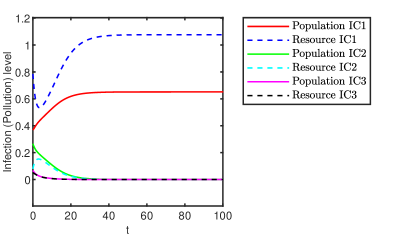
- Bistability can occur in the single-virus SIS model on a hypergraph even when the basic reproduction number R₀ < 1, due to the influence of higher-order interactions.
- When R₀ > 1 and higher-order interaction terms are sufficiently small, the unique endemic equilibrium is globally stable.
- In the bi-virus model, coexisting equilibria exist only under specific parameter conditions, but numerical simulations consistently show they are unstable.
- Solutions of the generalized SIS model on hypergraphs—whether with polynomial or abstract interaction functions—always converge to an equilibrium point, provided the system is irreducible and monotone.
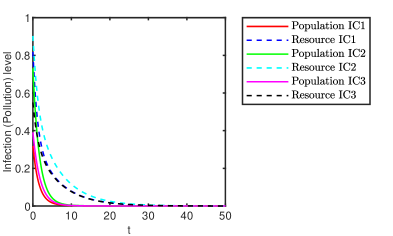
- Numerical simulations confirm analytical findings: for both single-virus and bi-virus systems, solutions converge to either the healthy state or a dominant endemic equilibrium, with no convergence to coexisting equilibria observed.
- The system's structure as an irreducible monotone dynamical system ensures long-term convergence to equilibria, enabling a unified theoretical framework for hypergraph-based epidemic dynamics.
Read this paper
Open the full text in the Nubint reader and ask about any passage as you read.
Read this paper on NubintThis review was generated by AI from the original paper. Please check the paper before citing it.